Top 10 Challenges Multi-Branch Restaurants Face in Saudi Arabia
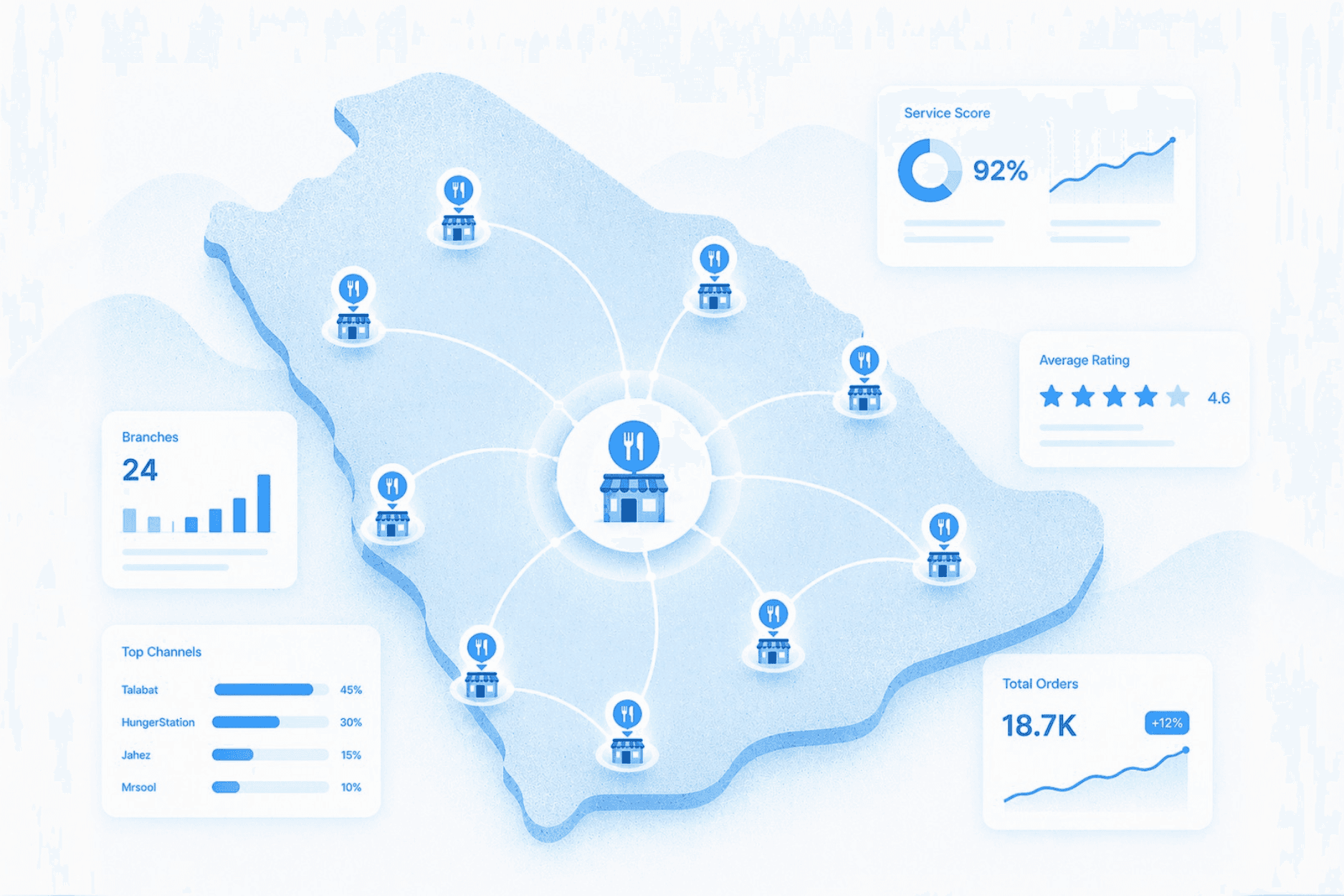
Running one restaurant is hard. Running ten, twenty, or fifty across different cities in Saudi Arabia is an entirely different game. The Kingdom's F&B sector is booming, with over 132,000 outlets and counting, but that growth comes with a specific set of operational challenges that multi-branch operators know all too well. Here are the ten most common, and what the best operators are doing differently.
1. Maintaining Service Consistency Across Branches
This is the single most cited challenge among multi-location restaurant operators in the region. When you have 20 branches across Riyadh, Jeddah, and the Eastern Province, each one develops its own micro-culture. Shift managers interpret standards differently. Kitchen teams drift from SOPs. The customer who had a great experience at your Olaya branch expects the same at your Tahlia branch, and when they do not get it, your brand takes the hit.
The fix is not more inspections or mystery shoppers. It is better visibility. Operators who can see customer feedback broken down by branch, shift, and channel in real time catch inconsistencies before they become patterns.
2. Staffing and Saudization Compliance
The Nitaqat system requires a specific percentage of Saudi employees, and that percentage varies by company size and sector classification. For restaurant operators, meeting these requirements while keeping service quality high is a constant balancing act. Saudi employees often command higher salaries and may have different expectations about work schedules and career development compared to expatriate staff.
The most successful operators invest heavily in training programs, clear career paths, and a work environment that retains Saudi talent. They also use technology to reduce the number of manual, low-skill tasks, allowing them to do more with fewer (but better-trained) team members.
3. Managing Delivery Platform Complexity
A typical Saudi restaurant operator might be on Talabat, HungerStation, Mrsool, and Jahez simultaneously, each with its own commission structure, rating system, and operational requirements. Multiply that by 20 branches and you have 80 or more separate platform relationships to manage.
Reviews and ratings on each platform affect your visibility and order volume, but most operators have no unified way to monitor or respond to them. The data sits in silos, and by the time someone from the marketing team checks last week's HungerStation ratings, the damage is already done.
4. Customer Feedback Overload (and Underuse)
Multi-branch operators generate thousands of customer data points every week across Google reviews, delivery app ratings, social media comments, and internal surveys. The problem is not a lack of data. It is the inability to turn that data into actionable intelligence.
Most operators either ignore the majority of feedback (because no one has time to read 500 reviews a week) or they aggregate it into meaningless averages that hide the real issues. The operators who get value from feedback are the ones who can automatically categorize it, identify root causes, and route the right insights to the right people.
5. Google Business Profile Management at Scale
Each branch needs an accurate, optimized Google Business Profile. That means correct hours, categories, menus, photos, and descriptions, updated consistently across every location. When one branch has wrong hours or an outdated menu, it directly affects customer trust and foot traffic.
For a 30-location operator, keeping all of this current is a full-time job. And beyond basic accuracy, there is the SEO dimension: are your profiles optimized with the keywords customers actually search for? Are you posting regularly? Is your review response rate high enough to signal freshness to Google's algorithm?
6. Real Estate and Location Strategy
Saudi Arabia's commercial real estate market is competitive, particularly in premium locations in Riyadh and Jeddah. Securing the right location at the right rent can make or break a branch's profitability. Add to this the challenge of navigating different municipality requirements, licensing processes, and construction timelines across different cities, and expansion planning becomes a complex exercise.
Operators increasingly use customer data to inform location decisions. Understanding where your existing customers come from, what areas show unmet demand, and how competitors are distributed helps de-risk new location investments.
7. Supply Chain Reliability
Sourcing consistent quality ingredients across multiple locations requires robust supplier relationships and logistics. Saudi Arabia imports a significant portion of its food supply, which means operators are exposed to international supply chain disruptions, currency fluctuations, and seasonal availability issues.
Multi-branch operators need centralized procurement with local flexibility. The best operators standardize core ingredients centrally while allowing branch-level adaptation for perishables and local preferences.
8. Keeping Up with Regulatory Changes
The Saudi regulatory environment for F&B is evolving rapidly. From Baladi municipality requirements to SFDA food safety standards, VAT compliance, and labor regulations, the compliance burden on multi-branch operators is substantial. Each branch must be individually compliant, and a violation at one location can have consequences for the entire brand.
Operators who stay ahead of regulatory changes, rather than reacting to them, avoid costly disruptions. This requires dedicated compliance resources and systems that track requirements at the branch level.
9. Brand Dilution During Rapid Expansion
Growth is exciting, but it carries a real risk: the faster you expand, the more likely you are to dilute the qualities that made your brand successful in the first place. The intimate, personal touch that defined your first three locations becomes nearly impossible to maintain at thirty.
The operators who scale without losing their brand identity are the ones who invest in systems that replicate the customer experience, not just the menu. They use customer feedback to measure whether new locations are delivering the same experience as established ones, and they catch deviations early.
10. Lack of Centralized Visibility
Perhaps the most fundamental challenge is simply not knowing what is happening across your locations in real time. When you rely on weekly reports from area managers, you are always looking at yesterday's problems. By the time a trend shows up in a monthly report, it has been affecting customers for weeks.
The shift from periodic reporting to real-time intelligence is the single biggest operational upgrade a multi-branch operator can make. It does not replace human judgment. It gives human judgment better data to work with.
Building for Scale
None of these challenges are unsolvable. The operators who are winning in Saudi Arabia's competitive F&B market are not the ones with the biggest budgets or the most locations. They are the ones who have invested in the systems, processes, and intelligence infrastructure that makes scaling possible without sacrificing quality.
The foundation of that infrastructure is understanding your customers: what they experience, what they say about it, and what it means for your operations. Everything else builds on that.