Restaurant Reputation Management: The Complete Guide
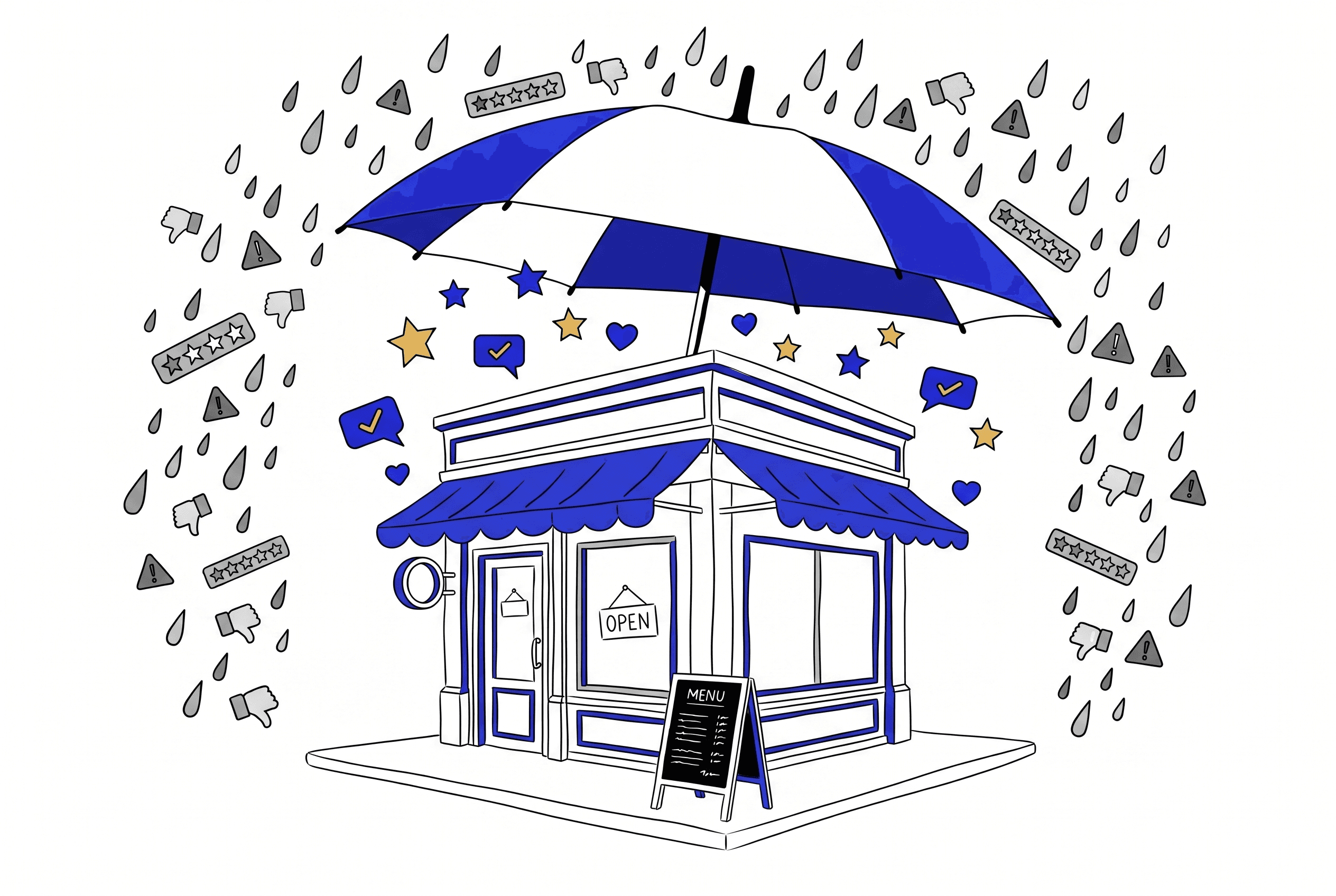
How multi-location restaurant brands build, defend, and measure the reputation that drives revenue.
TL;DR
Restaurant reputation management is the discipline of monitoring and shaping how customers perceive a restaurant across reviews, search, social media, and direct feedback channels.
For multi-location brands, reputation is the single largest variable affecting whether a new customer chooses you over a competitor with similar pricing and menu.
Reviews are the visible part. The work behind a strong reputation sits in the operational layer: response speed, complaint resolution, presence consistency, and the connection between feedback and operational change.
This guide covers the full system, from definitions through measurement to the tools that fit different sizes of operation.
What is restaurant reputation management?
Restaurant reputation management is the discipline of monitoring, shaping, and defending how customers perceive a restaurant across every public-facing channel. It covers reviews on Google, delivery platforms, and third-party sites, search visibility, social media presence, direct customer feedback, and the response patterns that connect them. For multi-location brands, the work is structural rather than tactical, because the volume of signals across locations cannot be managed manually.
The simpler definition is the one most operators use day to day. Reputation is what shows up when a potential customer looks you up. The management is everything you do to make sure that picture is accurate, current, and earned.
This is a different discipline from marketing. Marketing creates the message a brand wants to send. Reputation management responds to the message customers are already sending about you. The two interact, but the work is separate, and most multi-location brands eventually realize that reputation needs its own ownership rather than living as a marketing sub-task.
Why reputation matters for restaurants specifically
Reputation matters for every consumer business, but the dynamics in the restaurant industry are sharper than in most categories. Three patterns make the discipline disproportionately consequential.
The decision window is short
Most restaurant choices happen within 5 to 15 minutes of the decision moment. Someone is hungry, opens a delivery app or Google Maps, scans options, and chooses. There is no week-long evaluation cycle. The reputation visible in that window (the rating, the recent reviews, the photos, the response pattern) is the reputation that affects revenue.
This compresses the value of reputation into specific signals. The average rating matters less than what the most recent five reviews say. The photo on the listing matters more than the brand's website. The response to the latest negative review matters more than a marketing campaign that ran last month.
The decision is comparative, not absolute
Customers rarely evaluate a restaurant in isolation. They compare against the alternatives visible on the same screen at the same moment. A 4.3-star restaurant looks weaker next to a 4.6-star competitor on the same delivery platform, regardless of how good a 4.3 rating is in absolute terms. The reputation management work is a competitive game, not a brand-health one.
This means the right benchmark for any location is its visible competitors, not an industry average or the brand's historical baseline. A reputation system that does not track competitive context is missing the half that matters.
Reputation is a leading indicator of revenue
Revenue is a lagging measure. By the time weekly covers or delivery orders show a decline, the reputation drift that caused it has been compounding for weeks or months. Operators who watch reputation as a metric see issues 6 to 12 weeks ahead of the revenue line. Operators who only watch revenue see them after the damage is done.
This is why reputation management is operationally valuable, not just communicatively valuable. Reading reputation correctly is reading the future of the P&L.
The four pillars of restaurant reputation
A useful reputation management system covers four pillars. Most brands focus on the first one and underinvest in the other three. The pillars compound. A weak pillar drags down the strength of the others.
Pillar 1: reviews and ratings
Reviews are the most visible signal. They appear on Google Business Profile, on delivery platforms (Talabat, HungerStation, Mrsool, Jahez, Instashop, Uber Eats, Deliveroo), on third-party review sites (Yelp, TripAdvisor, Zomato), and on social media platforms in less structured ways. For multi-location brands, the volume of reviews per week across the portfolio is usually in the hundreds, sometimes thousands.
The work in this pillar is collecting reviews systematically without violating platform policies, monitoring sentiment trends across all sources, responding to negative reviews quickly and to a defined quality standard, and identifying patterns that point to operational issues rather than treating each review as isolated.
For a deeper guide to choosing review management software, see the comparison of restaurant review management tools. For the rules around compliant collection (review gating is prohibited by Google and increasingly by other platforms), see the explanation of review gating policy.
Pillar 2: search presence
Reviews live inside listings. The listings themselves (Google Business Profile, Apple Business Connect, Bing Places, delivery platform profiles) are the search-layer infrastructure that determines whether reviews are visible at all. A perfect review portfolio on a poorly optimized listing reaches fewer customers than a moderate review portfolio on a strong listing.
The work in this pillar is keeping every listing accurate (name, address, phone, hours, menu), claiming and merging duplicates, populating photos and posts regularly, optimizing categories and descriptions for the searches customers actually use, and standardizing the presence across every location for franchises and chains.
The standardization work is unglamorous and outsized in impact. Multi-location brands that audit their portfolios usually find 15 to 30 percent of locations have inconsistencies that are quietly suppressing search visibility.
Pillar 3: social presence
Social media is part of reputation, even for brands with no active social strategy. Customers post photos of their meals, tag locations, leave reviews on Facebook, mention the brand in their stories, and share complaints in Twitter threads. The brand does not control any of this directly, but the brand's response (or absence of response) shapes how the conversation is read by everyone else who sees it.
The work in this pillar is monitoring brand mentions across platforms, responding to direct customer comments and complaints, identifying the user-generated content worth amplifying through the brand's own channels, and noticing emerging patterns (a viral complaint, a sudden uptick in mentions of a specific menu item) before they compound.
Most brands do not staff this work fully. The minimum useful version is a single person spending 30 minutes a day reviewing brand mentions across the major platforms, with a clear escalation path for issues that need broader response.
Pillar 4: direct customer feedback
The fourth pillar is the feedback that does not happen in public. This includes post-visit surveys, in-store comment cards, app-based feedback, customer service emails, complaint logs, and any other direct channel where customers tell the brand what they think before (or instead of) telling everyone else.
Direct feedback is the most actionable of the four pillars. Public reviews are influenced by emotion, screenshot-worthy framing, and public performance. Private feedback tends to be more practical, more specific, and more useful for operational improvement. The brands that treat private feedback as a primary signal often see the issues that drive public reviews several weeks earlier.
The challenge in this pillar is response rate. Most brands see single-digit percentage response rates on post-visit surveys. The fix is not better surveys but a tighter response loop. Customers who give feedback and see it acted on (with visible follow-up) become loyal advocates and feed more feedback in future. Customers who give feedback and hear nothing stop giving feedback.
How to build a reputation management system
Reputation management as a system has five layers. Each one builds on the previous. Skipping a layer creates instability that the layers above cannot compensate for.
Layer 1: monitoring
The foundation is knowing what is happening. Every channel where the brand is reviewed, mentioned, or rated needs to feed into a single view. Without consolidated monitoring, operators react to the squeakiest signal rather than the most important one.
The minimum coverage for a multi-location restaurant brand includes Google Business Profile, every active delivery platform, the major third-party review sites in the operating market, Facebook and Instagram, and Twitter. For brands operating in MENA, the delivery platform layer specifically covers Talabat, HungerStation, Mrsool, Jahez, and Instashop. Coverage that ignores delivery platforms misses the majority of customer feedback for most modern restaurant brands.
Layer 2: response
Once monitoring is in place, the brand needs a defined response practice. Who responds, on what timeline, to what standard, with what tone, and with what escalation path. Response practice is the most visible part of reputation management to customers, so consistency across locations matters more than perfect quality at any single location.
The useful response targets for most multi-location brands are 24 to 48 hours for negative reviews, 72 hours for neutral reviews, and within a week for positive reviews. Response rate (percentage of reviews that get a response) is a useful metric to track per location. Variance in response rate across locations is usually a sign that ownership is unclear.
Layer 3: root cause linkage
A response is a one-time action. Root cause linkage is what turns reviews from a communication problem into an operational signal. When a pattern of complaints points to a slow kitchen on Thursday evenings at one location, the useful response is to fix the kitchen workflow. The review responses, while necessary, are downstream of the actual fix.
This layer is where most reputation management efforts hit a wall. The tools that capture reviews are usually different from the tools that capture operational data, so the linkage between sentiment and cause is manual and slow. Brands that invest in connecting these systems see the largest reputation improvements over time, because the underlying issues actually get fixed.
Layer 4: collection
Once monitoring, response, and root cause work are in place, the brand can responsibly invest in increasing review volume. Doing this earlier (before the response and root cause systems are working) usually backfires, because more reviews means more issues become visible without the infrastructure to address them.
Compliant collection follows a few principles. Ask every customer, not a filtered subset. Use neutral request language. Send requests through the customer's preferred channel (often SMS for delivery orders, email for dine-in reservations). Time the request appropriately for the experience type. For dine-in, this usually means same-day or next-day. For delivery, this usually means within 6 hours of order completion.
Layer 5: analysis
The top layer is the strategic view. What patterns are emerging across the brand? Which locations are improving, which are declining, and what factors correlate with the movement? Where is the competitive gap widening or narrowing? What changes in the underlying experience would shift reputation most?
This layer is the input to brand strategy decisions, not just operational ones. Multi-location restaurant brands that treat reputation analysis as a board-level input usually outperform peers that treat it as a tactical concern.
How to measure reputation health
Several metrics matter together. No single metric is sufficient on its own, and each is misleading in isolation.
Metric | What it measures | Useful range to monitor |
|---|---|---|
Average rating per location | Aggregate sentiment | Tracked over 90 days, not in absolute terms |
Review velocity per location per week | Visibility and engagement | Stable or growing trend |
Response rate | Active management signal | Above 80% for negative reviews |
Response time (median, negative reviews) | Speed of resolution | Under 48 hours |
Sentiment trend (text analysis) | Direction of perception | Stable or improving over 90 days |
Share of voice across platforms | Where the conversation is happening | Tracked monthly |
Competitive rating gap | Position vs. local alternatives | Tracked per location |
The composite picture across these metrics is what matters. A 4.5-star restaurant with falling velocity, slow response time, and a widening gap to local competitors is in worse shape than a 4.2-star restaurant with steady velocity, fast response, and a narrowing gap. The trajectory beats the snapshot.
Common mistakes restaurant brands make
Across the multi-location brands we work with, a small number of patterns account for most reputation drift. Each is fixable once it is named.
Treating reputation as a marketing function
Reputation issues are usually operational. A pattern of slow service complaints points to staffing or workflow, not messaging. Putting reputation under marketing means the team that does not have the levers to fix the issues is responsible for managing them. The right home for reputation is operations, with marketing supporting communication.
Responding only to negative reviews
Brands that only respond to complaints train customers to think the brand is purely defensive. Responding to positive reviews, especially the specific and detailed ones, signals attentiveness without coming across as performative. The right pattern is responding to most reviews, with negative reviews getting priority on speed.
Ignoring delivery platform reviews
Most brands track Google reviews closely and treat delivery platform reviews as secondary. For modern restaurant brands, especially in MENA, delivery platforms generate the majority of all customer feedback. Ignoring them is structural blindness, not selectivity.
Letting franchise locations manage reputation independently
Franchise brands frequently allow location operators to handle their own reviews. The result is enormous variance in response quality across the brand. Some locations excel; others are silent for months. The aggregate reputation of the brand reflects the worst-managed locations more than the best, because customers comparing brands see specific stores, not averages.
Confusing rating with reputation
Rating is a number. Reputation is a pattern. A brand can have a high rating and weak reputation (high but eroding, with concerning recent reviews) or a moderate rating and strong reputation (steady, well-managed, recovering from past issues). Optimizing for rating alone often produces decisions that hurt reputation, like aggressive review collection that triggers spam filters.
Choosing the right reputation management software
The tooling decision depends on three variables: the number of locations, the channels in scope, and the level of operational integration needed. The matrix below covers the practical options.
Brand size and need | Practical fit |
|---|---|
1-4 locations, basic monitoring | Native Google Business Profile + manual delivery platform tracking |
5-50 locations in MENA, full coverage | Specialized F&B platforms with MENA delivery integrations |
5-50 locations in US/EU, full coverage | F&B-focused platforms (Momos, Sira) or mid-market generalists |
50-200 locations, multiple channels, root cause linkage | Platforms with operational data integration |
200+ locations, enterprise complexity | Enterprise CX platforms (Reputation.com, Medallia) with services support |
For most mid-market restaurant brands (5 to 50 locations), the decision usually narrows to a small number of F&B-specific platforms. The choice depends on which delivery platforms the brand uses, what languages and dialects matter, and how much the operator values root cause linkage versus pure review aggregation.
A detailed comparison of the available options is in the restaurant review management software guide. The competitive matrix changes more slowly than vendor marketing implies; most decisions remain stable for 3 to 5 years once made.
How Sira approaches reputation management
Sira treats reputation as one outcome of a broader customer intelligence system. Reviews flow into the same view as internal feedback, sentiment trends, and operational data, so reputation signals connect to the underlying causes. The platform covers Google, the major delivery platforms (Talabat, HungerStation, Mrsool, Jahez, Instashop), social channels, and internal surveys natively.
Three design choices distinguish the approach. The Arabic-native AI handles dialect rather than relying on Modern Standard Arabic translation, which preserves sentiment that machine-translated tools lose. The root cause module connects review patterns to operational data automatically, so a complaint trend points to a specific shift, dish, or process rather than a vague theme. The per-location pricing model fits mid-market F&B economics, where enterprise tools usually price out at scale.
For multi-location brands operating in MENA, Sira covers a market that most global tools do not address natively. For brands operating across regions, Sira complements global coverage with the MENA layer.
Handling a reputation crisis
Most reputation work is steady-state. Occasionally something happens that pushes a brand into crisis mode: a viral negative review, a food safety incident, a staff conduct issue posted on social media, or a wave of one-star reviews tied to a specific event. The work in a crisis is different from the work in steady-state, and brands that handle it well usually recover within 60 to 90 days. Brands that handle it badly carry the damage for years.
The framework that works in restaurant crises has four stages.
Stage 1: acknowledge fast
The first hour matters more than the next week. A response within the first hour, even an interim one, signals that the brand is paying attention. A response 24 hours later, no matter how thoughtful, reads as defensive. The interim response does not need to resolve anything. It needs to acknowledge what is being raised, commit to investigation, and provide a direct contact path.
This stage is operational, not communicative. The brand needs to have a defined point of contact (a named person, not 'the team') and a defined response template for crisis acknowledgement that can be deployed quickly. Drafting these mid-crisis is too slow.
Stage 2: investigate substantively
The investigation needs to be real, not performative. Customers and the watching public can usually tell the difference. If a food safety incident is raised, the brand needs to actually pull the supplier, check the processes, and document what was found. If a staff conduct allegation is raised, the brand needs to actually look at the shift logs, the security footage if available, and talk to the people involved.
The investigation timeline matters. For most issues, customers expect substantive findings within 5 to 7 days. Longer than that and the perception is that the brand is hoping the issue will fade. Shorter than that and the perception is that the investigation was not real.
Stage 3: communicate findings
Once the investigation produces findings, communicate them publicly. The communication should name what was found, what changed because of it, and what the customer (and any other affected customers) can expect going forward. Vague language ('we have improved our processes') reads as evasive. Specific language ('we changed our supplier and rewrote the food handling protocol for the affected dish') reads as accountable.
Tone matters at this stage. Defensive language amplifies the issue. Direct, accountable language usually settles it. The brands that handle this stage well are the ones whose communication style was already direct in steady-state. Brands whose normal voice is corporate-evasive struggle to switch into accountable mode under pressure.
Stage 4: rebuild quietly
After the immediate communication, the rebuild work happens in the background. The patterns that drove the issue need to be addressed structurally. The reviews that were posted during the crisis fade in visibility over 60 to 90 days as new reviews come in. The brand's job is to make sure the new reviews accumulate steadily through normal operation, not to artificially accelerate them, which usually makes things worse.
Brands that try to bury crisis-period reviews with a wave of new positive reviews often trigger Google's spam filter, which removes both the legitimate new reviews and (sometimes) draws further attention to the original issue. The patient approach beats the aggressive one.
Frequently asked questions
How much does restaurant reputation management cost?
Software pricing ranges from around $40 per location per month at the F&B mid-market end to $400 or more at premium SMB or enterprise tiers. The team cost depends on volume; a single dedicated reputation manager can usually cover a portfolio of 10 to 30 locations effectively, with location managers handling first-line response.
How long does it take to see results?
Response time and operational pattern improvements show within 30 to 60 days. Sentiment and rating trends shift within 90 to 180 days. Revenue impact follows by 6 to 9 months for most brands. The compounding nature of reputation means the early period feels slow, then the trend accelerates.
What is the difference between reputation management and review management?
Review management is a subset of reputation management. Review management focuses specifically on collecting, monitoring, and responding to reviews. Reputation management is broader and includes search presence, social monitoring, direct feedback, and the operational integration that turns these signals into change.
Can AI handle reputation management end-to-end?
AI can handle large parts of the workflow (monitoring, drafting responses, identifying patterns, suggesting actions) very well. The parts that still need human judgment are the high-stakes responses (complaints involving allergies, food safety, or staff conduct), the strategic decisions (which patterns matter most this quarter), and the operational change (what to actually do about a recurring complaint). The right model is AI handling volume with humans handling judgment.
How do I get more positive reviews without violating policy?
Ask every customer through a single, identical review request. Send the request through their preferred channel at a sensible time after the experience. Do not filter by sentiment. Do not offer incentives for reviews specifically. Improve the underlying experience, which is the only sustainable way to raise the unfiltered average. The detailed compliance guide on review gating covers the rules in full.
What is the role of reputation management for closed locations?
Closed locations should be marked as permanently closed rather than deleted, so existing reviews remain visible. The brand still benefits from the historical reputation, especially for operators with multiple locations. The detailed walkthrough on deleting and merging Google Business listings covers the closure handling correctly.