Best Restaurant Management Software in 2026
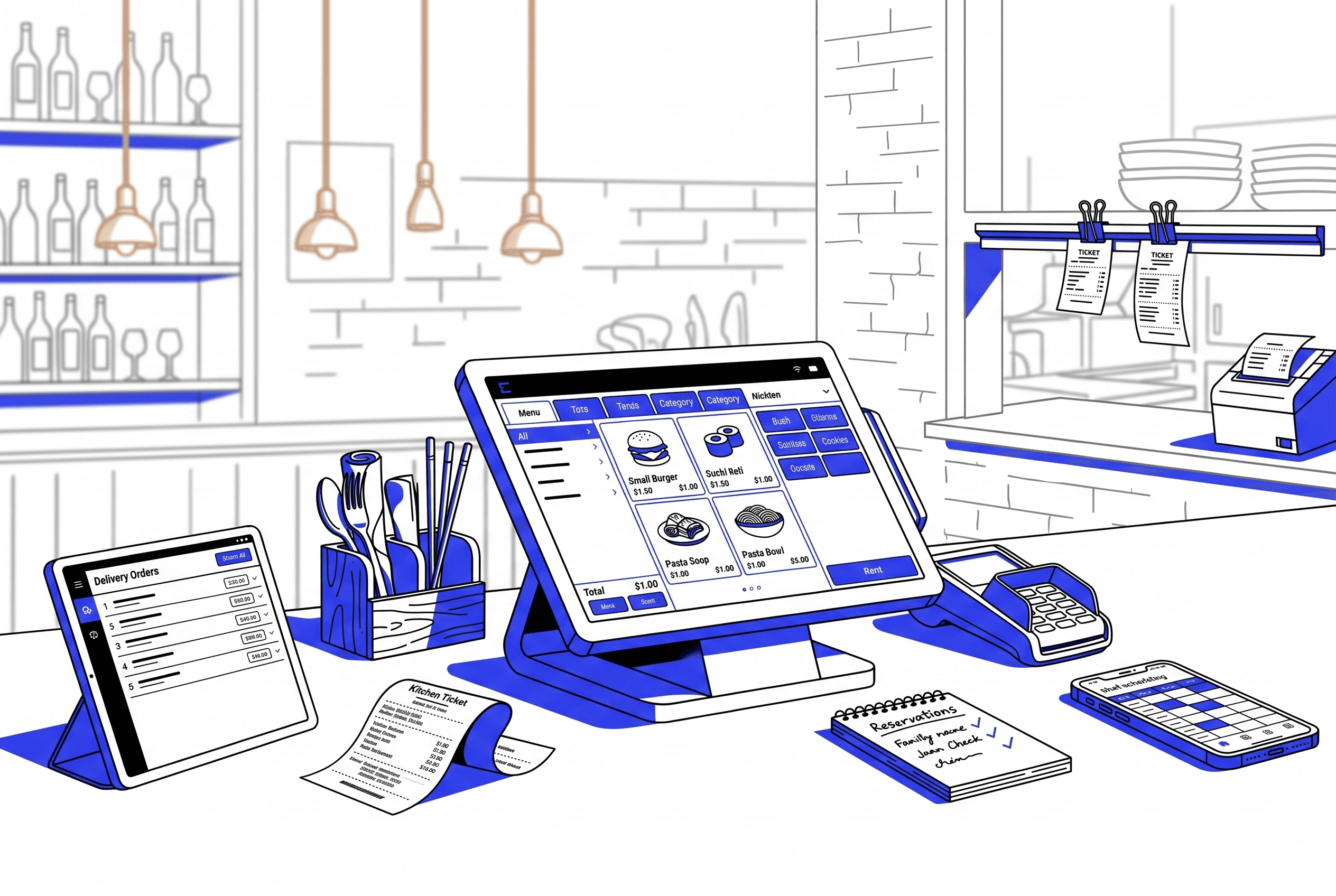
Eleven platforms across POS, scheduling, inventory, reservations, and customer intelligence, organized by what they actually solve.
TL;DR
Restaurant management software is not one category. It is a stack of specialized tools, each solving a different operational problem.
Most multi-location brands end up running 5 to 8 platforms across POS, scheduling, inventory, reservations, marketing, and customer intelligence. The right combination matters more than any single product.
This guide covers eleven tools across the major categories of the restaurant operations stack, with notes on which tools fit which size of operation.
Operators usually evaluate replacements category by category, not platform by platform. The migration cost of changing a POS is significantly higher than the cost of changing most other tools.
What restaurant management software actually means
'Restaurant management software' is one of those phrases that hides more than it reveals. There is no single product that manages a restaurant. There is a stack of specialized tools, each handling a different operational layer, and the work of running a multi-location brand is the work of choosing and integrating the right combination.
This guide covers eleven tools across the six categories that make up the modern restaurant management stack. The categories are POS systems, staff scheduling, inventory and supply chain, reservations and table management, marketing and loyalty, and customer intelligence. Each tool is best understood in the context of its category, not against the others.
The brands that get the most value are usually the ones that pick a strong tool in each category and integrate them, rather than trying to find a single platform that does everything moderately well. The 'all-in-one' marketing pitch usually trades depth for breadth in ways that hurt operations at scale.
Category 1: point of sale (POS)
The POS is the operational hub. It records orders, processes payments, sends tickets to the kitchen, and feeds data to almost every other system in the stack. Choosing a POS is the highest-stakes software decision a restaurant brand makes, because the migration cost of changing later is significant: data history, integrations, training, and operational disruption all compound.
Toast
Best for: US restaurant brands, especially full-service and casual dining.
Toast is the dominant POS for US restaurants, particularly for full-service and casual dining concepts. The product covers core POS functions, online ordering, delivery integration, payments, payroll, and basic loyalty. The depth of the integration ecosystem (third-party tools that connect to Toast natively) is one of its strongest advantages.
For brands operating outside the US, Toast's coverage is thinner. The product is built around US operational and tax patterns, and adapting it to other markets is workable but not seamless.
Strengths: Restaurant-specific design, deep integration ecosystem, strong US support.
Limitations: US-centric, hardware lock-in, pricing complexity.
Foodics
Best for: MENA-region restaurants needing a regionally-built POS.
Foodics is the leading POS for restaurants in MENA, with deep coverage in Saudi Arabia, the UAE, Egypt, and the broader region. The product is built around regional operational realities (Arabic interface, ZATCA compliance for Saudi tax requirements, local payment integration) rather than retrofitted from a Western product.
For restaurant brands operating across MENA, Foodics is usually the practical default. The integration with regional delivery platforms and the local support infrastructure are difficult to match with global products.
Strengths: MENA-specific design, regional compliance, strong local support, native integrations.
Limitations: Less depth outside MENA, third-party ecosystem smaller than US-focused products.
Square for Restaurants
Best for: small to mid-market restaurants prioritizing simplicity and predictable pricing.
Square's restaurant product extends the broader Square POS ecosystem with restaurant-specific features (table management, kitchen tickets, course coursing). The strength is simplicity and pricing predictability. The limitation is that it does not match Toast or Foodics in restaurant-specific depth at scale.
Strengths: Easy setup, predictable pricing, strong payments.
Limitations: Less restaurant-specific depth than dedicated F&B POS, weaker for complex multi-location operations.
Lightspeed Restaurant
Best for: international restaurant brands needing multi-region support.
Lightspeed has historically been strong outside the US, with significant presence in Europe, Australia, and Canada. The product covers POS, payments, inventory, and reservations. For international restaurant brands wanting a single POS across multiple regions, Lightspeed is one of the few products with credible global coverage.
Strengths: International coverage, multi-region support, integrated payments.
Limitations: Less specialized than Toast in the US, less specialized than Foodics in MENA.
Category 2: staff scheduling and labor management
7shifts
Best for: multi-location restaurants managing complex shift patterns and labor cost.
7shifts is the leading staff scheduling product for restaurants. The platform covers shift creation, swap requests, time tracking, labor cost forecasting, and team communication. Integration with major POS systems pulls sales data into labor planning, which is where the value compounds.
For multi-location brands, the differentiator is centralized visibility across locations with delegated authority to local managers. Brands above 5 locations typically see clear ROI within the first quarter, mostly from labor cost optimization rather than scheduling efficiency alone.
Strengths: Restaurant focus, POS integrations, labor cost analytics.
Limitations: US-centric, less depth outside core scheduling.
HotSchedules (now part of Fourth)
Best for: enterprise restaurant brands with complex labor compliance requirements.
HotSchedules has been the enterprise standard for restaurant scheduling for over a decade. The product handles complex labor scenarios (predictive scheduling laws, union rules, multi-state compliance) better than most alternatives. The trade-off is implementation complexity and pricing that fits enterprises rather than mid-market.
Strengths: Enterprise depth, compliance handling, mature product.
Limitations: Implementation overhead, enterprise pricing, dated UI.
Category 3: inventory and supply chain
MarketMan
Best for: multi-location restaurants managing food cost and supplier ordering centrally.
MarketMan covers inventory management, supplier ordering, recipe costing, and food cost analysis. The platform integrates with most major POS systems to track inventory depletion in real time, which closes the loop between sales and inventory automatically.
For multi-location brands, the value is centralized supplier management combined with location-level visibility. The product fits brands that have grown past spreadsheet-based inventory but are not large enough to need full ERP integration.
Strengths: POS integrations, recipe costing, supplier management.
Limitations: Implementation requires data hygiene, less powerful for very large operations needing full ERP capabilities.
Category 4: reservations and table management
OpenTable
Best for: full-service restaurants prioritizing diner network reach.
OpenTable's value is the dual-sided network. The platform serves restaurants as a reservation management tool and serves diners as a discovery and booking platform. For full-service restaurants, the diner-facing reach often justifies the cost on its own, before considering the table management features.
The trade-off is per-cover fees that scale with reservation volume. High-volume restaurants often find the economics challenging at scale, especially when the platform is generating most of the bookings the restaurant could capture directly.
Strengths: Diner network, brand recognition, mature product.
Limitations: Per-cover pricing, channel dependency risk.
Resy
Best for: premium and high-end restaurants in major US markets.
Resy (now owned by American Express) competes directly with OpenTable and has stronger positioning in the premium dining segment, particularly in major US cities. The diner network is smaller than OpenTable's overall but denser in the segments Resy targets.
Strengths: Strong premium positioning, modern interface, Amex integration.
Limitations: Smaller diner network than OpenTable, US-focused.
Category 5: marketing and loyalty
Toast Marketing (or equivalents like Punchh)
Best for: brands building first-party customer relationships and loyalty programs.
Marketing and loyalty platforms close the loop between customer transactions (captured in POS) and outbound communication (email, SMS, app push). For brands that want to reduce reliance on delivery platforms by building direct customer relationships, this category is essential.
Most major POS systems now include native marketing tools (Toast Marketing, Square Marketing, Lightspeed Marketing). For brands that want best-in-class capability, dedicated platforms like Punchh, Thanx, or Paytronix offer deeper functionality at higher cost.
Strengths: Direct customer relationships, reduced platform dependency, repeat-visit growth.
Limitations: Requires customer data discipline, separate cost layer, integration complexity.
Category 6: customer intelligence and CX
Sira
Best for: multi-location F&B operators in MENA who want CX as an operational discipline.
Sira sits in a different category from the rest of the stack. POS, scheduling, inventory, reservations, and marketing tools handle the operational mechanics of running restaurants. Sira handles the customer perception layer that determines whether the operations produce revenue.
The product covers reviews across all major channels (Google, Talabat, HungerStation, Mrsool, Jahez, Instashop, social), internal surveys, sentiment analysis, root cause linkage to operational data, and incident ticketing. The Arabic-native AI handles dialect rather than relying on Modern Standard Arabic, which preserves sentiment that machine-translation tools lose.
Sira is a complement to the operational stack, not a replacement for any of it. The integrations with POS systems and delivery platforms feed the operational data Sira needs to connect customer signals to causes.
Strengths: MENA delivery platform coverage, Arabic dialect handling, operational integration, per-location pricing.
Limitations: Coverage outside MENA is growing, complement rather than replacement for operational tools.
How the stack fits together
For most multi-location restaurant brands, the stack ends up looking similar: a POS as the data foundation, scheduling and inventory as the operational layer, marketing and loyalty for direct customer relationships, and customer intelligence for the perception layer. The integrations between these tools are where the value compounds.
Stack layer | Typical fit (US) | Typical fit (MENA) |
|---|---|---|
POS | Toast | Foodics |
Scheduling | 7shifts | 7shifts or local alternative |
Inventory | MarketMan | MarketMan or local alternative |
Reservations | OpenTable or Resy | OpenTable or in-house solution |
Marketing/Loyalty | Toast Marketing or Punchh | Native POS tools or local platforms |
Customer intelligence | Momos or Sira | Sira |
How to evaluate stack changes
Most operators do not evaluate the full stack at once. They evaluate one category at a time, usually triggered by a specific operational pain. The right framework for any single category replacement has three steps.
Define the operational problem the change is solving. Vague answers ('we want better software') produce vague decisions. Specific answers ('our food cost reporting takes three days and we need same-day visibility') produce decisions that fit.
Identify the integrations the new tool must preserve. Changing one tool can break integrations across the stack. The replacement needs to maintain or replace every integration the existing tool participates in, or the operational gain is offset by integration loss.
Estimate the migration cost honestly. Software migration costs are usually underestimated by 50 to 100 percent. The realistic cost includes training time, data migration, integration rebuild, parallel running periods, and the productivity loss during the transition.
How data should flow through the stack
The value of a multi-tool stack comes from the integrations, not the individual tools. A POS that does not share data with the scheduling tool means labor planning happens without sales context. An inventory tool that does not integrate with the POS means food cost variance is calculated days after the fact instead of in near real-time. Each broken connection multiplies the manual work needed to operate the brand.
The integrations that matter most for multi-location restaurants follow a consistent pattern.
POS to scheduling
Sales data from the POS feeds labor forecasting in the scheduling tool. Without this connection, schedules are built on historical assumptions that may not match actual demand patterns. With it, labor cost can be optimized within 1 to 2 percentage points of revenue, which often pays for the entire scheduling tool on its own at multi-location scale.
POS to inventory
Sales of menu items deplete inventory automatically based on recipe configurations. Without this connection, inventory counts drift from reality and food cost variance becomes invisible until manual counts catch up. With it, inventory variance is detectable within hours instead of weeks.
POS to customer intelligence
Order patterns, channel mix, and customer identifiers from the POS feed the customer intelligence layer. Without this connection, customer analytics operate on review data alone, which captures only the customers who chose to leave reviews. With it, the analysis covers every transacting customer, including the silent majority who never leave feedback.
Marketing to POS
Campaign data from marketing tools attributes back to specific transactions in the POS, closing the loop on which marketing actions drove which revenue. Without this connection, attribution is a guess. With it, marketing spend can be evaluated against actual revenue impact rather than vanity metrics.
Common stack mistakes
Across the multi-location brands we work with, a few patterns of stack mismanagement appear repeatedly. Each is correctable, but each costs significant operational efficiency until it is.
Choosing tools without checking integrations
Brands frequently pick the best individual tool in each category without checking whether the tools integrate with each other. The result is a stack of strong tools that do not share data, which produces less operational value than a stack of moderate tools that do share data. Integration capability should be a primary criterion in any tool decision, not an afterthought.
Underestimating migration cost
Software migrations, especially POS migrations, consistently cost 50 to 100 percent more than initial estimates. The technical migration is usually the smaller part. The training time, parallel running period, and operational disruption during transition compound. Brands that budget realistically for migration cost make better tool decisions because they evaluate whether the new tool is genuinely worth the switch.
Letting individual locations choose their own tools
In franchise systems and brands with strong local autonomy, individual locations sometimes choose tools independently. The result is fragmented data that cannot be aggregated to brand level. The brand operates partially blind, making decisions based on the locations that happen to share data and missing the locations that do not. Brand-level standardization on the core stack (POS, scheduling, customer intelligence) is usually worth the autonomy trade-off.
Skipping the customer intelligence layer
Most brands invest heavily in operational tools (POS, scheduling, inventory) and underinvest in customer intelligence. The reasoning is usually that operational tools have visible cost reduction effects while customer intelligence feels softer. The reality is that customer perception is the leading indicator of revenue, and brands without visibility into it are operating with a six to twelve week blind spot on their own future performance.
Using all-in-one platforms past their useful range
All-in-one platforms work well below 5 locations because the integration overhead of a multi-tool stack outweighs the depth advantage. Above 10 locations, the equation usually flips. Brands that stay on all-in-one platforms past 10 locations because the migration feels disruptive often end up with operational ceilings they cannot cross until they migrate.
Frequently asked questions
Should we use one all-in-one platform or a stack of best-in-class tools?
For brands above 10 locations, best-in-class stacks usually outperform all-in-one platforms. The depth advantage of specialized tools compounds at scale. For brands below 5 locations, all-in-one platforms reduce integration overhead and are often the right choice.
How long does it take to migrate a POS?
3 to 9 months for a multi-location brand, depending on the number of locations and the complexity of integrations. The technical migration is usually faster than the operational training and data reconciliation that follows.
What is the right time to add a customer intelligence layer?
Most brands add customer intelligence after the operational stack stabilizes (POS, scheduling, inventory) and after the brand reaches 5 to 10 locations. Earlier than that, the volume of customer feedback is usually small enough to manage manually. After 10 locations, manual handling breaks down.
Do we need separate tools for dine-in and delivery operations?
Usually not separate tools, but tools that handle both natively. Most modern POS systems integrate dine-in and delivery channels. The integration matters more than separate tools, because customers and revenue do not split cleanly along channel lines.
What does an average restaurant tech stack cost per location?
For mid-market multi-location brands, total stack cost typically runs between $300 and $800 per location per month across all categories. Higher-end stacks with enterprise tools can reach $1,500 or more. The economics work when the stack drives measurable improvements in labor, food cost, customer retention, or speed of service.