Online Reputation Management for Multi-Location Businesses
How brands operating across 10 to 200 locations build a reputation system that scales without breaking.
TL;DR
Single-location reputation management and multi-location reputation management are different disciplines. The tools, workflows, and ownership models that work at one scale break at the other.
The most common failure pattern is letting individual locations manage their own reputation. The result is enormous variance in response quality and visible inconsistency to customers comparing brands.
Effective multi-location reputation management uses a hub-and-spoke model: brand-level standards and oversight, location-level execution, and a tooling layer that makes both visible to each other.
What changes when you go multi-location
Reputation management for a single location is mostly a tactical practice. Someone reads the reviews, responds to them, files the complaints to the right person, and tracks rating averages monthly. The work is bounded and visible. One person can hold the entire picture in their head.
Reputation management for 30 locations is a different discipline. The volume of reviews per week is too high to read individually. The variance in how each location handles complaints becomes a brand consistency problem. The signals that matter (which location is drifting, which complaint patterns are recurring across the brand, which platforms are surfacing new issues) are invisible without aggregation tooling. The work shifts from tactical to systemic, and the tools and roles shift with it.
Three changes drive the discipline transition.
Volume forces aggregation
A single restaurant might receive 20 to 50 reviews a month across all platforms. A 30-location brand receives 600 to 1,500. A 100-location brand receives 2,000 to 5,000. At single-location volume, manual review is feasible. At multi-location volume, manual review is impossible without sampling, and sampling misses the early signals that matter most.
The aggregation requirement is not optional once volume crosses the threshold of what one person can read in a working week. Tools that automate the aggregation, sentiment classification, and pattern detection become structural, not optional.
Consistency becomes a brand problem
Customers comparing two locations of the same brand notice when the response patterns differ. Brand A's flagship location responds to every negative review within 24 hours with thoughtful, specific replies. Brand A's secondary location ignores reviews for weeks and replies with generic templates when it does. Both locations are the same brand to the customer, and the inconsistency reads as poor management.
Single-location brands cannot have this problem. Multi-location brands cannot avoid it without deliberate effort.
Operational cause analysis becomes possible and necessary
With one location, a complaint pattern (slow service, cold food, rude staff) can be diagnosed by walking the floor. With 30 locations, the same pattern requires data: which shift, which staff, which delivery platform, which dish, which time of day. The data has to come from somewhere, and it has to connect to the review signal automatically. Without that linkage, multi-location brands respond to symptoms repeatedly without ever fixing the cause.
The hub-and-spoke operating model
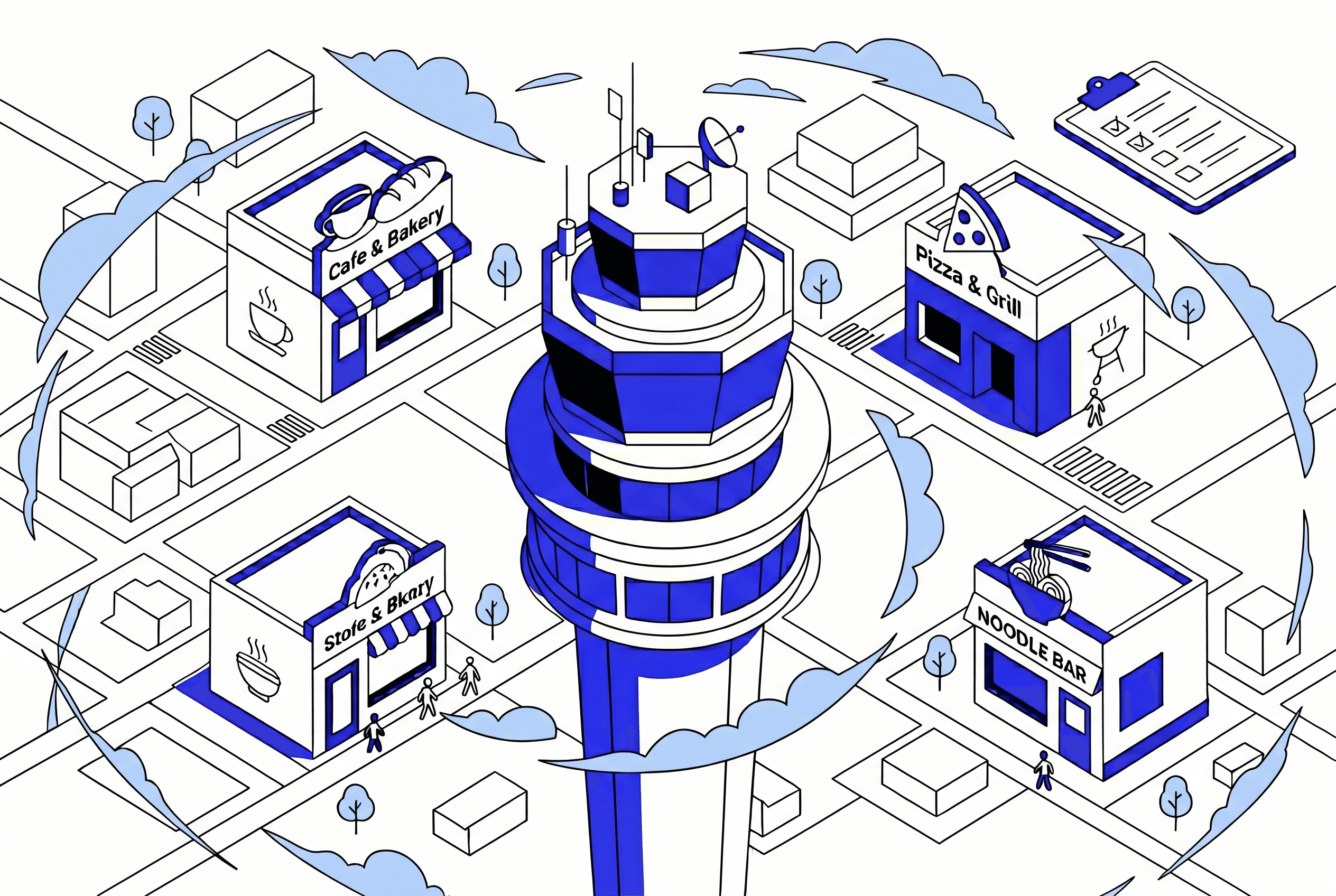
The operational pattern that works for multi-location reputation management is hub-and-spoke. The brand level (the hub) sets standards, owns the tooling, monitors patterns, and intervenes when locations drift. The location level (the spokes) execute the day-to-day response work within the standards. The tooling layer makes each visible to the other.
What the hub does
The brand-level reputation function owns four things. The response standards (target response time, tone, escalation criteria) that every location follows. The tooling stack that aggregates and routes reviews. The monitoring dashboard that surfaces brand-wide patterns and per-location performance. And the intervention model for locations that fall outside the standards consistently.
This function is usually one person at brands with under 30 locations and a small team at brands above 50. Beyond 100 locations, the function often includes regional reputation managers who own clusters of 15 to 30 locations each, with the central function setting standards and monitoring aggregate patterns.
What the spokes do
Location-level reputation work is operational. The store or branch manager or a designated team member reviews the day's incoming reviews, responds within the brand standard, escalates complaints that need brand-level attention (food safety, allegations against staff, social media virality risk), and acts on the operational issues that drove specific complaints.
The role at the spoke level is not a full-time reputation job. It is usually 30 minutes to an hour daily for a multi-location brand operating well. The discipline of doing it daily matters more than the time invested. Locations that batch reputation work to once or twice a week consistently underperform locations that do it daily, even when the time totals are equal.
What the tooling does
The tooling layer is what makes the hub-and-spoke model functional. Without it, the brand level operates blind and the location level operates inconsistently. The tools handle aggregation across all platforms (so reviews appear in one place, not 8 separate platforms), routing to the right location manager (so each spoke sees only what is theirs), pattern detection across the portfolio (so the hub sees what no individual location can), and standard enforcement (so response time and quality become measurable).
Tooling requirements at scale
The tools that work for multi-location reputation management have specific requirements that single-location tools often lack. Five capabilities are non-negotiable above 10 locations.
Multi-location dashboards. Every metric (rating, response rate, response time, sentiment trend) needs to be viewable per location, per region, and at the brand aggregate, with the ability to drill from one to the other.
Permission and routing. Location managers should see and respond to their location's reviews, not the entire brand's. Brand-level managers should see everything. The tool needs role-based permissions that scale to the org structure.
Standardized response templates with location flexibility. Templates ensure brand consistency. The tool should make templates available without forcing rigid use, so location managers can customize while staying within the brand voice.
Cross-platform coverage. Multi-location brands cannot afford a tool that covers Google but not delivery platforms. For brands operating in MENA, the tool needs native coverage of Talabat, HungerStation, Mrsool, Jahez, and Keeta in their respective markets, not just Google.
Operational data integration. The tool needs to read POS, scheduling, or other operational data to connect review patterns to causes. Pure review aggregation tools become reporting layers without this integration.
Common failure patterns
Multi-location brands fail at reputation management in predictable ways. Three patterns account for most of the breakdowns.
Letting locations manage independently
This is the most common failure. The brand decides reputation is the location's problem and gives each location its own login, its own response practices, and its own standards. The result is enormous variance: some locations excel, others go silent for months, and the brand aggregate reflects the worst locations more than the best.
The fix is not to centralize execution (location managers are still the right people to respond, because they know the operational context). The fix is to centralize standards and monitoring while keeping execution local.
Buying enterprise CX platforms before the discipline is ready
Brands that recognize the multi-location complexity sometimes overcorrect by buying enterprise CX platforms (Medallia, Qualtrics, Reputation.com) before they have the operational maturity to use them. The tools are powerful but require dedicated reputation teams, mature data hygiene, and 6 to 12 month implementation cycles. Most mid-market brands stall in implementation and never extract the value the tool promised.
The fix is to pick tools that match operational maturity. F&B-specialized platforms (Sira, Momos, Localyser) deploy in weeks, fit mid-market budgets, and produce value quickly. Brands can graduate to enterprise platforms later if they need to.
Treating reputation as a marketing problem
Marketing teams are often given reputation ownership because reviews seem like brand communication. The result is reputation programs that focus on rating averages, response templates, and PR-style crisis management without addressing the operational issues that drive complaints. Marketing teams do not have the levers to fix slow kitchens or undertrained staff.
The fix is to put reputation under operations, with marketing supporting communication and crisis response. Most reputation issues are operational, and the team responsible needs the operational levers.
How Sira handles multi-location reputation
Sira is built around the hub-and-spoke model that multi-location reputation management requires. The platform aggregates reviews across Google, the major delivery platforms (Talabat, HungerStation, Mrsool, Jahez, Instashop), social channels, and internal surveys. The dashboard surfaces metrics at the location, region, and brand levels with the same fidelity at each.
Three design choices distinguish the approach for multi-location brands. Per-location pricing scales predictably from 5 to 200+ locations without enterprise contract negotiation overhead. Native MENA delivery platform coverage means the tool captures the full review volume that brands operating in the region actually receive. And the root cause module connects review patterns to operational data automatically, which is the difference between identifying that 'service is slow at 3 locations' and identifying that 'service is slow on Thursday evening shifts at 3 locations because the same scheduling pattern undercovers peak demand.'
For brands at the 5 to 50 location stage where most multi-location reputation programs are built, Sira fits the operational realities of mid-market F&B economics. For brands above 50 locations, the platform scales to the regional reputation manager structure that brands at that size require.
FAQ
How do we standardize response quality across locations?
Three mechanisms working together. Templates for common review types (positive, negative, mixed) that location managers can customize but not bypass. A response review process at the brand level that audits a sample of responses weekly and provides feedback to location managers. And clear escalation criteria so location managers know when to hand off to the brand level (food safety complaints, allegations against staff, viral social media risk).
Should the brand level respond directly or only set standards?
The brand level should respond only in specific cases: crises, viral situations, and complaints that escalate beyond the location's authority. Day-to-day responses should come from the location, because location managers have the operational context that produces specific, useful replies. Brand-level responses to routine reviews tend to read as generic and corporate.
How much should we expect to pay for multi-location reputation tooling?
For mid-market F&B brands, expect $30 to $80 per location per month for the reputation layer specifically. Adding presence management, surveys, and customer intelligence usually pushes the per-location cost to $40 to $150. Enterprise platforms can range from $200 to $500+ per location, but most mid-market brands do not need that depth.
How long does it take to roll out a reputation program across 30 locations?
Tooling deployment takes 2 to 6 weeks. Standard-setting and training takes another 4 to 8 weeks. Hitting consistent execution across all 30 locations takes 3 to 6 months. The full discipline maturing usually takes 9 to 12 months. Brands that try to compress this timeline often see uneven adoption that takes longer to fix than starting at the right pace.
What KPIs should we report at the brand level?
Five metrics cover most of what matters. Average rating per location and brand aggregate (trended over 90 days). Response rate per location (target above 80% for negative reviews). Median response time for negative reviews (target under 48 hours). Sentiment trend across the brand (stable or improving over 90 days). Variance across locations (the gap between best and worst, narrowing means consistency is improving).