How to Collect and Act on Restaurant Customer Feedback
A practical system for capturing useful feedback across every channel and turning it into operational change.
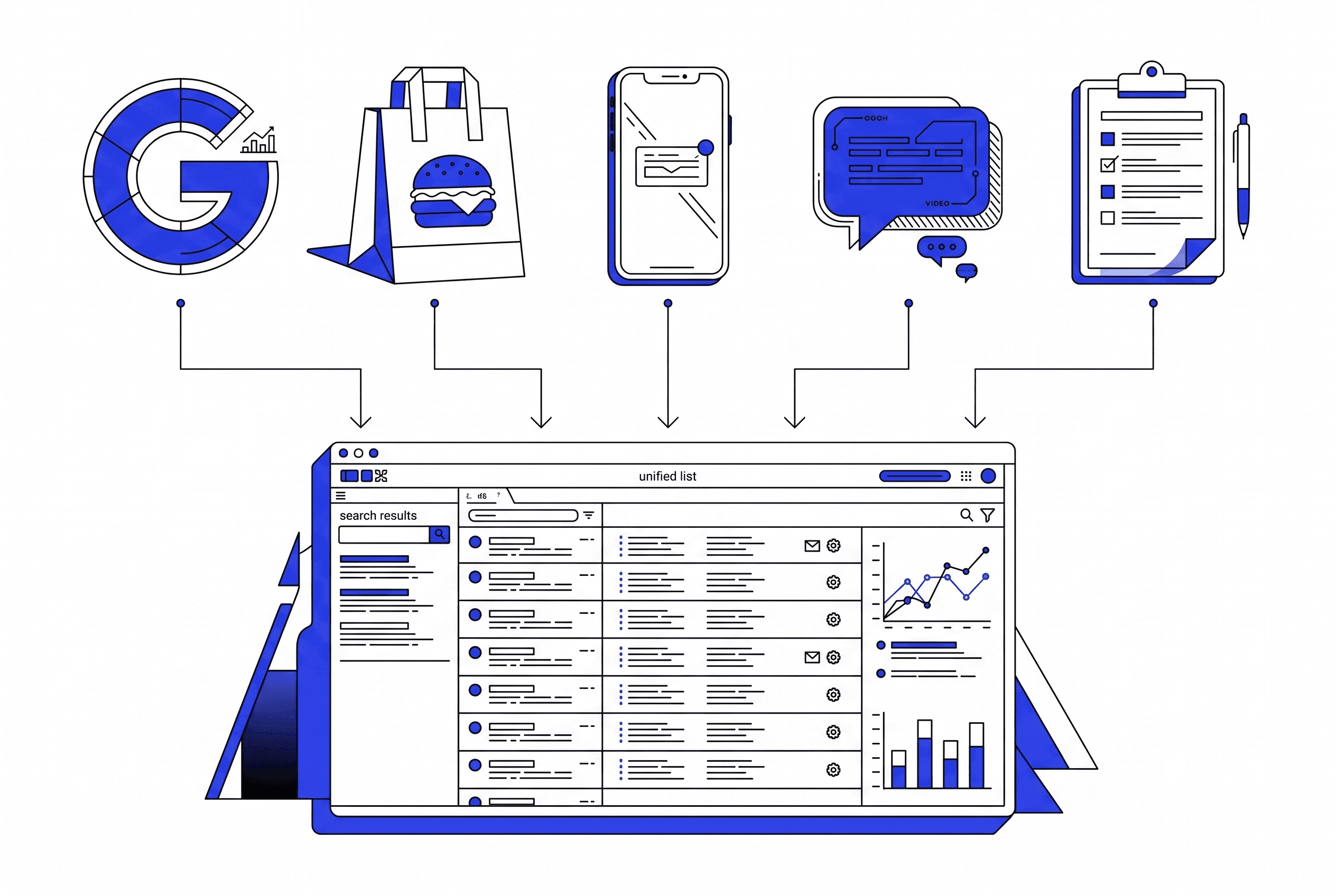
Customer feedback comes through five channels: in-store, post-visit surveys, delivery platforms, social media, and Google reviews. Most brands monitor one or two and miss the rest.
The hardest part is not collecting feedback. It is closing the loop so customers see their input lead to change. Without the loop, response rates drop and the data dries up.
Useful feedback is specific. Generic 'how did we do?' surveys produce generic answers. The right questions produce diagnostic answers that connect to specific operational levers.
This guide covers the channels, the question design, the response loop, and the operational system that turns feedback from a reporting exercise into a change discipline.
The five channels and what each one tells you
Customer feedback for a restaurant comes through five channels. Each one captures a different population, a different moment, and a different type of signal. Most brands monitor one or two and conclude they have a feedback program. The complete picture requires all five.
Channel | Captures | Best for |
|---|---|---|
In-store (verbal, comment cards, table tablets) | Customers who finished a meal and are still on premises | Immediate reaction, service-related issues, recovery in real time |
Post-visit surveys (SMS, email) | Engaged customers who opted into communication | Considered feedback, NPS and CSAT measurement, open-text issues |
Delivery platforms (Talabat, HungerStation, Mrsool, Jahez, Instashop) | Delivery customers | Delivery-specific issues: timing, packaging, accuracy, driver experience |
Social media (Twitter, Instagram, Facebook) | Customers who chose to broadcast publicly | Strong emotion, brand perception, virality risk |
Google reviews and similar | Customers willing to write a public review | Public-facing reputation, search-decision signal, latest visible feedback |
Each channel surfaces a different slice of the customer base. In-store catches issues fast but only from people on premises. Post-visit surveys reach more customers but only the ones who opted in to communication. Delivery platform reviews show up days later. Social media captures the emotional outliers. Google reviews are the most public but also the most filtered (only customers willing to write publicly). A program that uses all five sees patterns no single channel reveals on its own.
How to design useful feedback questions
The biggest difference between feedback programs that produce operational change and those that produce reports is question design. Specific questions produce diagnostic answers. Generic questions produce noise.
Avoid 'how did we do?' as the entire survey
Asking 'how was your experience?' produces 'great' or 'fine' from most respondents. That data tells you nothing operational. The respondents who give detailed feedback in response to a generic question are usually outliers (very upset or very delighted), which means the data is biased toward extremes.
The fix is to ask specific questions that map to specific operational levers. Instead of 'how was your experience,' ask 'how would you rate the speed of your meal arrival?' and 'how would you rate the temperature of your food?' and 'was your order accurate?' Each question maps to a specific operational system, so a low score points directly to where to look.
Use a mix of scaled and open-text questions
Scaled questions (1-5 ratings, NPS, CSAT) produce data you can trend over time. Open-text questions produce the why behind the trend. Both are necessary. A program with only scaled questions cannot diagnose. A program with only open-text questions cannot measure.
The useful pattern is two to four scaled questions targeting specific operational dimensions, plus one open-text question that asks 'what could we do better?' or 'what stood out about your visit?' The scaled questions produce the trend data; the open-text question produces the diagnostic detail.
Keep total length under 90 seconds
Customer feedback fatigue is real. Surveys that take more than 90 seconds to complete see drop-off rates above 40%. The respondents who push through are skewed toward the extremes (very motivated to praise or complain), which biases the data.
A 90-second survey usually means 4 to 6 total questions. More than that and the response rate drops while the data quality also drops. Less than that and the data becomes too thin to act on. The sweet spot is 4 specific questions plus one open-text prompt.
Channel-by-channel collection guide
Each channel has different mechanics. The collection method, timing, and incentive model shifts by channel.
In-store feedback
In-store feedback works best when it is captured at the right moment. Asking at the table while the meal is in progress disrupts the experience. Asking at payment is too late to fix anything. The window that works is between the meal ending and the customer leaving, usually through a brief verbal check-in or a tablet at the exit.
Comment cards work but produce single-digit response rates. Table tablets produce higher rates but require operational discipline (they need to be functional, charged, clean). Verbal check-ins from a manager produce the highest engagement but require staffing the role.
The most operationally important use of in-store feedback is real-time recovery. A customer flagging a slow kitchen or a cold dish can be addressed before they leave, which preserves the relationship more than any post-visit response.
Post-visit surveys
SMS surveys outperform email by 3 to 5 times on response rate. The trade-off is cost: SMS has a per-message cost while email is effectively free. For multi-location brands, the SMS cost is usually justified by the higher response rate and the ability to reach customers who do not check email regularly.
Timing matters. Send the survey within 6 hours of the visit for dine-in customers, within 2 hours for delivery customers (because delivery customers grade against immediate experience). Surveys sent more than 24 hours after the experience see significantly lower response rates and produce more generic answers.
Incentives modestly improve response rate (15-25% versus 3-8% unincentivized) but introduce bias. Incentivized respondents are more motivated to complete the survey, which means they may also be more motivated to give the answer they think gets them the reward. Use incentives selectively, not as the default.
Delivery platform reviews
Delivery platform reviews are not collected. They are received. The customer leaves a review on the platform and the brand sees it. The brand's role is to monitor, respond, and act on patterns.
For brands operating in MENA, this means active monitoring of Talabat, HungerStation, Mrsool, Jahez, and Instashop reviews continuously, with response practices that match what brands do on Google. Most brands neglect these platforms and lose visibility into the largest source of their customer feedback.
Social media monitoring
Social monitoring catches the high-emotion outliers: customers delighted enough to post, or angry enough to broadcast. The signal is real but unrepresentative. Social feedback skews toward extreme experiences, so treating it as a measure of brand health is a mistake. Treating it as an early warning system for crises is the right framing.
The minimum useful version is monitoring brand mentions and tagged photos across the major platforms with a 24-hour response window for direct customer comments. The escalation criteria should be: anything with above-average engagement, anything mentioning food safety or staff conduct, anything from accounts with significant follower counts.
Google reviews and similar
Google reviews are the most publicly visible feedback channel and the one most brands focus on first. The volume is usually moderate (5 to 20 reviews per location per month for a typical mid-market brand), the public visibility is high, and the response practice has direct impact on conversion for future customers reading the profile.
The collection mechanism is review request links sent through SMS or email after a visit. Compliance matters: do not filter requests by sentiment (which is review gating, prohibited by Google), do not incentivize reviews specifically, and ask every customer the same way. The detailed compliance rules are covered in the review gating policy guide.
Closing the loop
The most under-invested part of feedback programs is the response loop. Customers who give feedback and see no response stop giving feedback. Customers who give feedback and see action become more engaged and more likely to give feedback again. The compounding effect of a closed loop is what separates programs that produce useful data over time from programs that dry up after the launch quarter.
A useful response loop has three components.
Acknowledgment within 24 hours. The customer who left feedback should hear back, even if just to confirm receipt. For survey responses, this can be automated. For complaints in particular, automated acknowledgment that promises follow-up is better than silence.
Action visible within 7 days. If the feedback warrants change (a recurring complaint, a specific service issue), the customer should hear what changed. Even if the change does not affect them directly, the visible action signals the program is real.
Periodic reporting back to the customer base. Quarterly or semi-annual communications that share aggregate themes ('the most common feedback theme this quarter was X, here is what we did about it') make the program visible at the brand level. Customers who never gave feedback see that the program produces change and become more willing to participate.
Turning feedback into operational change
Feedback that does not produce change is wasted spend. The bridge from feedback to operational change usually breaks at one of three points.
Aggregation gap
Individual feedback items are signals, not insights. The insight comes from seeing patterns across many items: 'cold delivery food' as a recurring theme at one location, 'slow service' clustering on Thursday evenings, 'staff behavior' concentrating in one shift. Without aggregation tooling, brands respond to individual items and miss the patterns that would point to root causes.
The fix is tooling that automatically tags, categorizes, and trends feedback so the patterns become visible. Manual review of individual feedback items can capture sentiment but cannot reliably identify cross-location patterns above modest volume.
Ownership gap
Feedback that surfaces a pattern needs an owner who can act on it. Without clear ownership, patterns get logged, discussed in monthly reviews, and never resolved. The most common cause is putting feedback under marketing while the issues that drive feedback live in operations.
The fix is to assign feedback patterns to operational owners explicitly: a recurring kitchen issue belongs to the kitchen lead, a recurring delivery issue belongs to the delivery operations lead, a recurring staff issue belongs to the people manager. Marketing supports communication; operations owns the change.
Verification gap
Operational changes need verification that they worked. Without measurement, fixes are guesses. The customer feedback that drove the change is also the measurement that confirms it: if the pattern fades, the fix worked; if it persists, the fix was wrong.
The fix is to define the metric that will indicate the change worked before making the change, and to track it for at least 6 weeks afterward. Most operational fixes that get attention but no follow-up turn out to have been ineffective when measured later.
How Sira supports the full feedback loop
Sira aggregates feedback from all five channels (in-store surveys, post-visit surveys, delivery platforms, social, Google) in one platform. The Arabic-native AI handles dialect-level sentiment for brands operating in MENA, where machine-translation tools miss the nuance that determines whether a review is mildly positive or sarcastically critical.
The differentiator for closing the loop is the root cause module. Patterns in feedback connect automatically to operational data: which shift, which dish, which delivery platform, which time of day. Operators see the cause linked to the symptom, which makes the operational change concrete instead of vague.
Frequently asked questions
What response rate should we target?
For unincentivized post-visit surveys, 5 to 10% is realistic for SMS, 1 to 3% for email. For incentivized surveys, 15 to 25% is achievable but introduces selection bias. The right target is enough volume per location per week to identify patterns (usually 20+ responses per location per month). If volume is below that, the program needs higher response rates or wider question coverage.
How often should we change the survey questions?
Stable questions over time are essential for trending. Change the core 4 questions only when a major operational shift requires it. Add or rotate one or two situational questions monthly to capture specific issues or campaigns without disturbing the trend baseline.
Should we let customers respond anonymously?
Yes for surveys, where anonymity increases honest feedback. No for complaints requiring follow-up, where the brand needs to be able to contact the customer to resolve. The right pattern is optional contact information: customers can choose to leave their name and phone if they want a follow-up, and remain anonymous otherwise.
How do we handle feedback in multiple languages?
For brands operating in MENA, Arabic and English are usually both required. Arabic feedback specifically needs dialect handling: Egyptian, Gulf, and Levantine each carry sentiment differently, and machine translation misses the nuance routinely. Tools with Arabic-native AI process this directly; tools without it produce inaccurate sentiment classification.
What is the role of in-store feedback if we have post-visit surveys?
In-store feedback catches issues at the moment of experience, which post-visit surveys cannot. The unique value is real-time recovery: a slow kitchen flagged at the table can be addressed before the customer leaves, which preserves the relationship. Post-visit surveys catch the considered reflection but cannot intervene operationally.