Google Business Profile Posts, Q&A, and Service Areas
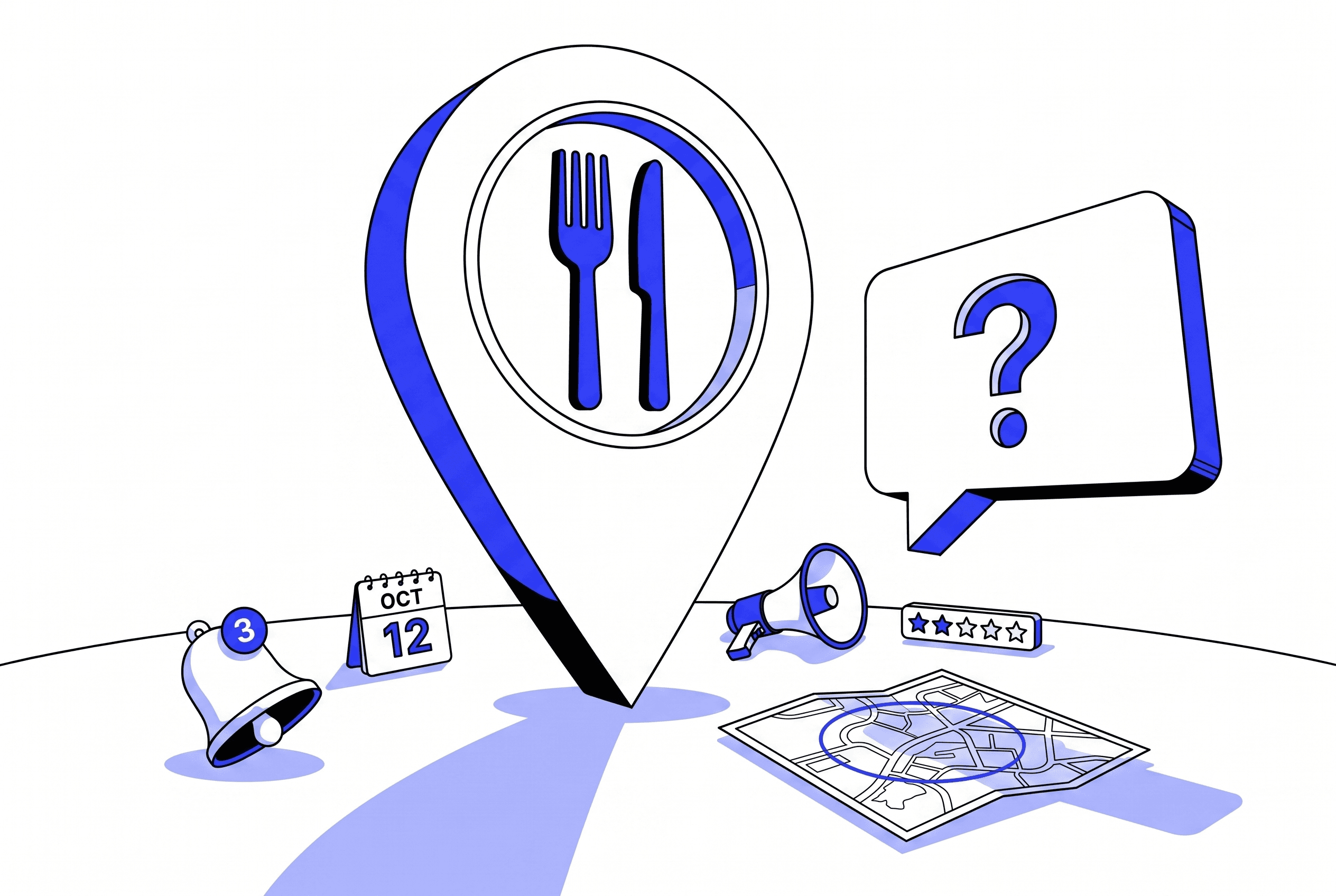
Posts, Q&A, and service areas are GBP features that most restaurants underuse. Each one drives engagement and visibility when used correctly.
Posts work best for limited-time offers, events, and product launches. They expire after 7 days for most types, so they require ongoing creation.iews are anecdotes. Patterns are intelligence. Look at which branches had the most negative reviews this week, whether a recurring topic is appearing across multiple branches,
Q&A is publicly visible and often goes unanswered for days. Active management produces a meaningful boost in customer trust.
Service areas matter for delivery-focused operations and for restaurants that want to define their delivery coverage explicitly to Google.
Why these features get neglected
Most restaurant operators focus on the basic GBP fields (name, address, hours, photos) and stop. Posts, Q&A, and service areas usually get added to the to-do list and never reached. The result is profiles that have the foundation right but leave significant engagement and visibility on the table.
Each of these three features has measurable impact on customer engagement and search performance. Profiles that use them consistently outperform profiles that do not, on dimensions that compound over time. The work involved is modest once a system is in place.
Google Business Profile Posts
Posts let restaurants publish short updates directly on the profile. Customers see them in the profile view, and Google sometimes surfaces them in search results. The visibility window is limited (most post types expire after 7 days), which means consistent creation is what produces consistent benefit.
The post types and when to use them
Post type | Best for | Expiration |
|---|---|---|
Offer | Limited-time deals, discounts, promotional pricing | End of offer date |
Event | Specific dated events: chef's tables, holiday menus, openings | End of event date |
Update | Brand news, new menus, hours changes | 7 days |
Product | Featured menu items, new launches | 7 days |
For most restaurants, the practical mix is offers and events when they have them, with update or product posts to maintain visibility between specific campaigns. The minimum useful cadence is one post per location per week. Below that frequency, the gaps between posts become long enough that the profile reads as inactive.
What makes a post work
Three elements determine whether a post produces engagement.
Specific content. Generic posts ('come visit us this weekend') produce minimal engagement. Specific posts ('20% off our seafood platter all weekend' or 'new Wagyu burger launching Friday') produce meaningful clicks. The specificity is the differentiator.
Strong photo. Posts with high-quality, on-brand photos significantly outperform those with weak or missing images. The photo should match the post content (a photo of the dish for a product post, a photo of the venue for an event post).
Clear call to action. Each post should have one specific action it asks the reader to take. Book now. Order delivery. View menu. Get directions. Multiple competing actions dilute the response.
Multi-location posts
For multi-location brands, post creation can happen at the brand level (pushed to all locations) or the location level (created locally for one specific location). Both work, and the right balance depends on the brand.
Brand-level posts that work cover everything that applies brand-wide: new menu launches, brand campaigns, holidays. Location-level posts work for everything specific to one location: a chef's table at one restaurant, parking changes at one site, location-specific events. Most multi-location brands run roughly 60% brand-level, 40% location-level posts in practice.
Common posting mistakes
Treating posts as social media posts. Google posts have different design and expectations than Instagram or X. They are commercial-leaning, focused on offers and events, not lifestyle content.
Repeating the same post. Posting the same content week after week produces declining engagement and signals inactivity to Google's algorithm.
Skipping the photo. Text-only posts perform poorly compared to posts with images. Even a quick phone photo of a relevant dish or venue is better than no photo.
Letting posts expire without replacement. The 7-day expiration means there is always a need for fresh content. Profiles with no current post read as inactive.
Q&A: the section that often goes silent
The Q&A section on Google Business Profile lets customers ask questions publicly and receive answers from the business or other users. The feature is widely used by customers (especially for time-sensitive questions like dining options or hours) and widely neglected by restaurants. The result is questions sitting unanswered for days, sometimes weeks.
Why active Q&A management matters
Q&A produces three benefits when actively managed.
Direct customer service. Customers asking questions get answers faster, which improves trust and conversion.
Public-facing service signal. Future customers see the active responses and read the brand as attentive and responsive, which improves perception even for customers who never asked a question.
SEO contribution. Q&A content adds keyword-relevant text to the profile, which contributes to search ranking on the topics customers actually ask about.
The risk of inactive Q&A is the inverse: customers asking questions that go unanswered, future customers seeing the silence as inattention, and other users sometimes answering questions incorrectly with information that misrepresents the brand.
Daily monitoring practice
The minimum useful Q&A practice is daily monitoring with a 24-hour response target. For multi-location brands, this means location managers (or designated team members) check their profile's Q&A section once a day and respond to anything new.
Most questions are simple: do you take reservations, do you have parking, do you serve halal food, is the menu vegetarian-friendly, do you offer private dining. Each of these can be answered in 1 to 2 sentences and takes a minute. The discipline of doing it daily, not the time per response, is what matters.
Proactive Q&A seeding
Restaurants can post the questions customers actually ask along with clear brand-controlled answers. This populates the Q&A section with accurate information and gives future customers searching the same questions immediate answers without waiting for the brand to respond ad-hoc.
The questions worth seeding are the ones that customers ask repeatedly: dietary accommodations, parking, reservations, payment options, family-friendliness, alcohol service, special requirements. Each of these can be a seeded Q&A pair that exists from day one and serves customers searching for that specific information.
Handling incorrect crowd answers
When other users answer questions incorrectly, the brand can post the correct answer alongside the incorrect one. Google does not allow brands to delete user-submitted answers in most cases, but correct brand-posted answers usually appear above community answers and become the dominant signal.
In severe cases (incorrect information that affects food safety, allergens, or business hours), brands can flag answers for Google review. This works best when the incorrect information is clearly false and harmful; subjective disagreements rarely succeed.
Service areas: what they are and when to use them
Service areas in Google Business Profile let businesses define the geographic area they serve, separate from their physical address. For restaurants, service areas are most relevant when the operation includes delivery (defining the delivery zone) or when the restaurant operates from a location that is not a customer-facing address (delivery-only kitchens, virtual brands, ghost kitchens).
When to use service areas
Three scenarios call for service area configuration.
Delivery-only or ghost kitchen operations. The physical address is not a customer-facing location. The customer-facing service is delivery to a defined area. The profile should be configured as service-area only, with the delivery zone defined and the physical address hidden.
Restaurants with significant delivery alongside dine-in. The restaurant has a customer-facing address but also serves a defined delivery area. The profile can be configured as both, showing the address and listing the service area.
Catering or event services. The restaurant has a physical address but also serves customers at their own locations through catering. The service area can include the catering coverage, separate from the dine-in profile.
How to configure service areas correctly
The most common mistake is defining service areas too broadly. A restaurant in central Riyadh that lists the entire city as its service area is unlikely to actually deliver to all of it within reasonable time and cost. Google's algorithm increasingly catches inflated service areas and discounts them. Define the service area realistically, even if smaller than aspirational.
Service areas can be defined by city or region (Riyadh, Khobar) or by specific zones (within 10km of the location, specific neighborhoods). For most delivery operations, neighborhood-level definition produces more accurate results than broad city-level definition.
Service area limits
Google allows up to 20 service areas per profile. For most restaurants, this is plenty. For very large delivery operations or catering services that cover wide regions, 20 service areas can become a constraint. The right approach is to define the service areas that produce the most customer volume rather than trying to cover every possible area.
How multi-location brands manage these features
For brands with more than a few locations, managing posts, Q&A, and service areas across every profile becomes operationally heavy. The pattern that works is splitting the responsibility between brand and location levels.
Feature | Brand level | Location level |
|---|---|---|
Posts | Brand-wide campaigns and offers | Location-specific events and updates |
Q&A | Common questions seeded brand-wide | Daily monitoring and response per location |
Service areas | Brand standard for delivery zone definition | Location-specific zone calibration |
The brand level provides standards, templates, and the technology to push consistent content. The location level handles the day-to-day execution that requires local knowledge: which questions need answering today, which events to post about this week, what specific delivery zones make sense for this location.
How Sira's presence management handles these features
Sira's presence management module covers posts, Q&A monitoring, and service area configuration alongside the rest of GBP optimization. For multi-location brands, the platform pushes brand-level posts to every location with one click, monitors Q&A across all profiles in one view, and flags inconsistencies in service area configuration that suppress search visibility.
The useful capability for franchise and multi-location brands is the alerting on Q&A. New questions across the brand portfolio appear in one inbox with response time tracking, so location managers cannot let questions sit indefinitely without the brand level seeing the gap.
Frequently asked questions
How often should we post on GBP?
Minimum of once per week per location. Posts expire after 7 days for most types, so weekly posting maintains continuous visibility. Brands posting more frequently (2-3 times per week) see modestly better engagement; the diminishing returns kick in above 4 posts per week.
Do GBP posts affect search ranking?
Indirectly. Google does not have a confirmed direct ranking signal for posting frequency. The signals that posts contribute to (recent activity, content freshness, customer engagement) do influence ranking. Active posting correlates with better visibility, even if the mechanism is indirect.
Can we delete questions or answers in Q&A?r support XYZ?
In most cases, no. The brand can post correct answers alongside incorrect ones, and can flag clearly false or harmful answers for Google review. Direct deletion of user-submitted content is not generally available.
How do we handle Q&A in multiple languages?amer support XYZ?
Most multi-location brands in MENA see Q&A questions in both Arabic and English. The right practice is to respond in the language of the question. Brands can also seed Q&A pairs in both languages to populate the section with bilingual content from day one.
What is the difference between a service area and an address?
The address is the physical location of the business. The service area is the geographic zone the business serves customers in. A restaurant with both a dine-in location and delivery service has both: a physical address (the dining room) and a service area (the delivery zone). A delivery-only operation has only a service area, with the physical address hidden from public view.
Can multiple locations share a service area?
Each location's profile defines its own service area independently. For brands with overlapping delivery zones across multiple locations, this can produce situations where a customer in the overlap zone could order from either. Google's algorithm usually directs the customer to the closer location, but the brand should ensure both profiles are configured consistently to avoid mismatched information.