The Restaurant's Guide to Google Business Profile
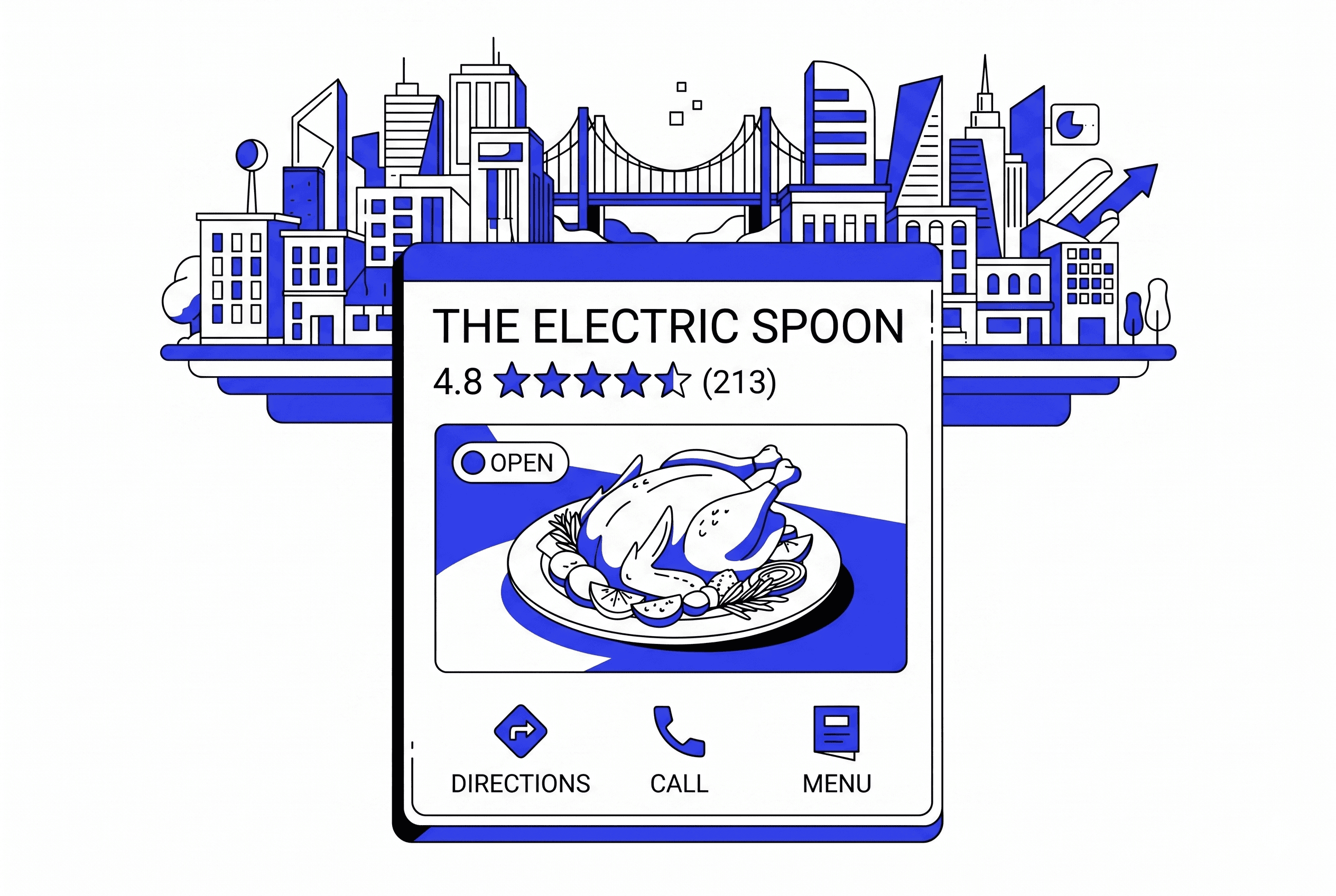
Google Business Profile is where most customers find restaurants. The search-decision pattern compresses into the first three results most of the time, so visibility on the profile drives revenue more directly than most other marketing channels.
Restaurants need restaurant-specific GBP optimization, not generic local SEO advice. Categories, food photos, menu links, reservation integrations, and the descriptions that work for restaurants are different from what works for other local businesses.
Multi-location brands need a standardization layer across every location's profile. Inconsistencies between locations are the most common source of suppressed search visibility.
This guide covers categories, descriptions, photos, posts, Q&A, attributes, and the multi-location workflow that keeps everything consistent.
Why Google Business Profile matters for restaurants
Most restaurant decisions happen on Google. A potential customer searches 'restaurants near me,' 'Italian restaurant Riyadh,' or a specific brand name, and Google returns a map view with three featured profiles, followed by additional results. The customer scans the top three, opens one or two, and decides within minutes. The profile that appears in those top three positions and reads as live, current, and credible wins the visit.
Most other marketing channels feed into this moment rather than substituting for it. Social media drives consideration, delivery platforms capture transaction, and reviews shape perception, but Google Business Profile is where the discovery decision usually happens. Investing in GBP optimization is investing in the channel that converts the most directly to revenue for many restaurants.
For multi-location brands, every location has its own profile. The brand-level profile (if one exists) matters less than the individual location profiles, because customers searching locally see the nearest location's profile, not the brand average. This means GBP optimization is not a brand-level project. It is a location-by-location operational practice.
Get the basics right first
Before anything sophisticated, the foundational fields need to be accurate, consistent, and complete. Brands that skip the basics and try to optimize for ranking signals usually find the basics are what was actually limiting visibility.
NAP: name, address, phone
Name should match how the business is registered and signed at the location. No keywords stuffed into the name (Google penalizes this). Address should match the physical location exactly, including unit numbers or floor numbers where they exist. Phone should be a working number that reaches the restaurant directly, not a corporate switchboard or a shared line.
For multi-location brands, NAP consistency across locations matters. Slight variations (St. vs Street, abbreviations of brand name, formatting differences) can produce duplicate listings or suppressed visibility. Standardize the format brand-wide and apply it to every location identically.
Hours of operation
Hours need to be accurate for every day, including special hours for holidays. Customers who arrive at a location that the profile said was open lose trust in the brand and leave reviews accordingly. Most multi-location brands have at least some locations with outdated hours; a quarterly audit catches this.
Categories
Category selection has direct ranking impact. Restaurants choosing the wrong categories appear less often in relevant searches. Choosing too many categories dilutes the signal.
The pattern that works is one specific primary category (Italian Restaurant, Lebanese Restaurant, Coffee Shop) plus 2-4 supporting categories (Restaurant, Family Restaurant, Takeout Restaurant). Avoid categories that do not match the actual operation; Google's algorithm increasingly catches mismatched categories and discounts them.
Restaurant type | Suggested primary category | Supporting categories |
|---|---|---|
Casual dining Lebanese restaurant | Lebanese Restaurant | Restaurant, Mediterranean Restaurant, Family Restaurant |
Specialty coffee shop | Coffee Shop | Cafe, Espresso Bar, Breakfast Restaurant |
Burger QSR | Hamburger Restaurant | Fast Food Restaurant, American Restaurant, Takeout Restaurant |
Fine dining seafood | Seafood Restaurant | Restaurant, Fine Dining Restaurant |
Saudi traditional restaurant | Saudi Arabian Restaurant | Restaurant, Middle Eastern Restaurant, Family Restaurant |
The description and how to write it
The business description on a Google Business Profile is up to 750 characters. Most restaurants either leave it blank or fill it with marketing language that does not match how customers search. The description that works for restaurants follows three principles.
Lead with what the restaurant actually serves. The first 100 characters appear most often in preview snippets, so the cuisine, signature dishes, and atmosphere should be there. Generic phrases like 'casual dining experience' or 'memorable culinary journey' waste this space.
Include specific items and concepts customers search for. If a customer might search 'best mansaf in Riyadh,' the description should mention mansaf if it is on the menu. Natural language, not keyword stuffing. The goal is for the description to match how customers describe what they are looking for.
Mention the operational facts that affect customer choice. Family-friendly, late-night service, outdoor seating, halal certification, valet parking, private dining rooms. These are filters customers actively use; including them in the description makes the listing match those filters more reliably.
Avoid putting the restaurant address or phone number in the description. Those fields exist separately. Repeating them in the description wastes characters.
Photos: what to upload and how often
Photos drive engagement on a Google Business Profile more than almost any other element. Restaurants with 100+ photos see significantly higher engagement than those with fewer than 20. The photos that work for restaurants follow specific patterns.
The photos that matter most
The cover photo and logo display first, so they need to be high quality and on-brand. Beyond those, four categories of photo drive engagement.
Food photos that show actual dishes the restaurant serves. Stock food photography reads as fake to customers and is usually penalized by Google's algorithm. Real photos of real dishes, even if not professionally shot, outperform stock images.
Interior photos that show the dining room as customers will experience it. Empty restaurants in photos read as unwelcoming; photos with some customers (with appropriate permissions) read as live and active.
Exterior photos that help customers find the location. Especially important for restaurants in malls, complex addresses, or shared buildings.
Team photos that show staff and chefs. These humanize the brand and produce engagement, especially for brands with strong service or chef-driven concepts.
Avoid menu photos as primary content. They are useful but not the lead, because Google's algorithm and customer attention both prefer prepared food and atmosphere over menu cards.
Frequency of photo updates
Profiles that add new photos regularly outperform those that go static. The minimum useful cadence is 2 to 4 new photos per location per month. For multi-location brands, this means standardizing the practice (which staff member uploads, when, what types) across every location.
Posts and how to use them
Google Business Profile Posts allow restaurants to publish short updates, offers, events, and announcements directly on the profile. Posts appear in the profile and sometimes in search results. They expire after 7 days for most types, so they require ongoing creation to maintain visibility.
The post types that work for restaurants are limited-time offers (specific items at promotional prices for a defined window), event posts (a chef's table dinner, a Ramadan iftar buffet, a holiday menu), product posts (new menu launches, seasonal items), and update posts (new hours, new locations, news about the restaurant).
Posts that work follow three rules. They are specific (a real offer, not a generic 'visit us soon'), they have a clear call to action (book now, order delivery, view menu), and they include a strong photo. Generic posts without these elements rarely produce meaningful engagement.
Q&A and how to manage it
The Q&A section on Google Business Profile lets customers ask questions publicly and receive answers from the business or other users. The feature is underused by most restaurants, which produces two problems. Customers ask questions that go unanswered for days, which reads as inattentive. And other users sometimes answer questions incorrectly, which spreads misinformation about the restaurant.
The minimum useful practice is monitoring Q&A daily and responding within 24 hours. Most restaurant Q&A questions are simple (do you take reservations, do you have parking, do you serve halal food, is the menu suitable for vegetarians) and can be answered briefly. The response also serves future customers who search the same questions.
A useful proactive practice is seeding common questions. Restaurants can post the questions customers actually ask (with permission from a customer who asked, or as the business directly) along with clear answers. This populates the Q&A with brand-controlled accurate information rather than waiting for ad-hoc questions and possibly incorrect crowd answers.
Attributes and how they affect search
Attributes are the structured tags Google Business Profile uses to filter restaurants in search. Family-friendly, dog-friendly, outdoor seating, valet parking, accepts reservations, serves halal food, vegetarian options, free Wi-Fi, and many others. Customers actively filter on attributes, especially in search results that allow refinement.
The right approach is to set every accurate attribute and leave inaccurate ones unset. Inflating attributes (claiming features the restaurant does not actually offer) produces customer disappointment and negative reviews. Most multi-location brands have at least some locations with incomplete or incorrect attributes; a quarterly audit catches this.
Attributes specific to restaurants in MENA and Saudi Arabia include halal certification, family seating sections, prayer facilities nearby, and dietary specifications that matter regionally. These attributes appear in localized search results and matter for customer choice.
Multi-location consistency: the standardization layer
For brands with more than 5 locations, the most important GBP work is not optimizing any single profile. It is standardizing every location to the same level of completeness and consistency. Inconsistencies are usually the largest source of suppressed visibility for multi-location brands.
The pattern that works is a brand-level standard for every GBP field, applied uniformly to every location.
Field | Brand standard |
|---|---|
Business name | Exact format defined at brand level, applied to every location identically |
Categories | Same primary category for every location, same supporting categories |
Description | Brand template with location-specific details inserted |
Photos | Brand-standard cover photo and logo, location-specific food and interior photos |
Hours | Audited monthly per location, holiday hours updated centrally |
Attributes | Brand baseline attributes for all locations, with location-specific additions |
Posts | Brand-level posts pushed to all locations, location-level posts created locally |
Without standardization, locations drift in inconsistent directions. Some get fully optimized; others stay neglected. The brand visibility in search reflects the worst-managed locations more than the best, because customers searching locally see specific locations, not averages.
Common mistakes that suppress visibility
Stuffing keywords into the business name
Adding keywords like 'Best Italian Restaurant Riyadh' to the name violates Google's guidelines. Google detects the pattern and demotes profiles that do this. Use the actual business name and let categories, descriptions, and content handle keyword relevance.
Selecting too many categories
Choosing 8 to 10 categories dilutes the signal. Google's algorithm prefers profiles with focused category selection (one primary plus 2-4 supporting) over profiles that try to appear in every possible search.
Letting the profile go static
Profiles that have not added a photo, post, or update in 6 months read as inactive. Activity signals (new content, recent reviews, recent photos) factor into ranking. Multi-location brands frequently have some locations with consistent activity and others that have been silent for months.
Using stock food photography
Stock food photos read as fake and Google's algorithm increasingly penalizes profiles that rely on them. Real photos of real food, even from a phone camera with reasonable lighting, perform better.
Ignoring duplicate listings
Duplicate listings split review equity, suppress visibility, and confuse customers. Most multi-location brands have at least some duplicates accumulated over time. The detailed walkthrough on deleting and merging Google Business Profiles covers the consolidation work.
How Sira's presence management module handles GBP
For multi-location brands managing GBP across many locations, the standardization work becomes ongoing operational overhead. Sira's presence management module monitors every location's profile against brand standards, flags inconsistencies as they emerge, and tracks the changes that affect visibility (new reviews, new questions, profile edits) automatically.
The useful capability for franchise brands is alerting when individual locations drift from brand standard. When a location manager updates hours incorrectly or a duplicate listing is created, Sira flags the variance the same week. Multi-location brands using the module can maintain consistent presence at scale without monthly manual audits across every profile.
Reservation and booking integrations
For full-service restaurants, GBP integrates with reservation platforms (OpenTable, Resy, and others depending on the market) to let customers book directly from search results without leaving Google. This integration produces meaningful incremental bookings because it removes the friction of opening a separate platform.
The setup requires connecting the reservation provider to the GBP profile. Once connected, the 'Reserve a Table' button appears on the profile and on search result cards. Customers click and complete the booking inline. The brand sees the booking flow into the reservation platform as if the customer had booked through it directly.
For brands not using a major reservation platform, GBP also supports direct booking links to a brand-controlled URL (the restaurant's own booking page or a phone number). The integrated experience with major platforms produces higher conversion than direct links in most cases, but for brands with strong direct booking flows, the link option is a viable alternative.
For QSR and fast-casual brands without reservations, the equivalent integration is online ordering. GBP supports direct ordering links to the brand's online ordering system or to delivery platforms. These also reduce friction and produce incremental orders. For brands operating in MENA, ordering integrations can route customers to delivery platforms (Talabat, HungerStation, Keeta, Mrsool, Jahez, Ninja, Instashop) directly from the profile.
Frequently asked questions
How long does it take for GBP changes to affect search ranking?
Most changes propagate within 1 to 2 weeks. Major changes (categories, address, name) can take 3 to 6 weeks for ranking impact to fully appear. Minor changes (descriptions, photos, attributes) typically show effect within days.
Should we run paid ads on Google Business Profile?
Local Services Ads and standard Google Ads both interact with GBP. The right answer depends on the brand's marketing budget and operational priorities. For most mid-market restaurant brands, optimizing the organic profile produces better ROI than paid amplification of an underoptimized profile. Once organic optimization is mature, paid layering can extend reach.
How do we handle GBP for delivery-only or virtual brands?
Delivery-only operations can have GBP profiles, but they need to be set up correctly: address marked as a service area rather than a physical retail location, hours reflecting delivery availability, categories that signal delivery-first operation. Misconfigured profiles for delivery operations produce ranking penalties that take time to recover from.
How often should we audit our GBP across locations?
Quarterly for brands under 20 locations. Monthly for brands with 20 to 100 locations. Continuous through tooling for brands above 100 locations. The audit covers NAP consistency, hours accuracy, attribute completeness, photo recency, and review response performance.
What is the relationship between GBP and Google Maps?
They are the same product with different surfaces. Google Business Profile is the management interface; Google Maps is one of the customer-facing surfaces where the profile data appears. Search and Maps both pull from the same profile, so optimization affects both.
Can a single business have multiple GBP profiles for different concepts?
Yes, when the concepts are genuinely separate operations (different brand, different staff, different hours) at the same address. A restaurant that operates a coffee bar and a dinner service from the same kitchen but with different brand identities can have separate profiles. The verification process for two profiles at the same address is more complex but possible.