Top Digital Payment Solutions for Restaurants in Riyadh (2026)
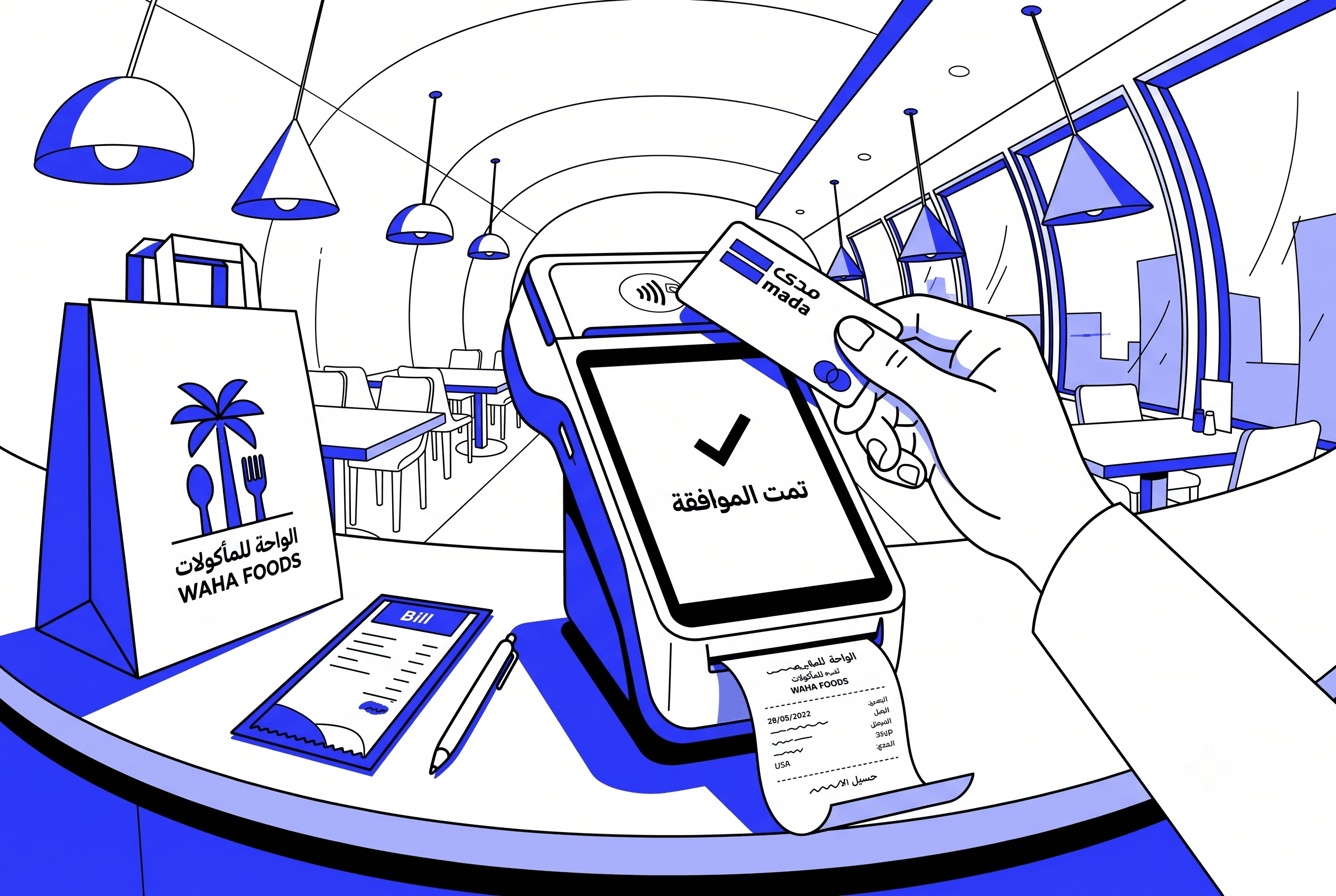
Saudi Arabia is rapidly moving toward a cashless economy. 94 percent of digital transactions in the kingdom are now contactless, and Vision 2030 is accelerating the shift. Restaurants that don't support the major digital payment methods lose meaningful share at the point of sale.
The non-negotiable payment methods for KSA restaurants in 2026 are mada (the national debit network), STC Pay, Apple Pay, Samsung Pay, and major credit cards. mada specifically accounts for the majority of card-based consumer transactions in the kingdom.
The leading payment gateways for restaurants are Moyasar, PayTabs, Tap Payments, HyperPay, and Geidea. Each has different strengths around pricing, settlement speed, integration depth, and SAMA licensing.
Buy-now-pay-later through Tabby and Tamara is increasingly expected for higher-ticket dining and group orders, particularly at fine dining and premium casual venues.
Restaurants on Foodics POS benefit from integrated payment processing as part of the platform's fintech licensing. Restaurants on other POS systems typically pair with one of the major payment gateways and need to evaluate fees, settlement speed, and reliability carefully.
Saudi Arabia is in the middle of one of the fastest payment transformations in the world. Vision 2030 has set explicit goals around moving the economy to digital payments, and the data shows the shift is well underway. Contactless transactions now make up roughly 94 percent of digital payments in the kingdom. mada, the national debit network, is ubiquitous. STC Pay, Apple Pay, and Samsung Pay are widely adopted. ZATCA e-invoicing has become a regulatory requirement for all merchants.
For restaurants, this matters operationally. Customers expect to pay with the methods they use everywhere else. Restaurants that only accept cash or only support some digital methods are creating friction at the point of sale and losing share to competitors that don't. The choice of payment infrastructure has moved from a backend administrative decision to a customer experience decision.
This post covers the digital payment landscape for restaurants in Riyadh and the wider KSA market in 2026, including the payment methods that matter, the leading gateways and their trade-offs, and what operators should evaluate before integrating.
The payment methods restaurants in KSA need to support
mada
mada is the Saudi national debit network and the most important payment method for KSA restaurants by a significant margin. Operated by SAMA (the Saudi Central Bank), mada is the default debit card issued by every Saudi bank and accounts for the majority of card-based consumer transactions in the kingdom. Any restaurant in KSA that doesn't accept mada is leaving a meaningful share of customers without their preferred payment method.
mada processing fees are lower than international credit card fees (typically 1.75 percent plus a small fixed fee) and settlement is fast. mada-compatible POS hardware and gateway integration is the table stakes for KSA restaurant operations.
STC Pay
STC Pay is the digital wallet from Saudi Telecom Company, with broad adoption across the kingdom and particularly among younger consumers. Acceptance is now standard for restaurants and increasingly expected. Integration is straightforward through the major payment gateways and POS platforms.
STC Pay also supports peer-to-peer transfers and bill payments, which contributes to its general adoption. For restaurants, the relevant feature is accepting STC Pay at the point of sale and through online ordering.
Apple Pay and Samsung Pay
Apple Pay launched in KSA in 2019 and has become ubiquitous, particularly among higher-income segments. Samsung Pay has slightly less penetration but is also widely supported. Both rely on the underlying mada or credit card rails, so integration is typically a function of supporting the rails rather than adding the wallet specifically.
Contactless terminals are required to support these wallets. Most modern POS hardware in the region supports contactless out of the box; older terminals may need upgrades.
Credit cards (Visa, Mastercard, American Express)
Credit cards remain important for higher-value transactions, business expense accounts, and international customers (tourists, business travelers). Acceptance of all three major networks is standard for serious restaurant operations.
Processing fees vary by gateway and card type, typically 2.2 to 2.9 percent plus a small fixed fee. Settlement timelines vary, with most gateways processing in T+1 to T+7 depending on the card type and gateway agreement.
Buy-now-pay-later (Tabby and Tamara)
BNPL has become an increasingly expected payment option in KSA, particularly for higher-ticket transactions and group orders. Tabby and Tamara are the two leading BNPL providers in the kingdom, both with full SAMA licensing.
For restaurants, BNPL matters most for fine dining venues, premium casual chains with high check averages, and delivery operations with significant order sizes. The integration is gateway-dependent and typically adds a small additional fee per transaction, with the trade-off of higher conversion at the point of sale.
Cash
Cash is declining but not yet irrelevant in KSA. Some customer segments still prefer it, particularly for smaller transactions and in some neighborhoods. Restaurants in most formats still need to accept cash, with disciplined cash handling procedures and ZATCA-compliant receipt generation.
The leading payment gateways for restaurants in KSA
Payment gateways are the infrastructure that connects your POS or online ordering system to the underlying payment networks. The choice of gateway affects pricing, settlement speed, integration depth, and operational reliability. The leading options in 2026:
Moyasar
Moyasar is a SAMA-licensed, Saudi-built payment gateway with a focus on simplicity and developer-friendly integration. Pricing is straightforward: flat 2.5 percent per transaction with no monthly fees or setup costs for the basic tier.
Strengths: simple pricing, fast onboarding, supports mada with T+1 settlement (the fastest available), Apple Pay, Samsung Pay, STC Pay, and major cards. Built specifically for the KSA market with deep local payment integration.
Limits: Saudi Arabia only. Operators with GCC-wide operations need a different solution. Less enterprise-tier customer support than international competitors.
Best fit: restaurants operating in KSA that want fast, predictable payment processing with strong local payment method support.
PayTabs
PayTabs is a Gulf-built payment gateway with SAMA licensing and broad GCC coverage. Supports mada, cross-border cards, e-wallets, instant transfers, and BNPL through a single contract.
Strengths: broader GCC coverage than Moyasar (operates across multiple Gulf markets), next-day settlement in SAR, integrated with the national payment scheme, supports multiple payment methods through a single integration.
Limits: fees can be slightly higher than the simplest local options. Less developer-focused than Moyasar.
Best fit: restaurants operating across KSA and the wider GCC region that want unified payment processing.
Tap Payments
Tap Payments is a SAMA-licensed payment provider with fast onboarding (live in days rather than months) and strong focus on growing brands. Acquired by Checkout.com in late 2022 but continues to operate as a regional brand.
Strengths: fast onboarding, strong developer tools, broad payment method support, full GCC coverage. Particularly used by newer brands and tech-forward operators.
Limits: pricing can be higher than the simpler local options (typically 2.9-3.94 percent plus fixed fees on credit cards). Settlement varies by payment method.
Best fit: growing restaurant brands that want fast onboarding and modern developer infrastructure.
HyperPay
HyperPay is a regional fintech serving enterprise and SME merchants across MENA, recognized for enterprise-grade infrastructure and AI-driven fraud monitoring.
Strengths: strong for enterprise-scale operations, omni-channel processing (in-store and online), fraud monitoring, detailed reporting. Covers KSA, UAE, Egypt, and Jordan.
Limits: doesn't cover Kuwait, Bahrain, Oman, or Qatar; brands with full GCC needs should consider PayTabs or Tap. Onboarding slower than Moyasar or smaller players. Monthly fees and setup fees apply.
Best fit: larger multi-location restaurant brands needing enterprise-grade processing across multiple MENA countries.
Geidea
Geidea is a Saudi-based fintech offering combined POS, payment processing, and merchant services. Particularly common for smaller F&B operations and merchants needing integrated payment and POS.
Strengths: Saudi-based with strong local support, ZATCA compliance, deep mada integration, integrated hardware and software stack.
Limits: primarily POS plus payment processing rather than a standalone gateway. Less suited for restaurants that want to keep payment processing separate from POS.
Best fit: smaller F&B operations wanting an integrated POS-plus-payment solution with strong local support.
Other options worth knowing
Amazon Payment Services (formerly PayFort) is backed by Amazon and combines global reach with local acquiring, with installment plans through 15+ Saudi banks.
Checkout.com is an established enterprise-grade gateway with strong technical capabilities, used by larger brands with complex needs.
Al Rajhi Bank Payment Gateway is a direct bank-owned gateway with no setup or monthly fees, but only supports Al Rajhi and Arab Bank accounts.
Foodics Pay is the integrated payment processing built into Foodics POS, leveraging the company's SAMA fintech license. The most natural option for restaurants already using Foodics POS.
Integrated POS payments versus standalone gateways
Restaurants in KSA face a meaningful architectural choice: use an integrated POS-plus-payment solution (Foodics, Geidea) or run a separate gateway alongside the POS (Moyasar, PayTabs, Tap, HyperPay).
Integrated stacks are simpler operationally. One vendor, one contract, one settlement flow, one support relationship. Foodics specifically has become a serious payment processor in its own right since obtaining its SAMA fintech license, and for many operators on Foodics POS, using Foodics Pay is the path of least resistance.
Standalone gateway stacks offer more flexibility around pricing, settlement, and feature depth. Operators on POS systems that don't have integrated payments (or whose integrated payment terms aren't competitive) typically use one of the major gateways. The trade-off is slightly more operational complexity in exchange for cost savings or feature advantages.
The right choice depends on operator priorities. Operations-first brands tend to prefer integrated stacks for simplicity. Cost-sensitive brands and brands with specific payment requirements tend to prefer standalone gateways.
What to evaluate before choosing a payment solution
Total cost of payment processing
The headline rate is rarely the full picture. Calculate the total annual cost based on your expected transaction mix (mada vs credit cards, in-store vs online, BNPL share). Smaller gateways often offer better mada rates; larger gateways often offer better international card rates. Get a fee schedule that reflects your actual volume.
Settlement speed
Settlement timelines vary by gateway and payment method. Moyasar settles mada at T+1 (the fastest available in KSA), while credit card settlement is typically T+7 to T+14 across most gateways. Faster settlement helps cash flow, particularly for newer brands and operations with thin margins.
SAMA licensing
Any payment provider operating in KSA should be SAMA-licensed. All the major gateways listed above are. Unlicensed providers are not viable for compliant operations and should be avoided.
Integration depth with your POS
Native integration between your gateway and POS is essential. Manual reconciliation between two systems creates errors and consumes hours that should be spent on the floor. The strongest gateways have direct integrations with Foodics, Oracle MICROS, and the other major regional POS platforms.
Fraud monitoring and chargeback handling
Online ordering and delivery channels create chargeback exposure that in-restaurant operations don't have. Gateways with strong fraud monitoring (HyperPay specifically) and clear chargeback handling reduce operational headaches and recover revenue that would otherwise be lost.
Reporting and reconciliation
Daily settlement reports that reconcile cleanly with your POS sales reports save accounting time and reduce errors. Gateways with strong reporting interfaces and exportable data formats (CSV, accounting software integrations) work better for multi-location operations than those with weaker back-office tools.
The takeaway
Digital payment infrastructure has become a customer experience decision in KSA, not just a backend administrative one. Restaurants that don't support mada, STC Pay, Apple Pay, and major cards are leaving share at the point of sale that competitors capture by default.
The leading payment gateways for restaurants in Riyadh and KSA in 2026 are Moyasar (simplest local), PayTabs (broad GCC coverage), Tap Payments (fast onboarding), HyperPay (enterprise-grade), and Geidea (integrated POS-plus-payment). Foodics Pay is the natural choice for restaurants already on Foodics POS, with the simplicity of a fully integrated stack.
The right choice depends on operator priorities around cost, settlement speed, GCC coverage, and the depth of integration with your existing POS. The non-negotiables for any choice are SAMA licensing, mada support, ZATCA compliance, and reliable daily reconciliation with your operational systems.
Frequently asked questions
What payment methods do restaurants in KSA need to accept?
The non-negotiables in 2026 are mada (the national debit network), STC Pay, Apple Pay, Samsung Pay, and major credit cards (Visa, Mastercard, American Express). Buy-now-pay-later options (Tabby and Tamara) are increasingly expected for higher-ticket dining. Cash is still relevant for some customer segments but declining. Restaurants that don't support the major digital payment methods are losing share at the point of sale to competitors that do.
Which payment gateway is best for restaurants in Riyadh?
There isn't a single best. Moyasar is the simplest and fastest for KSA-focused operations with the fastest mada settlement. PayTabs has the broadest GCC coverage for multi-country operators. Tap Payments has the fastest onboarding for newer brands. HyperPay is the strongest for enterprise-scale operations with fraud monitoring needs. Geidea is the most integrated POS-plus-payment option for smaller operations. Foodics Pay is the natural choice for restaurants already on Foodics POS. The right choice depends on operator scale, geography, and POS stack.
How much does payment processing cost for restaurants in KSA?
Mada processing typically runs 1.75 percent plus a small fixed fee. Credit card processing varies from 2.2 percent to 3.5 percent plus fixed fees depending on the gateway and card type. STC Pay and Apple Pay run on the underlying mada or card rails so use the rail fees. BNPL adds a small additional fee per transaction (typically 2-3 percent) in exchange for the conversion lift. Total payment processing for a typical KSA restaurant runs 2-3 percent of revenue on average across the payment mix.
What is mada and why is it important for restaurants?
mada is the Saudi national debit network operated by SAMA (the Saudi Central Bank). It's the default debit card issued by every Saudi bank and accounts for the majority of card-based consumer transactions in the kingdom. Any restaurant in KSA that doesn't accept mada is leaving a meaningful share of customers without their preferred payment method. mada has lower processing fees than international credit cards and faster settlement, which makes it the most cost-efficient digital payment method for KSA operations.
An integrated POS-plus-payment system or a separate gateway?
It depends on operator priorities. Integrated systems (Foodics Pay, Geidea) are simpler operationally: one vendor, one contract, one settlement flow, one support relationship. Separate gateway stacks (Moyasar, PayTabs, Tap, HyperPay) offer more flexibility around pricing and features. Operations-first brands often prefer integrated stacks. Cost-sensitive or feature-specific brands often prefer separate gateways. For most multi-location operators on Foodics POS, the integrated path is the default unless there's a specific reason to use a separate gateway.
Are Tabby and Tamara worth integrating for restaurants?
For higher-ticket dining and delivery operations with larger order sizes, yes. Tabby and Tamara typically lift conversion at the point of sale for orders above SAR 200-300, particularly at fine dining and premium casual venues. For QSR or low-ticket operations, the conversion lift is smaller and the integration may not pay for the added complexity. Both providers are SAMA-licensed, which makes integration straightforward through any of the major payment gateways.