How to Manage Restaurant Operations: What Changes When You Go from 5 Locations to 50
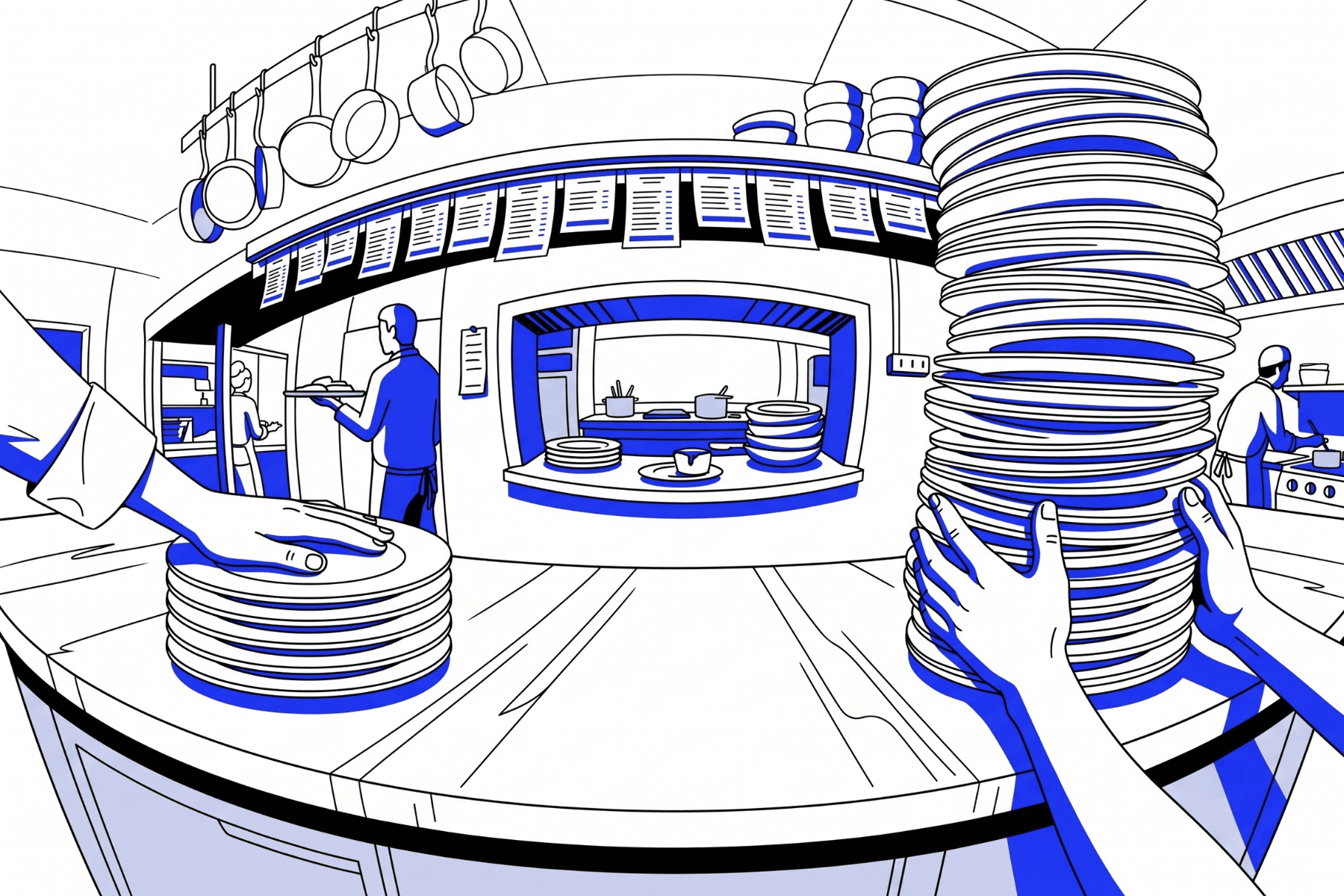
Restaurant operations at multi-location scale is a systems problem, not a people problem. The operator who runs five locations on instinct and daily walkthroughs cannot run fifty the same way.
Seven core functions define restaurant operations: kitchen and food production, service delivery, supply chain and inventory, workforce management, financial controls, technology and data, and customer experience. Each requires its own process, owner, and measurement cadence.
The transition from small to large is where most operators struggle. The shift is from managing tasks to managing systems, from knowing every problem personally to building infrastructure that surfaces problems automatically.
For KSA and MENA operators, three regional factors shape operations uniquely: labor market structure (high reliance on expatriate staff with Saudization requirements), delivery platform economics (Keeta, HungerStation, Jahez, Mrsool as significant revenue channels), and Arabic-language customer feedback that most global tools handle poorly.
The practical starting point is an operations audit: map every function, identify who owns it, measure whether data flows between functions or stays siloed, and find the gaps where customer signals never reach the people who can act on them.
Restaurant operations is a phrase that covers everything from kitchen prep schedules to how you handle a complaint on Google. In a single-location restaurant, the operator holds most of it in their head. They walk the floor, taste the food, talk to customers, manage the staff, and make adjustments in real time. The system is the person.
That model breaks at scale. Somewhere between five and fifteen locations, the operator can no longer be in every kitchen, at every shift meeting, reading every customer review. The question stops being "how do I run my restaurant?" and becomes "how do I build a system that runs my restaurants the way I would if I could be everywhere at once?"
This article is for operators navigating that transition: CEOs, COOs, and VPs of Operations at multi-location F&B brands in KSA, Egypt, and the wider region. We will cover what restaurant operations actually consists of at scale, the seven core functions that define it, where most operators lose control during growth, and a practical framework for getting it back.
What restaurant operations actually means at scale
Restaurant operations is the sum of every repeatable process that produces, delivers, and supports your product. It includes everything from how food moves from suppliers to plates, to how complaints move from customers to the people who can fix the underlying problem.
At a single location, operations is mostly execution: doing things right, today, in this kitchen, for these customers. At multi-location scale, operations becomes orchestration: ensuring that dozens of teams in dozens of locations execute consistently against the same standards, and that deviations from those standards are detected and corrected before they compound.
The distinction matters because most operators who grew from a single location instinctively approach multi-location operations as "more of the same." Hire good people, train them well, visit often. That approach produces diminishing returns after about ten locations, because the operator becomes the bottleneck. Every decision, every escalation, every quality check routes through the same person or small team, and the system slows to the speed of that bottleneck.
The operators who scale well make a different shift. They stop trying to be in the system and start building the system. The seven functions below are what that system consists of.
The seven core functions of restaurant operations
Every multi-location restaurant operation, regardless of format or cuisine, runs on seven interdependent functions. Some operators organize them differently, combine two or three under one leader, or call them by different names. The functions themselves are constant.
1. Kitchen and food production
Everything that happens between receiving ingredients and sending food to the customer. Recipe standardization, prep schedules, cooking procedures, plating standards, food safety, kitchen equipment maintenance, and quality control. At scale, the challenge is consistency: the same dish should taste the same in every branch, every shift, every day. This requires documented recipes with exact weights and procedures, regular quality audits, and a central kitchen or commissary model for brands that produce components centrally.
2. Service delivery
The front-of-house experience for dine-in customers and the fulfillment process for delivery and takeaway. Seating flow, order accuracy, service speed, table turnover, complaint handling at the point of service, and the handoff to delivery platforms. At scale, the challenge is variance: the difference between your best branch's service and your worst branch's service is the gap your customers notice most.
3. Supply chain and inventory
Procurement, supplier management, receiving, storage, stock rotation, waste tracking, and the variance analysis between theoretical food cost and actual food cost. At scale, the challenge is visibility: knowing which branch is over-ordering, which is under-stocked, and where the gap between what you bought and what you sold is hiding margin. Saudi Arabia wastes roughly 33% of food at the national level (approximately SAR 40 billion annually), and restaurants contribute meaningfully to that figure. Inventory discipline is one of the highest-leverage operational improvements available.
4. Workforce management
Hiring, onboarding, scheduling, training, performance management, retention, and labor compliance. For KSA operators, this function carries additional complexity: Saudization requirements (Nitaqat) mandate specific ratios of Saudi nationals, labor regulations differ for expatriate staff, and turnover in F&B is structurally high across the region. At scale, the challenge is standardization without rigidity: every branch needs the same training program and performance standards, but scheduling and staffing levels need to flex for local demand patterns.
5. Financial controls
Revenue tracking, cost management, P&L by branch, cash handling, payment reconciliation, ZATCA compliance (including Phase 2 e-invoicing integration), and financial reporting. At scale, the challenge is speed: operators who see branch-level P&L monthly are making decisions on stale data. The operators who see it weekly (or closer to real-time) catch problems before they compound across a full quarter.
6. Technology and data
POS systems, kitchen display systems, delivery platform integrations, payment processing, inventory software, scheduling tools, customer feedback platforms, and the data infrastructure that connects them. At scale, the challenge is integration: most multi-location brands run five to ten distinct software systems, and data flows between them are often manual, delayed, or nonexistent. The result is that operational decisions get made in silos, without the full picture.
7. Customer experience
Feedback collection, sentiment analysis, complaint response, root cause detection, recovery programs, reputation management, and the operational loop that translates customer signals into changes in the other six functions. At scale, the challenge is volume and language: a 50-location brand generates tens of thousands of customer data points annually, most of them in Arabic (often in dialect), and no human team can read them all. This is where AI customer intelligence platforms like Sira sit in the stack, automating the classification and root cause analysis that makes the other six functions responsive to what customers are actually saying.
Where operators lose control during growth
The pattern is remarkably consistent across brands and markets. Operators lose control in the same places, for the same structural reasons.
The founder bottleneck. The operator who built the brand is still the decision-maker for everything. Quality, hiring, complaints, vendor negotiations, menu changes. This works beautifully at three locations and becomes a chokepoint at fifteen. The fix is delegation with measurement: define standards, assign owners, and build the reporting infrastructure that lets the founder verify without being in the loop on every decision.
The data gap between branches. Each branch operates as a semi-independent unit, with its own manager, its own version of the standards, and its own relationship with corporate. Data flows upward in monthly reports (if at all), and cross-branch comparison happens in quarterly reviews. By the time a pattern is visible, it has been compounding for months. The fix is a shared operational dashboard, updated at least weekly, that makes branch-level variance visible to everyone who needs to see it.
The feedback black hole. Customer feedback arrives on five or six platforms (Google, HungerStation, Jahez, Mrsool, Keeta, Instagram, internal surveys), in different formats, in different languages, and nobody owns the full picture. Marketing reads some of it. Operations reads some of it. Branch managers read their own reviews. No one synthesizes it into a single view that connects what customers are saying to what the operation should change. The fix is a unified feedback infrastructure, with classification, routing, and measurement built in.
The training decay. The initial training program is strong. Six months later, the standards have drifted. New hires learn from the team around them (who have already drifted), not from the original standard. The drift is invisible until it shows up in customer complaints or quality audits. The fix is continuous reinforcement: regular re-training, mystery shopper programs, and branch-level performance data that makes drift visible before it becomes a customer problem.
The technology patchwork. The brand adopted tools opportunistically as it grew: one POS here, a different inventory system there, a delivery aggregator that does not talk to either. The result is manual reconciliation, duplicated data entry, and operational blind spots. The fix is a technology audit followed by a consolidation plan that prioritizes integration over features.
Regional factors that shape operations in KSA and MENA
Three factors make restaurant operations in the region structurally different from the models described in most global operations literature.
Labor market structure. F&B in KSA relies heavily on expatriate labor, with Saudization (Nitaqat) requirements that mandate minimum ratios of Saudi nationals. Compliance is a genuine operational function, not a checkbox. Operators who treat it as an afterthought face penalties and disruption. The more practical challenge is that turnover among expatriate staff is high, onboarding cycles are long (visa processing, housing, training), and labor costs are rising. Workforce management at scale in KSA requires more infrastructure than in markets with more fluid labor pools.
Delivery platform economics. In KSA, delivery through Keeta, HungerStation, Jahez, and Mrsool is not a supplementary channel; for many brands it is 30 to 60% of revenue. This means delivery operations (packaging, kitchen-to-handoff speed, order accuracy, platform-specific menu management) are core operations, not a side function. The customer experience on delivery is shaped partly by the restaurant and partly by the platform, which creates a shared-accountability challenge that most global operations frameworks do not address.
Arabic-language customer feedback. Most customer feedback in the region is in Arabic, often in local dialect. Global operations tools and sentiment analysis engines are built for English and handle Arabic as an afterthought. The result is that operators who rely on global tools for customer intelligence get inaccurate classification, missed nuance, and sentiment dashboards that diverge from reality. Arabic-native NLP, trained on F&B language and regional dialects, produces materially better signal, which is why it matters for the customer experience function specifically.
A practical framework for getting operations under control
If you are a multi-location operator looking at your operations and feeling the gaps, the approach is sequential, not simultaneous. Trying to fix everything at once produces chaos. The order that works for most brands:
Phase 1: Audit (weeks 1 to 4). Map every one of the seven functions. For each, identify: who owns it, what tools support it, how data flows in and out, and where the biggest gap between standard and reality exists. The audit is not about finding solutions; it is about seeing the full picture for the first time.
Phase 2: Standards (weeks 5 to 12). For the two or three functions with the largest gaps, document the standard. Not a 200-page manual; a clear, short description of what "right" looks like, who is responsible, and how compliance is measured. Start with kitchen and food production (because it affects every customer) and customer experience (because it affects retention).
Phase 3: Measurement (weeks 13 to 24). Build the reporting infrastructure that makes compliance visible. Branch-level dashboards for kitchen quality, service speed, inventory variance, complaint response time, and customer sentiment. The data does not need to be perfect; it needs to be directional and timely. Weekly is better than monthly. Daily is better than weekly.
Phase 4: Integration (ongoing). Connect the technology that supports each function. POS feeding inventory and financial controls. Customer feedback feeding operations meetings. Delivery platform data feeding kitchen scheduling. The goal is not one platform for everything; it is clean data flow between the platforms you have, so that decisions in one function reflect reality in the others.
Most brands that follow this sequence see meaningful operational improvement within two quarters. The improvement is not from working harder; it is from seeing clearly what was previously invisible.
Conclusion
Restaurant operations at scale is not a bigger version of restaurant operations at a single location. It is a different discipline: building and maintaining systems that produce consistent outcomes across dozens of teams, locations, and channels, in a market with specific labor, delivery, and language dynamics that global playbooks do not fully address.
The seven functions (kitchen, service, supply chain, workforce, finance, technology, customer experience) are the skeleton. The measurement infrastructure that connects them is the nervous system. And the customer feedback loop that translates what customers say into what the operation changes is what makes the whole thing adaptive rather than static.
Operators in KSA and the region who are building that infrastructure now are the ones whose quality will hold as they scale. Operators who are still running on instinct and founder presence will hit the same ceiling that every fast-growing brand hits, usually somewhere between ten and twenty locations, where the complexity outgrows the person.
Frequently asked questions
What are the main functions of restaurant operations?
The seven core functions are kitchen and food production, service delivery, supply chain and inventory, workforce management, financial controls, technology and data, and customer experience. Each requires its own process, owner, and measurement cadence. At multi-location scale, these functions are interdependent: a problem in one (like inconsistent food production) surfaces in another (like negative customer feedback), and the operator who manages them in silos misses the connection.
How is managing restaurant operations different at 5 locations versus 50?
At five locations, the operator can be personally present, make real-time decisions, and hold standards through direct oversight. At fifty, that is physically impossible. The shift is from managing tasks to managing systems: documented standards, assigned owners, automated measurement, and reporting infrastructure that surfaces problems without requiring the operator to discover them personally. Most operators struggle in the transition between ten and twenty locations, where the old approach stops working but the new infrastructure is not yet built.
What are the biggest operational challenges for restaurants in Saudi Arabia?
Three structural challenges distinguish KSA operations. First, labor market dynamics: high reliance on expatriate staff with Saudization (Nitaqat) compliance requirements, long onboarding cycles, and rising labor costs. Second, delivery platform economics: Keeta, HungerStation, Jahez, and Mrsool can represent 30 to 60% of revenue, making delivery operations a core function rather than a side channel. Third, Arabic-language customer feedback: most customer signals are in Arabic with dialect variations, and global tools handle this poorly, creating a gap in customer intelligence that affects operational decision-making.
How do you build a restaurant operations manual for multiple locations?
Start with the two or three functions that have the largest gap between your standard and current reality, usually kitchen and food production plus customer experience. Document what right looks like in clear, short terms: specific procedures, responsible owners, and measurable compliance indicators. Avoid building a 200-page manual nobody reads. Instead, create living documents that branch managers reference daily, linked to the performance data that shows whether standards are being met. The manual grows as you add functions; trying to document everything at once produces a document that is comprehensive and unused.
What technology do multi-location restaurants need for operations management?
At minimum: a POS system with multi-branch reporting (Foodics is the default in KSA), inventory management software with variance analysis, a delivery platform aggregator or direct integrations with Keeta, HungerStation, Jahez, and Mrsool, workforce scheduling software, and a customer feedback or customer intelligence platform that aggregates signals across all channels. The critical factor is integration: these tools need to share data so that operational decisions reflect the full picture. A stack of disconnected tools, each excellent in isolation, produces operational blind spots that connected but simpler tools would not.
How do you measure restaurant operations performance across branches?
Five metrics cover most of what matters for cross-branch comparison: food cost variance (actual versus theoretical, by branch), complaint response time (by branch and platform), customer sentiment score (by branch, tracked monthly), service speed (order to delivery or order to table, by branch), and staff turnover rate (by branch, quarterly). The key is not the metrics themselves but the cross-branch comparison: the gap between your best and worst branch on any metric is where the operational improvement opportunity lives. A single-number average hides the variance that matters most.