The 30/30/30 Rule for Restaurants: What It Means and Whether It Still Holds Up
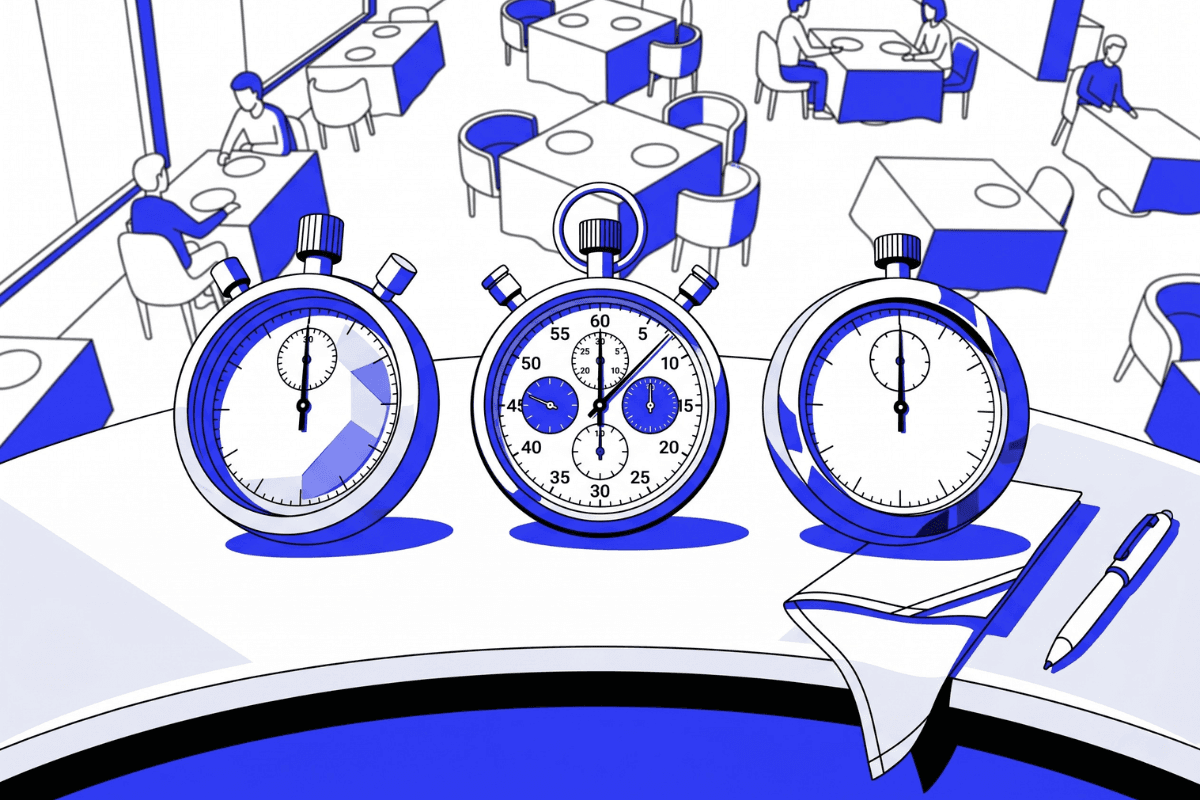
The 30/30/30 rule for restaurants says staff should greet a customer within 30 seconds, deliver food within 30 minutes, and thank them as they leave (within 30 seconds). It's a simple service standard from an older era of restaurant operations.
The rule still holds at the framing level: speed of greeting, speed of delivery, and quality of farewell remain meaningful predictors of customer experience. The specific timings are debatable, especially for delivery and QSR.
The 5 C's of customer service (Care, Communication, Competence, Confidence, Connection) describe the qualities staff should bring to every interaction. They translate the 30/30/30 rule from time targets into observable behaviors.
The 7 qualities of good customer service (Professionalism, Patience, Empathy, Effective Communication, Product Knowledge, Problem-Solving, Adaptability) are the training-friendly version of the 5 C's.
For multi-location operators in 2026, the more useful framework is one that includes feedback capture and recovery, not just front-of-house service speed. The 30/30/30 rule was designed for a single restaurant, not a 50-location brand.
What the 30/30/30 rule for restaurants actually says
There are several versions of the 30/30/30 rule in circulation. The most common, and the one we'll use here, is:
30 seconds: A customer should be greeted within 30 seconds of arriving.
30 minutes: Food should be delivered to the table within 30 minutes of ordering.
30 seconds: A customer should be acknowledged or thanked within 30 seconds of leaving.
A second version, used in some service-design contexts, frames the same idea differently:
30 seconds for the first impression.
30 minutes for the dining experience.
30 days to convert the customer into a regular.
A third version focuses on payment: 30 seconds to bring the bill after a request, 30 seconds to process the payment, 30 seconds to thank the customer at the door.
The first version is the one most relevant to operations, so we'll spend most of the post there.
Why the 30/30/30 rule still gets cited
The rule survives because the underlying instinct is correct. Speed of greeting matters. Speed of food delivery matters. Quality of farewell matters. Customers form their first impression in seconds and their last impression in seconds, and what happens between those moments is shaped by whether the food took 18 minutes or 48.
The data supports this. A customer who waits more than two minutes before being acknowledged is significantly more likely to leave a negative review. A meal that takes more than 35 minutes to arrive at a casual dining table sees CSAT scores drop sharply. A customer who isn't thanked or acknowledged on the way out is materially less likely to return, regardless of how good the meal was.
So the 30/30/30 rule isn't wrong. It's a simplified version of a real pattern.
Where the rule breaks
The problem is that the rule was designed for a single, casual-dining restaurant in a relatively quiet market. The numbers don't translate cleanly across formats, channels, or volumes.
For QSR (quick service restaurants), 30 minutes is too long. Customers expect food in 5 to 10 minutes. The 30-minute target would tolerate operational failure that customers would punish heavily.
For fine dining, 30 minutes is sometimes too short. Customers expect a longer, paced experience, and a meal arriving at minute 22 can feel rushed.
For delivery, the entire framework collapses. The greeting is a notification on the customer's phone. The delivery time depends on the rider, the platform, and the distance, not just the kitchen. The farewell is whatever the rider says at the door, which the restaurant doesn't control.
For brands operating across multiple formats and multiple branches, a single 30/30/30 standard isn't sufficient. The rule needs to be reinterpreted as a set of format-specific service standards, which is most of what brand operating manuals try to do.
The 5 C's of customer service
The 5 C's of customer service translate the 30/30/30 rule from time targets into qualitative behaviors. They're more useful for training because they describe what good looks like, not just how fast it should happen.
Care. Staff treating each customer as someone whose experience matters, not as the next item in a queue. Eye contact, listening, attention to detail.
Communication. Clear, accurate, and timely information. Confirming orders, explaining wait times, alerting customers to issues before they have to ask.
Competence. The ability to do the job correctly. Knowing the menu, handling payment, executing on the kitchen-to-table flow without errors.
Confidence. Staff who project authority over their work. Customers feel calmer when their server or cashier seems to know what they're doing, even when something is going wrong.
Connection. Some genuine human warmth in the interaction. A small joke. Remembering a regular's order. The micro-moments that turn transactions into relationships.
The 5 C's are most useful as a training framework because each of them maps to observable staff behavior. You can score a server on each of the five during a coaching session in a way you can't score them on "good service."
The 7 qualities of good customer service
The 7 qualities of good customer service are an extension of the 5 C's, often used in more formal training programs. They overlap heavily with the 5 C's but break the categories down further.
Professionalism. Appearance, language, and conduct that meet brand standards regardless of how busy the shift is or how difficult the customer is being.
Patience. The capacity to handle slow customers, indecisive customers, frustrated customers, and demanding customers without visible irritation.
Empathy. Understanding what the customer actually needs in the moment, including the emotional component of their experience.
Effective communication. Speaking and listening clearly, in a way the customer can understand and respond to. This includes language fluency in the customer's preferred language.
Product knowledge. Knowing the menu, the ingredients, the allergens, the brand story, the specials, and the policies well enough to answer customer questions confidently.
Problem-solving. The ability to recognize when something has gone wrong and take action to recover, often without escalating to a manager.
Adaptability. The capacity to handle non-standard situations, special requests, and operational disruptions without breaking the experience.
The 7 qualities map well to the 5 elements of customer service we covered in another post (respect, attentiveness, helpfulness, knowledge, problem-solving). The differences are mostly in granularity, with the 7 qualities breaking down what the 5 elements compress.
A more useful framework for 2026
The 30/30/30 rule, the 5 C's, and the 7 qualities are all useful as training scaffolding. None of them is sufficient as an operating framework for a multi-location brand managing customer experience across multiple formats, multiple channels, and multiple languages.
The shift that operators in the region are making is from "what should staff do?" frameworks toward "what should the system do?" frameworks. The 30/30/30 rule tells your staff to greet a customer in 30 seconds. It doesn't tell you what to do when 12 percent of customers across 30 branches mention slow greetings in their Google reviews. The first is a service standard. The second is a customer intelligence problem.
The frameworks we use at Sira around the customer journey (Exploring, Ordering, Delivery, Internal Feedback, External Feedback) are designed to answer the second kind of question. They tell you where to look in the data, who owns the issue, and what operational change would address the root cause. They don't replace service standards like 30/30/30 in the staff training program; they sit on top of them at the brand level.
If you're running 10+ locations, you need both. The service-standard frameworks (30/30/30, 5 C's, 7 qualities) for training. The customer-journey framework for operations. The brands that mistake one for the other tend to either over-train without measurement, or measure without changing how staff actually behave.
The takeaway
The 30/30/30 rule for restaurants is a useful relic. The instinct behind it (greet fast, deliver fast, farewell well) still matters. The specific timings need to be reinterpreted for your format, your channel mix, and your customer expectations.
The 5 C's and the 7 qualities of good customer service are training frameworks, not measurement frameworks. They translate the rule into behaviors staff can be coached on.
For multi-location operators, none of these frameworks alone is enough. They tell you what good service looks like at the staff level. They don't tell you whether your customer experience function is producing returning customers, where your branches are diverging from brand standards, or which complaints are signaling deeper operational issues. That's a different problem, and it requires a different toolkit.
The right move for most operators is to keep the old rules in the training program (because they still help new staff) and layer the customer-journey view on top at the brand level (because that's where the operational decisions actually happen).
Frequently asked questions
What is the 30/30/30 rule for restaurants?
The 30/30/30 rule says staff should greet a customer within 30 seconds of arrival, deliver food within 30 minutes of ordering, and thank or acknowledge the customer within 30 seconds of leaving. It's a simple service standard used to train front-of-house teams in casual dining. Other versions of the rule frame it as 30 seconds for first impression, 30 minutes for the dining experience, and 30 days to convert a customer into a regular.
Does the 30/30/30 rule still apply in 2026?
Partially. The instinct (fast greeting, reasonable food delivery time, warm farewell) is still correct and still predictive of customer experience. The specific timings don't translate well across all formats: 30 minutes is too long for QSR, sometimes too short for fine dining, and doesn't apply at all to delivery. The rule is most useful today as a baseline for casual dining staff training, not as a brand-level operating standard.
What are the 5 C's of customer service?
The 5 C's of customer service are Care, Communication, Competence, Confidence, and Connection. They describe the qualities staff should bring to every customer interaction. The framework is most useful for staff training and coaching because each C translates into observable behaviors that can be scored.
What are the 7 qualities of good customer service?
The 7 qualities are Professionalism, Patience, Empathy, Effective Communication, Product Knowledge, Problem-Solving, and Adaptability. They overlap with the 5 C's but break the categories down further, which makes them useful for more formal training programs. They describe the qualities of the staff member, not the qualities of the experience as a whole.
How is the 30/30/30 rule different from the 5 C's?
The 30/30/30 rule sets time targets for specific service moments. The 5 C's describe the qualitative behaviors that should fill those moments. You can hit the 30/30/30 timings while delivering bad service if your staff aren't bringing care, competence, or connection to each interaction. The two frameworks work better together than either does alone.
What's the right service-standard framework for multi-location restaurants?
For staff training, keep the time-based frameworks (30/30/30 or your own brand variant) and layer the 5 C's or 7 qualities on top to define what good behavior looks like during each service moment. For operations, use a customer-journey framework (Exploring, Ordering, Delivery, Internal Feedback, External Feedback) that tells you where in the experience to look when feedback patterns appear and which operational owner should act on them. The two layers serve different purposes and shouldn't be conflated.