Customer Service vs Customer Experience in Restaurants: Why Operators Keep Confusing the Two
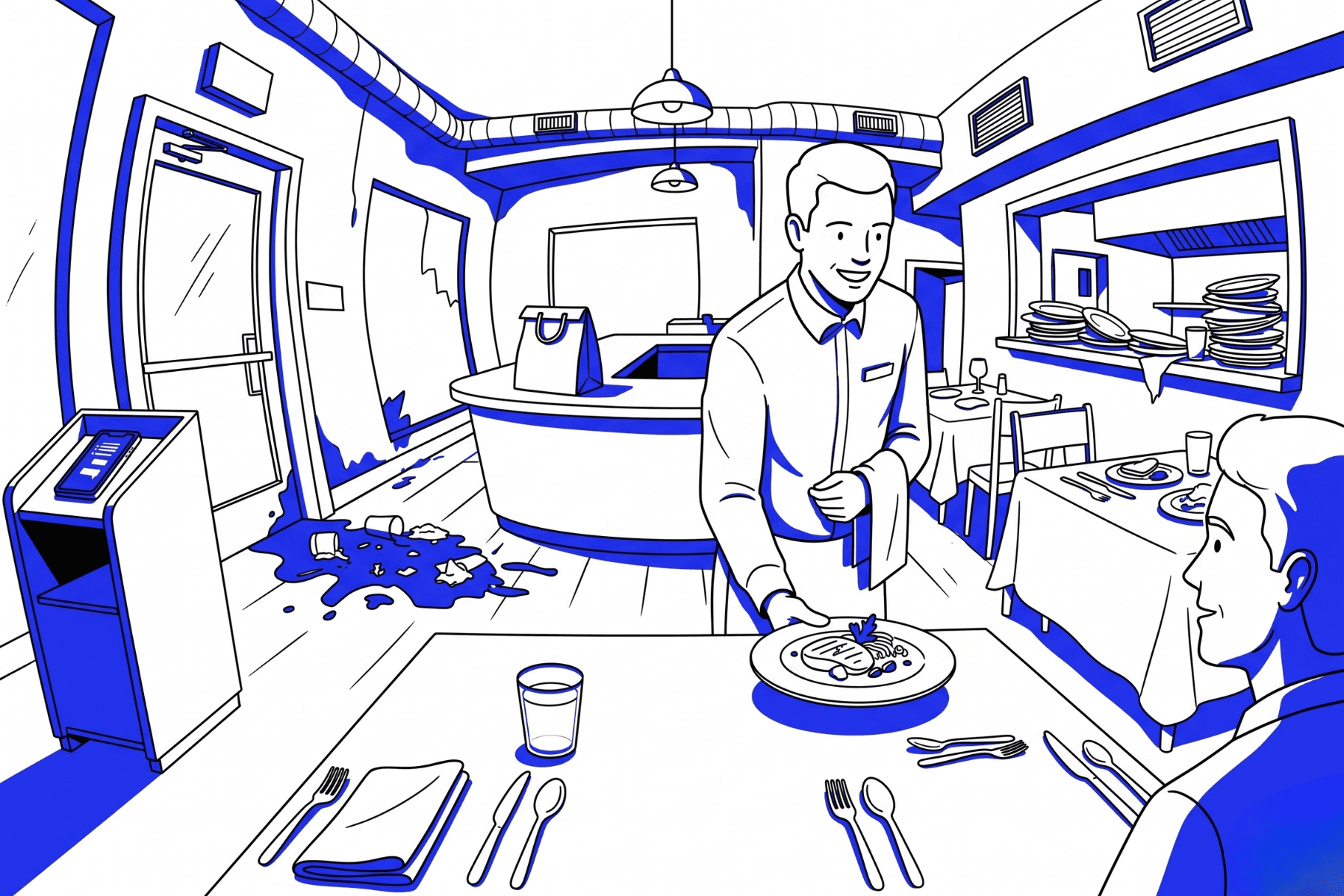
Customer service is what your team does in a single moment. Customer experience is the pattern across thousands of those moments, shaped by everything around them: food, ambience, exploration, complaint handling, and the post-visit relationship.
Operators confuse them because the two overlap in the moments staff actually serve customers. But customer service is one component of customer experience, not a synonym for it.
The distinction matters financially. Most retention problems at multi-location brands aren't service problems (which can be fixed with training) but experience problems (which require a system).
Branches that score well on service can still produce poor customer experience if the food is inconsistent, the delivery experience is broken, or complaints aren't being captured and acted on.
Managing both at scale requires two separate functions: a service standards program for staff training (the 5 C's, the 7 qualities, branch-level coaching) and a customer experience function for operational signal capture and recovery.
The basic distinction
Customer service is what your team does in a single moment with a single customer. The greeting at the door. The way an order is taken. The handling of a special request. The recovery when food arrives wrong. The farewell at the door.
Customer experience is the pattern across thousands of those moments, mediated by everything around them. The food, the ambience, the wait time, the cleanliness, the response to a Google review three days after the visit. Customer experience includes customer service, but it also includes a lot of things that have nothing to do with what staff do.
A useful test: if you fired your entire staff and replaced them tomorrow, the customer service component of the experience would change immediately. The customer experience component would change much more slowly, because most of what shapes it (food consistency, brand image, packaging, app design, exploration phase) is built into the operation, not delivered moment-to-moment by individual staff.
Why operators keep confusing the two
The conflation persists for three reasons.
First, in a small restaurant, the two are nearly identical. When you have 12 tables and one manager, almost every aspect of the customer experience is shaped by what the staff do in real time. The distinction is academic. It only becomes operationally meaningful at scale.
Second, the language overlaps in everyday use. People talk about a "customer service experience" without meaning anything technical by it. They mean "the experience I had with that company." Restaurant customer service experience and restaurant customer experience get used interchangeably in casual usage even though they refer to different things in operations.
Third, customer service is more visible and more controllable than customer experience. A bad service interaction is easy to identify, easy to coach against, and produces immediate feedback. A bad customer experience can be the result of a dozen invisible factors that no individual staff member could have addressed. So operators default to talking about service, because service is where the levers feel within reach.
Where customer service and customer experience overlap
The overlap is the front-of-house service moments. When your hostess greets a customer at the door, that single interaction is both a service event (was she warm, was she fast, did she handle the wait list well) and a customer experience event (does it match the brand, does it set the right tone for the meal, does it correct or amplify any issues with the exploration phase).
The same is true of order taking, food delivery to the table, complaint handling at the table, and the farewell. Each is a service interaction nested inside a broader experience. The service quality of each interaction contributes to the overall experience, but the experience also depends on factors that have nothing to do with the staff: the food itself, the ambience, the speed of the kitchen, the design of the menu, the cleanliness of the bathrooms.
A reasonable estimate is that customer service is somewhere between 25 and 40 percent of the total customer experience for dine-in. For delivery, it's much less, often under 15 percent, because the customer barely interacts with restaurant staff.
Where they diverge
Outside of those service moments, the two functions cover entirely different territory.
Customer service has nothing to say about your Google profile, the photos on your delivery app listings, or your Instagram presence. Those shape customer experience in the exploration phase, before any staff member is involved.
Customer service has nothing to say about food consistency across branches, the design of your packaging for delivery, or the way your menu communicates value. Those shape customer experience in the ordering and delivery phases, often without staff visibility.
Customer service has nothing to say about what happens after the customer leaves. The follow-up. The Google review they post three days later. The internal complaint they whisper to their friend. The decision they make next month about whether to come back. Those shape customer experience in the feedback phase, where customer service has already exited the picture.
The territory customer experience covers, that customer service doesn't, is most of the territory where retention and silent churn actually live.
Why the distinction matters financially
Most retention problems at multi-location F&B brands aren't service problems. They're experience problems.
When a customer stops coming back, the cause is usually something like: the food has slowly become less consistent than it used to be, the delivery experience has degraded as the brand expanded, the complaint they made on Google three months ago never got a response, the new branch that opened near them doesn't quite feel like the same brand. None of those are service problems in the moment. None of them would be fixed by a staff training program. They require a CX function that captures signal across the operation and acts on it systematically.
Operators who treat customer experience as a service problem tend to underinvest in the things that actually move retention. They train staff harder. They run more service audits. They roll out more incentive programs. The Google rating doesn't move. The repeat visit rate doesn't improve. The conclusion they draw is that CX is hard, when the real conclusion should be that they were solving the wrong problem.
This is why the distinction is financial, not academic. A brand confusing customer service with customer experience will allocate budget toward staff training and service standards, and away from feedback infrastructure, root-cause analysis, and recovery programs. The first kind of investment produces visible activity. The second kind produces returning customers.
How to manage both at scale
Brands operating well at scale run customer service and customer experience as two separate but linked functions.
The customer service function is owned at the branch level. It includes staff training (the 5 C's, the 7 qualities, brand-specific service standards), coaching by branch managers, daily and weekly service audits, and incentive structures tied to service-quality metrics. It's a people-management function. The frameworks that drive it (the 5 elements of service, the 30/30/30 rule, role-play training) are well-established.
The customer experience function is owned at the brand level. It includes systematic feedback capture across all surfaces, root-cause categorization, complaint response SLAs, recovery program management, and the operational meetings where customer signals get translated into decisions about food, packaging, branch staffing, and brand investments. It's an operations-management function. The frameworks that drive it (the customer journey, the 5 components, recovery retention rate) are newer and less standardized.
The two functions have to talk to each other. The CX function tells the service function what's actually happening on the floor (which branches are getting service-related complaints, which interactions are producing the most negative sentiment). The service function tells the CX function what's actually achievable at the staff level (which root causes are coachable, which require process changes, which require new tools).
Brands that run only the service function (most do) have well-trained staff and gradually slipping ratings. Brands that run only the CX function (very few do) have good signal capture and frustrated staff who don't understand what's expected of them. Brands that run both well are the ones whose ratings hold up as they scale.
The takeaway
Customer service and customer experience are related but not the same. Service is what staff do in the moment. Experience is the pattern across thousands of moments, shaped by everything around them.
The conflation is harmless at one or two locations. At scale, it's costly, because it leads operators to invest in training when the actual problem is a feedback infrastructure issue, or a food consistency issue, or a recovery program issue.
The fix is structural: run customer service and customer experience as separate functions, owned at different levels of the organization, with different frameworks and different metrics. Train staff on the 5 C's and the 7 qualities. Run the CX function on the customer journey, root-cause taxonomies, and recovery retention. Keep the two in regular conversation so neither drifts away from the operational reality.
The brands in KSA and the wider region that are pulling ahead on customer satisfaction at scale are the ones that have made this distinction explicit. The brands that haven't are the ones still wondering why their service scores are high and their ratings are slipping.
Frequently asked questions
What is the difference between customer service and customer experience in a restaurant?
Customer service is what your team does in a single moment with a single customer (greeting, order taking, complaint handling, farewell). Customer experience is the pattern across thousands of those moments, shaped by everything around them: food quality, ambience, exploration phase, complaint capture, and post-visit follow-up. Service is one component of experience, not a synonym for it.
Is customer service part of customer experience?
Yes. Customer service is one of several components that make up customer experience, alongside food quality, physical environment, perceived value, brand image, and the feedback loop. For dine-in, customer service contributes roughly 25 to 40 percent of the total experience. For delivery, it's much less because customers barely interact with restaurant staff.
Why do restaurant operators confuse customer service with customer experience?
Three reasons. At small scale, the two are nearly identical because almost every aspect of the experience is shaped by staff in real time. The language overlaps in everyday use, with terms like "customer service experience" used loosely to mean any company interaction. And service is more visible and more controllable than experience, so operators default to talking about it because the levers feel closer to hand.
Can a restaurant have great customer service but poor customer experience?
Yes, and it's common at multi-location brands. A branch can score high on service audits while producing poor customer experience if the food is inconsistent, the delivery experience is broken, complaints aren't being responded to, or the brand image has slipped relative to expectations. Service is a part of experience, not the whole of it.
How should multi-location restaurants manage customer service and customer experience separately?
Run them as two functions. The customer service function is owned at the branch level: staff training, coaching, service audits, incentives. The customer experience function is owned at the brand level: systematic feedback capture, root-cause analysis, complaint response SLAs, recovery program management. Both functions need to talk to each other so service issues that show up in feedback get coached, and experience issues that can't be fixed by staff get escalated to operations.
Which has more impact on customer retention, service or experience?
Customer experience has more impact on retention at scale. Most customers who stop returning aren't doing so because of one bad service interaction; they're doing so because of patterns in food consistency, delivery, complaint handling, or brand drift. Those are experience problems, not service problems. Investing only in service training tends to produce well-behaved staff and slipping retention. Investing in the broader experience function is what moves the repeat visit rate.