Restaurant POS Systems with Arabic Support in 2026
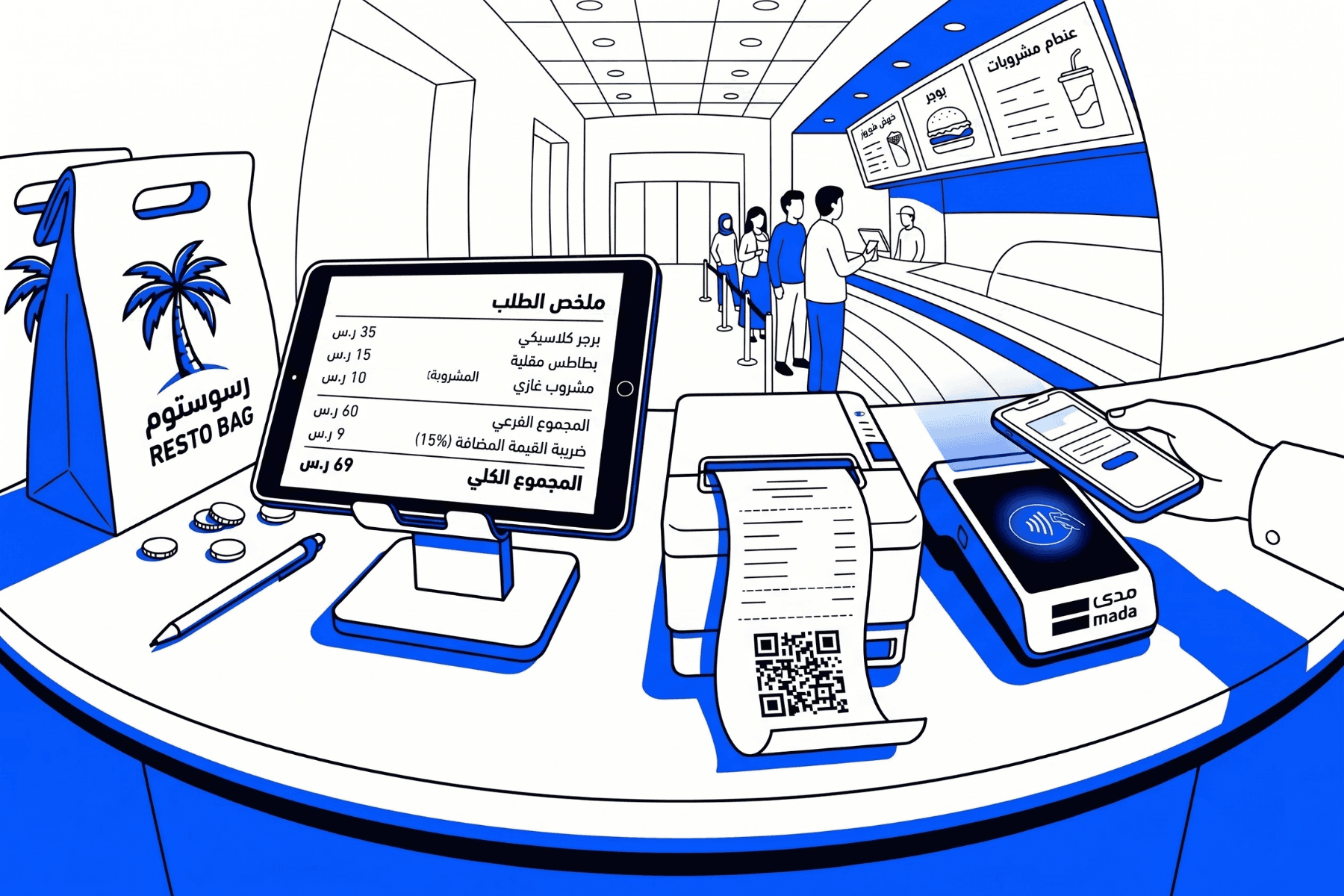
The essential features of a modern restaurant POS in KSA and MENA in 2026 are ZATCA e-invoicing compliance, native Arabic UI for both customer-facing and back-office screens, multi-branch management from one dashboard, mada and STC Pay integration, and reliable offline mode.
Foodics is the dominant POS in the region by a meaningful margin, with 33,000+ restaurant branches across 17+ countries, SAMA fintech licensing, and the deepest local integrations. It's the default option for serious F&B operators in KSA.
Credible alternatives include Posist, Touche, Lightspeed, Oracle MICROS, NCR Aloha, Geidea, and POSBytz, each with different strengths around brand size, format type, and integration depth.
POS is not a back-of-house management platform. Inventory depth, recipe costing, customer intelligence, and supplier management often require additional tools or modules layered on top of the POS.
The right POS evaluation prioritizes daily usability for branch staff, Arabic depth (not just Arabic UI), regional payment method support, and the quality of integrations into your existing operational stack.
Choosing a restaurant POS for a multi-location F&B operation in KSA or the wider region is one of the highest-stakes technology decisions an operator makes. The POS sits at the center of daily operations: orders, payments, kitchen flow, inventory, reporting, customer data. Switching POS systems mid-operation is painful, expensive, and rare, which means the choice you make at the start tends to compound over years.
This post is a practical guide for operators evaluating a restaurant POS with Arabic support in 2026. We'll cover the essential features the regional market actually requires, the leading players and where each one fits best, and the evaluation questions that decide most POS decisions in practice.
Essential features of a modern restaurant POS in 2026
The feature list for a restaurant POS has expanded significantly in the last few years. Most platforms now offer some version of every capability, which means the questions worth asking are about depth and fit rather than presence or absence. The features that matter most for KSA and MENA operators in 2026:
ZATCA compliance and e-invoicing
ZATCA Phase 2 e-invoicing is non-negotiable for any POS operating in Saudi Arabia. The system has to issue compliant e-invoices, generate QR codes on receipts, and either clear invoices with ZATCA in real time or report within 24 hours. POS systems without full ZATCA compliance are not legally viable for KSA operations.
Native Arabic support
Arabic support is a spectrum, not a binary. The minimum is an Arabic UI for customer-facing screens and receipts. The next level is full Arabic in the back-office for menu management, reporting, and staff training. The highest level includes Arabic-first design choices like right-to-left layouts that don't feel like translations and number formatting consistent with local conventions. Most regional staff will struggle with English-only back-office systems; the deeper the Arabic support, the lower your training overhead.
Multi-branch management
Multi-location brands need centralized control over menu, pricing, promotions, and inventory across branches from a single dashboard. The system has to allow brand-level changes to flow to every branch immediately and roll up reporting from every branch into consolidated views. Brands operating from spreadsheets and per-branch POS instances pay an enormous coordination cost that compounds with every additional location.
Regional payment methods
In KSA, the table-stakes payment methods are mada (the national debit network), STC Pay, Apple Pay, Samsung Pay, and major credit cards. mada specifically is non-negotiable; it accounts for the majority of card-based consumer transactions in the kingdom. POS systems without direct mada integration will have to be paired with a third-party payment gateway, which adds cost and complexity.
Cloud-based architecture with offline mode
Cloud-based POS is the industry standard in 2026. It allows real-time access from any device, reduces hardware dependency, and enables remote management of branches across multiple cities. The catch is internet reliability: in malls, basement venues, or remote locations, connectivity is not always guaranteed. A POS with strong offline mode that processes transactions during outages and syncs automatically when connectivity returns is essential for operating in KSA and the region.
Inventory and recipe costing
Basic inventory tracking is now standard. The depth varies. The strongest POS systems offer recipe costing (breaking down ingredient costs per menu item), automated reorder alerts, multi-location inventory synchronization, and supplier management. Operators wanting full back-of-house intelligence (theoretical food cost, variance tracking, recipe-driven ordering) often pair the POS with a dedicated inventory management tool.
Third-party integrations
Modern POS systems are platforms, not standalone tools. The value of the system depends heavily on what else it integrates with: delivery aggregators (HungerStation, Jahez, Mrsool, Keeta), accounting software, customer experience platforms, loyalty programs, kitchen display systems, online ordering platforms. The depth and reliability of these integrations is often the difference between a POS that fits your operation and one that becomes a bottleneck.
Delivery aggregator integration
For most F&B brands in KSA, delivery aggregators account for a significant share of total orders. Native integration with Keeta, HungerStation, Jahez, and Mrsool, with menus and orders synced between the POS and each aggregator, reduces operational friction. Brands managing multiple aggregator dashboards manually are paying a hidden time cost that scales with each location and each aggregator.
Customer-facing displays and KDS
Kitchen Display Systems (KDS) replace paper tickets with screens that route orders to specific stations, track preparation times, and feed real-time data back to the POS. Customer display screens at the counter improve transparency and reduce order errors. Both are now standard features in well-configured restaurant operations.
Reporting and analytics
Real-time sales reporting, performance comparison across branches, day-part analysis, menu-item profitability, and staff performance tracking are now baseline expectations. The strongest platforms also offer predictive analytics, demand forecasting, and AI-driven insights. The depth of analytics varies widely across platforms and is one of the more material points of differentiation.
The leading restaurant POS players in MENA
The MENA restaurant POS market has consolidated significantly in the last five years. A handful of players cover most of the market, with several specialty options for specific formats or scales.
Foodics
Foodics is the dominant restaurant POS in MENA. Founded in 2014 in Saudi Arabia, the company has raised approximately $200M, serves 33,000+ restaurant branches across 17+ countries, and is formally licensed as a Fintech company by the Saudi Central Bank (SAMA). The platform is available in Arabic, English, and French.
Strengths: deepest regional integrations, strongest local support, native Arabic across the platform, ZATCA-compliant, full multi-branch capabilities, integrated payment processing including mada, growing ecosystem of third-party integrations (delivery aggregators, accounting, customer experience, inventory management). Strong fit for brands of any size from single locations to enterprise chains.
Limits: pricing in higher tiers can become substantial for larger chains. Some operators report bugs after major updates that take time to resolve. The platform is broad, which means specific niche features may be less developed than in specialized point solutions.
Best fit: F&B brands in KSA, UAE, Egypt, and the wider MENA region looking for a comprehensive POS with the deepest regional integrations. The default option for most serious multi-location operators.
Posist (now Restroworks)
Posist is a global cloud-based POS with strong presence in MENA, particularly with chains and franchise operations. Originally from India, the platform has expanded internationally and is used by several recognizable regional brands.
Strengths: strong for multi-location chains and franchises, robust BI and analytics, good integration with aggregators, reasonable Arabic support. Strong for operators who want a platform with deep enterprise features.
Limits: some operators report slower sync times and customer support response. The regional integration depth is less than Foodics in KSA specifically.
Best fit: multi-location chains looking for a global platform with regional support, particularly those operating across multiple countries.
Touche (Prologic First)
Touche is a hospitality-focused POS used by 2,000+ businesses across 38 countries, including high-end venues like Wagamama, Trader Vic's, Radisson Blu, and Armani. Originally Indian, with offices across the Gulf.
Strengths: strong for hotels, fine dining, and complex hospitality operations. Robust reporting. Established brand among large hospitality groups.
Limits: Windows-based, less mobile-first than newer cloud platforms. UI feels older compared with the more modern options. Better fit for hotels and fine dining than for fast-casual or QSR.
Best fit: high-end hospitality operations, hotels, and fine dining chains where deep functionality matters more than UI modernity.
Oracle MICROS Simphony
Oracle's MICROS Simphony is the enterprise hospitality POS used by many of the world's largest restaurant brands and hotel groups. It's been the global standard at the high end for decades.
Strengths: extreme depth, very robust at scale, deep enterprise integrations, strong for global brands with complex operations. Trusted by major hotel chains and global QSR operators.
Limits: pricing and implementation cost are at the enterprise tier. Less agile than newer cloud-native platforms. Regional integration depth in MENA is less mature than Foodics.
Best fit: global enterprise brands with operations in multiple countries and existing Oracle infrastructure. Less suitable for regional or mid-market operators.
Lightspeed
Lightspeed is a globally established cloud POS with growing MENA presence. It serves restaurants, retail, and golf, with strong reporting and analytics capabilities.
Strengths: modern cloud-first architecture, strong reporting, broad ecosystem of integrations, established global brand.
Limits: less regionally focused than Foodics. Arabic support is functional but not as deep. Local payment integrations require more configuration than with regional platforms.
Best fit: brands operating across multiple regions including MENA, where global platform consistency matters more than regional integration depth.
NCR Aloha
NCR Aloha is one of the oldest and most established restaurant POS platforms globally, available in Saudi Arabia and used by major QSR and casual dining brands.
Strengths: very mature platform, strong QSR focus, deep functionality, established enterprise customer base globally.
Limits: aging architecture compared with cloud-native competitors. Higher implementation complexity. Less regional focus than Foodics for KSA-specific operations.
Best fit: established QSR brands with global Aloha infrastructure expanding into the region.
Geidea
Geidea is a Saudi-based fintech, supervised by the Saudi Central Bank (SAMA), that has grown from payment terminals into a broader business platform. Beyond payment processing, its point-of-sale offering now spans an all-in-one POS terminal, mobile ordering, an online store, self-service kiosks, a kitchen display system, a branded ordering app, and promotions and loyalty tools, alongside staffing, inventory, and 100+ real-time reports. It is ZATCA-ready with built-in tax reporting, offline mode, and the full local payment stack (mada, Visa, Mastercard, American Express, Apple Pay, and Samsung Pay).
Strengths: Saudi-based with strong local support and deep mada integration, an integrated payments-plus-POS stack, a genuinely broad feature set for a payments-led provider (kiosk, KDS, online ordering, branded app, loyalty), and an accessible entry point for smaller operations.
Limits: as a payments-first company expanding into restaurant software, its depth on advanced F&B workflows (recipe-level costing, theoretical food cost, multi-location menu engineering) is still lighter than dedicated F&B POS platforms like Foodics. Best suited to single sites and smaller chains rather than large, complex multi-brand operations.
Best fit: smaller F&B operations and SMEs needing integrated POS and payment processing with strong local support.
POSBytz
POSBytz is a ZATCA-compliant cloud POS specifically designed for the Saudi market, with strong presence among multi-branch chains in Riyadh, Jeddah, and Dammam.
Strengths: regional focus, ZATCA compliance from the start, multi-branch capabilities, scalable for franchise operations.
Limits: smaller user base than Foodics, less mature ecosystem of third-party integrations.
Best fit: regional chains looking for an alternative to Foodics with strong local compliance and multi-branch features.
Regional and local players worth knowing
Beyond the platforms above, several regional and local players are worth knowing, particularly for operators in Egypt and the wider region, or for brands that value a local team over the largest feature set. Not all of them lead with Saudi-specific compliance like ZATCA, so the notes below are honest about where each one fits.
Syrve (formerly iiko)
Syrve is the MENA brand of iiko, a cloud restaurant POS and management platform with regional offices in Dubai and Cairo. It is the same platform family referenced in inventory and back-of-house discussions, and it leans heavily on automation: AI-driven sales forecasting the company cites at 95 to 99% precision, real-time inventory, automated purchasing, a KDS, delivery and takeaway integrations, and loyalty. Support is offered in English, Arabic, Russian, Hindi, and Filipino.
Strengths: strong inventory and forecasting depth, mature all-in-one feature set, established UAE presence, multilingual local support, and UAE Federal Tax Authority compliance. A credible choice for chains and dark-kitchen operators that want automation depth.
Limits: its primary compliance and support footprint is strongest in the UAE and Egypt; KSA operators should confirm current ZATCA coverage and local support depth directly. Less KSA-native than Foodics for Saudi-specific operations.
Best fit: UAE and Egypt chains, dark kitchens, and multi-location operators that prioritize inventory and forecasting automation.
Lyve Global
Lyve is a cloud restaurant POS and management suite that forms one part of a broader commerce platform spanning ordering, delivery management, payments, workforce, and cross-border logistics. The restaurant POS itself runs on any hardware, supports QR and digital-menu ordering, integrates with food aggregators, and includes a kitchen display system that uses machine learning to predict preparation times. It also covers real-time inventory with batch and expiry tracking, nested recipes, per-branch product availability, loyalty and promotions, staff attendance and payroll, and an accounting module with tax reporting. The company operates across KSA, Egypt, Oman, the UAE, and into APAC and Europe, with a partner and reseller ecosystem.
Strengths: genuinely broad platform that pairs POS with delivery and workforce management, ML-based kitchen timing, fast cloud setup with offline mode, and multi-country coverage including KSA and Egypt.
Limits: the breadth that makes Lyve attractive can also mean evaluating a wider suite than a focused POS buyer needs. KSA operators should confirm current ZATCA e-invoicing coverage for their specific configuration.
Best fit: multi-location and multi-country operators that want POS, delivery management, and workforce tools from a single vendor.
Simple Touch (Deyafa)
Simple Touch is an Egypt-based F&B software specialist with more than 26 years in the market, built specifically for restaurants. Its product, Deyafa, comes in both classic and cloud versions and handles dine-in, takeaway, delivery, and drive-thru from one screen, with reporting, multi-branch management, offline mode, inventory, online ordering, and loyalty. It integrates with regional delivery platforms and has a deep client base across Egyptian F&B brands.
Strengths: long track record in the Egyptian market, restaurant-specific depth, local team and fast support, and a wide installed base among Egyptian chains.
Limits: this is an Egypt-first vendor; it does not lead with Saudi-specific compliance such as ZATCA, so KSA operators would need to confirm coverage. Most relevant for brands operating in or expanding within Egypt.
Best fit: Egyptian F&B brands and regional operators with a significant Egypt footprint who want a local, restaurant-focused vendor.
Crystal Mind (Restaurant Manager)
Crystal Mind is an Egyptian technology company, founded in 1994, that delivers business management solutions across retail, supermarket, ERP, and restaurants. For F&B it offers Restaurant Manager (R.M), a POS package covering real-time sales reporting, KDS, inventory and recipe cost control, table and floor management, loyalty and promotions, e-invoicing, and electronic payment integration. Notably for an operator focused on customer experience, R.M includes a built-in feature that lets guests rate their experience and alerts management when a customer is dissatisfied.
Strengths: long-established local integrator with a multi-vertical portfolio, Egyptian e-invoicing support, recipe-level cost control, and an unusual built-in guest-satisfaction alert in the POS itself.
Limits: an Egypt-focused integrator rather than a KSA-native SaaS POS; Saudi operators would need to confirm ZATCA coverage and local support. The restaurant product is one line within a broader retail and ERP business.
Best fit: Egyptian restaurants and groups that want a local integrator able to cover POS alongside ERP and retail systems.
Other options worth knowing
Loyverse offers a free POS with paid upgrades. Useful for very small operations starting out but limited for serious multi-location brands.
Square is widely used globally but has limited regional presence and limited Arabic support. Not a serious option for KSA-focused operators.
Marn is a regional player popular with smaller F&B operations in KSA, offering ZATCA compliance and Arabic support at accessible pricing.
How to evaluate a POS for a multi-location restaurant
The evaluation criteria that actually predict whether a POS will work for your operation aren't always the ones highlighted in vendor demos. A few that matter more than they appear:
Branch staff usability. Your branch managers and cashiers will use this system every day. If it's confusing for a new hire to learn in their first shift, the training overhead will exceed any feature advantage. Test with actual front-of-house staff during evaluation, not just managers.
Arabic depth. Arabic UI alone isn't enough. Test back-office functions in Arabic, generate reports in Arabic, walk through menu management in Arabic. The gaps appear in places vendors don't always demo.
Integration reliability. Check the actual reliability of integrations into your delivery aggregators and other tools, not just the marketing list. Talk to operators who use the specific integrations you need.
Support response time in your time zone. Restaurant POS issues happen at peak hours, often outside the support window of platforms not built for the region. Local-hour support is meaningful for operators in MENA.
Pricing predictability. Most POS platforms have layered pricing that increases with location count, transaction volume, or feature tier. Get a clear picture of where pricing will land in 12-24 months as you scale, not just where it starts.
POS is not a back-of-house platform
One pattern worth flagging: operators often expect their POS to cover capabilities that belong in dedicated back-of-house platforms. Recipe-driven inventory management, theoretical food cost analysis, deep customer intelligence, supplier procurement workflows: these are usually weaker in even the best POS systems than in dedicated tools.
The strongest operational stacks in the region pair a strong POS (usually Foodics) with specialized back-of-house tools: MarketMan or Apicbase for inventory and recipe costing, a customer intelligence platform like Sira for feedback aggregation and root-cause analysis, dedicated reservation and CRM tools for the front-of-house relationship management. The POS handles transactions and the immediate operational layer; the other tools handle the deeper analysis and longer-running workflows.
The takeaway
The essential features of a modern restaurant POS in KSA and MENA in 2026 are ZATCA compliance, native Arabic support, multi-branch management, regional payment integration including mada, reliable offline mode, and deep integrations with the rest of your operational stack.
Foodics is the default choice for most serious operators in the region, with the deepest local integrations and the strongest support infrastructure. Credible alternatives exist for specific use cases and scales, but the bar to displace Foodics for a regional multi-location F&B brand is high.
The right evaluation focuses on daily usability for branch staff, depth of Arabic support beyond just UI, reliability of integrations into your operational stack, and pricing predictability as you scale. POS evaluations that focus too much on feature lists and not enough on operational fit tend to produce expensive regrets.
Frequently asked questions
What's the best restaurant POS system in Saudi Arabia?
Foodics is the most widely used and most regionally integrated restaurant POS in Saudi Arabia, with native Arabic, full ZATCA compliance, integrated mada and STC Pay processing, and deep integrations with regional delivery platforms. It's the default option for most serious multi-location F&B operators in KSA. Credible alternatives include Posist, Lightspeed, and Oracle MICROS Simphony for specific use cases, with regional players like Geidea and POSBytz fitting smaller operations or specific compliance-first requirements.
What are the essential features of a modern restaurant POS system?
The non-negotiables in 2026 are ZATCA e-invoicing compliance (for KSA), native Arabic UI for both customer-facing screens and back-office management, multi-branch management from a single dashboard, regional payment method support including mada and STC Pay, reliable offline mode, and deep integrations with delivery aggregators, accounting, customer experience, and inventory management tools. Kitchen Display Systems, customer-facing displays, and real-time reporting are also baseline expectations.
Which POS systems have full Arabic support?
Foodics, Geidea, POSBytz, Posist, Marn, and Touche all offer Arabic UI and reporting at varying levels of depth. Foodics has the deepest native Arabic implementation across UI, back-office, and reporting. Global platforms like Oracle MICROS and Lightspeed have functional Arabic support but it's less deep than the regional players. Loyverse and Square have partial Arabic support that's generally not sufficient for serious operations in KSA.
Does a restaurant POS handle inventory and recipe costing?
Most modern POS systems include basic inventory tracking and simple recipe costing. The depth varies significantly. For full back-of-house intelligence (theoretical food cost analysis, variance tracking, recipe-driven procurement, supplier management), most serious multi-location operators pair their POS with a dedicated inventory management platform like MarketMan or Apicbase. The POS handles transactions; the inventory platform handles deeper analysis.
How long does it take to implement a new restaurant POS?
For a single location, most modern cloud POS systems can be operational in 1-2 weeks including menu setup and staff training. For multi-location chains, a phased rollout typically takes 4-12 weeks depending on integration complexity, number of branches, and data migration requirements. Enterprise platforms like Oracle MICROS can take significantly longer (3-6 months for major chain implementations). The longest pole in most implementations is menu setup, integration testing, and staff training, not the underlying technology.
What does a restaurant POS cost in Saudi Arabia?
Pricing varies substantially by platform, feature tier, and number of locations. For Foodics, plans start around $59 per month for the entry tier and scale up with locations, features, and integrations. Regional players like Geidea and POSBytz can be more accessible for small operations. Enterprise platforms (Oracle, NCR Aloha) start in the higher hundreds to low thousands per location per month. Total cost of ownership includes hardware, payment processing fees, integration costs, and ongoing support, so the headline subscription price is rarely the full picture.