Restaurant Loyalty Programs That Actually Work
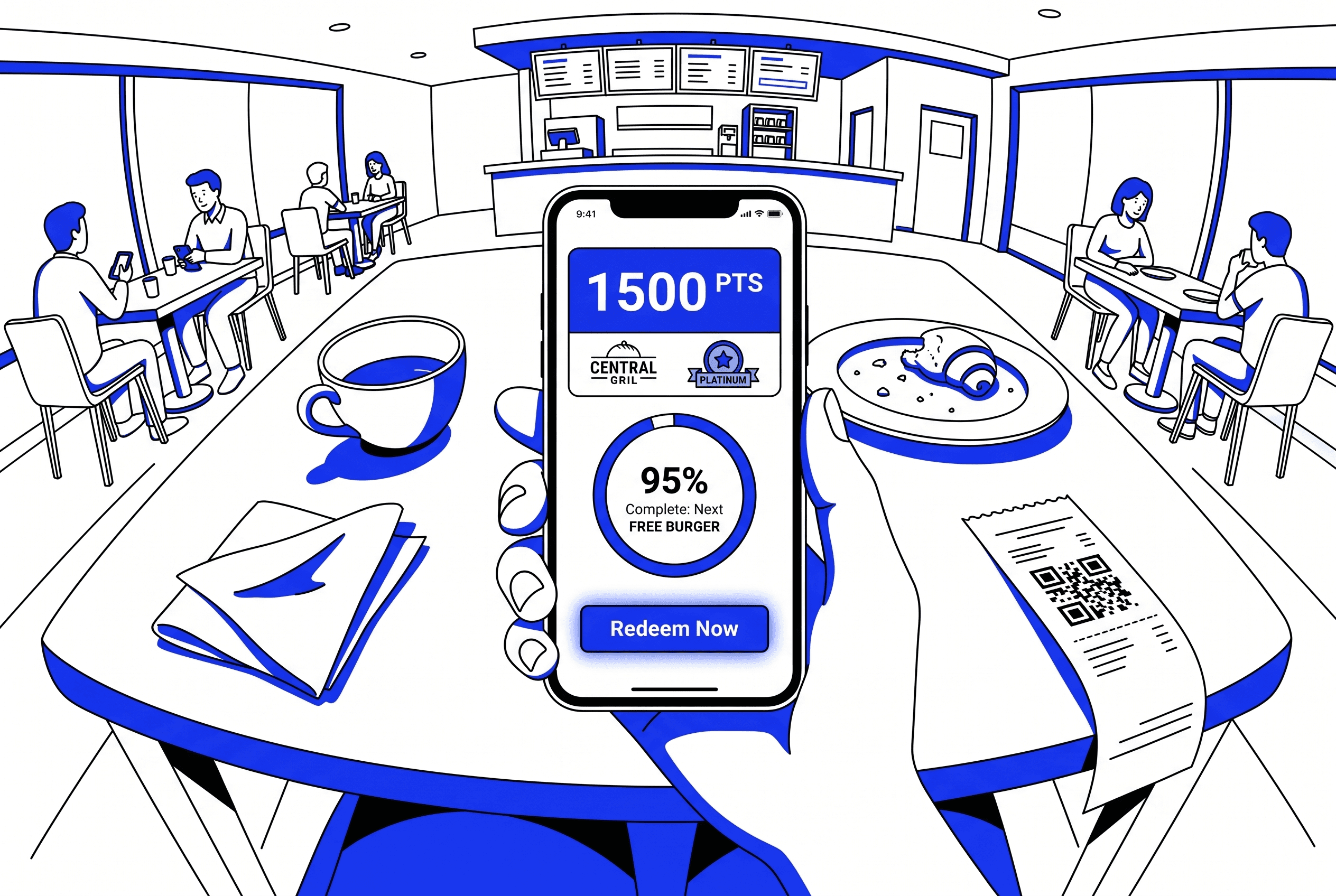
A loyalty program is a retention tool, not a discount machine. The goal is to increase visit frequency and lifetime value from customers you already have, not to buy one-time visits from deal seekers.
The four common structures are points-based, tiered, paid membership, and visit-based (punch card style). Most successful multi-location brands in the region run a points or tiered model integrated into their app and POS.
What makes a program work is not the size of the reward; it is relevance, ease of earning and redeeming, and a reason to come back sooner than the customer otherwise would. Friction kills loyalty programs faster than small rewards do.
For KSA and MENA operators, the program lives or dies on integration: it has to connect to the POS (usually Foodics), the delivery channels (Keeta, HungerStation, Jahez, Mrsool), and ideally the customer feedback loop, so that loyalty data and experience data inform each other.
The metric that matters is incremental behavior change: did enrolled members visit more often or spend more than they would have without the program? Most operators never measure this, which is why most loyalty programs cannot prove their value.
Almost every multi-location restaurant brand in the region either runs a loyalty program or is thinking about launching one. Far fewer can tell you whether their program actually changes customer behavior or simply gives discounts to people who would have come back anyway.
That distinction is the whole game. A loyalty program that rewards existing behavior is a cost. A loyalty program that changes behavior, making customers visit more often, spend more per visit, or choose you over a competitor, is an investment. The difference between the two is design, measurement, and integration, not the generosity of the rewards.
This article is a practical guide for operators in KSA and the wider region who want a loyalty program that earns its keep: the structures that work, what makes customers actually engage, how to measure real impact, and the mistakes that quietly drain budget.
What a loyalty program is actually for
The purpose of a loyalty program is to increase the lifetime value of customers you already have. It does this through three mechanisms: increasing visit frequency (the same customer comes more often), increasing average spend (the customer spends more per visit to earn or redeem rewards), and increasing retention (the customer keeps choosing you instead of drifting to competitors).
Notice what is not on that list: acquiring new customers. Loyalty programs are weak acquisition tools. People do not try a new restaurant because it has a points program; they try it because of the food, the location, a recommendation, or a first-time offer. The loyalty program’s job starts after the first visit, turning a one-time customer into a repeat one.
This is why discount-heavy programs disappoint. A program built around aggressive discounts attracts deal seekers, the customers least likely to become loyal and most likely to leave the moment the discount stops. The strongest programs reward and deepen the relationship with customers who already like you, rather than trying to bribe indifferent ones into staying.
The four loyalty program structures
1. Points-based
Customers earn points per riyal spent and redeem them for rewards (free items, discounts, exclusive access). This is the most common structure because it is flexible and easy to understand. The design questions that matter: how fast points accumulate (too slow and customers disengage), what they can be redeemed for (relevant rewards beat generic discounts), and whether points expire (expiry drives urgency but can frustrate).
Points programs work well for brands with frequent visits and a range of price points. They work poorly when the earning rate is so slow that a reward feels unreachable, which is the most common points-program mistake.
2. Tiered
Customers move through levels (for example, silver, gold, platinum) based on spend or visit frequency, with better rewards at higher tiers. Tiers add a status and progression element that points alone lack. The customer near the threshold of the next tier has a strong reason to visit again sooner.
Tiered programs work well for brands with a meaningful spread between casual and high-value customers, because they let you reward your best customers disproportionately. They require enough volume and data to manage the tiers, which makes them better suited to established multi-location brands than to new or small operations.
3. Paid membership
Customers pay a fee (monthly or annual) for ongoing benefits: free delivery, a standing discount, exclusive items, priority service. The paid model is growing globally and has started appearing in the region. It works because the customer who has paid for membership is psychologically committed to using it, which drives frequency.
Paid membership works for brands with high visit frequency where the member can clearly see the math working in their favor. It fails when the value proposition is unclear or when visit frequency is too low to justify the fee. It is the highest-risk, highest-reward structure.
4. Visit-based (digital punch card)
The classic “buy nine, get the tenth free” model, now usually digital. Simple, intuitive, and effective for driving a specific repeat behavior. Works best for single-product or limited-menu concepts (coffee, specific dishes) where the repeat purchase is predictable.
Visit-based programs are the easiest to launch and the easiest for customers to understand, but they are the bluntest instrument. They reward frequency without distinguishing between a customer who spends SAR 20 and one who spends SAR 200 per visit.
What actually makes a loyalty program work
Across structures, the programs that change behavior share a few characteristics that have little to do with how generous the rewards are.
Low friction to earn and redeem. If a customer has to remember a physical card, ask staff to look up their account, or navigate a confusing app, they will disengage. The best programs earn automatically (linked to the phone number or app at checkout) and redeem in one or two taps. Every point of friction loses members.
Relevant rewards. A reward the customer actually wants beats a bigger reward they do not care about. A free dessert at a brand known for dessert is relevant. A 5% discount on a future visit is generic and forgettable. The strongest rewards feel personal and tied to what the customer already enjoys.
A reason to return sooner. The mechanism that makes loyalty programs valuable is bringing the next visit forward. A points balance close to a reward, a tier threshold within reach, a time-limited bonus, all of these create a reason to visit this week instead of next month. A program that rewards behavior without accelerating it leaves most of its value on the table.
Emotional payoff, not just transactional. The best programs make members feel recognized: a birthday reward, a surprise upgrade for a loyal customer, early access to a new menu item. These moments build the emotional connection that pure discounts never will, and they cost little relative to their impact.
Integration: where regional programs succeed or fail
For multi-location brands in KSA and the region, the single biggest determinant of program success is integration into the operational stack. A loyalty program that lives in a separate app, disconnected from the POS and delivery channels, creates friction and blind spots that undermine it.
POS integration. The loyalty program has to connect to the POS (Foodics is the regional default) so that points earn automatically at checkout, across every branch, without staff intervention. Manual point entry is both a friction point and an error source.
Delivery channel integration. In KSA, a large share of orders come through Keeta, HungerStation, Jahez, and Mrsool. A loyalty program that only works for dine-in or only for direct orders ignores the channel where much of the volume happens. The strongest programs find ways to recognize and reward delivery customers, even when the aggregator owns the transaction, often by driving customers to a direct ordering channel or branded app where loyalty can be tracked.
Customer feedback integration. This is the connection most brands miss. Loyalty data tells you who your best customers are and how often they visit. Customer feedback data tells you what they experience and where they are frustrated. Connecting the two reveals the highest-value insight in customer management: when a high-value loyalty member starts visiting less often or leaves a negative review, that is a churn signal worth acting on immediately. An AI customer intelligence platform like Sira that analyzes feedback across channels can surface exactly these signals, letting you intervene before a valuable customer quietly disappears.
Measuring whether the program actually works
Most loyalty programs cannot prove their value because they measure the wrong things. Enrollment numbers, points issued, and rewards redeemed all measure activity, not impact. The question that matters is whether the program changed behavior.
The metric that captures this is incremental behavior: did enrolled members visit more often or spend more than they would have without the program? Measuring this properly requires comparing member behavior to non-member behavior, or to member behavior before they enrolled, controlling for the fact that frequent customers are more likely to enroll in the first place.
Practical metrics that approximate incremental impact: visit frequency of members versus non-members (members should visit measurably more often), change in member spend over time (are members spending more as they engage with the program?), member retention rate versus overall retention (do members churn less?), and redemption rate (low redemption suggests rewards are unreachable or irrelevant).
The most important discipline is tracking these over time and by cohort, not as static snapshots. A program that looked good at launch may be quietly underperforming a year later as the novelty fades. Brands that review loyalty metrics quarterly catch this; brands that set the program and forget it do not.
Common mistakes that drain budget
Rewarding existing behavior. If your most loyal customers were going to visit anyway, giving them points is a cost with no behavior change. The program needs to move marginal behavior, bringing forward visits that would not otherwise happen, not just reward visits that would.
Earning rates too slow to matter. When a reward requires so many visits that it feels unreachable, customers disengage. The first reward should feel achievable within a few visits to build the habit.
Over-discounting. Programs built on deep discounts attract deal seekers and erode margin without building loyalty. The moment the discount stops, the customer leaves. Reward relationship and recognition, not just price.
No connection to the rest of the operation. A loyalty program disconnected from POS, delivery, and feedback data is an island. It cannot tell you when a valuable member is at risk, cannot reward across all channels, and cannot inform operational decisions. Integration is what turns a loyalty program from a marketing gimmick into a customer intelligence asset.
Set and forget. Loyalty programs decay. The novelty fades, the rewards become stale, and engagement drops. The programs that keep working are reviewed and refreshed regularly, with new rewards, seasonal bonuses, and adjustments based on what the data shows.
Conclusion
A restaurant loyalty program is a retention tool whose value comes from changing customer behavior, not from rewarding behavior that would have happened anyway. The structure (points, tiered, paid, or visit-based) matters less than the design principles: low friction, relevant rewards, a reason to return sooner, and emotional recognition.
For multi-location brands in KSA and the region, integration is decisive. A program connected to the POS, the delivery channels, and the customer feedback loop becomes a source of intelligence about your most valuable customers, not just a points ledger. And measurement, specifically of incremental behavior change, is what separates programs that earn their keep from programs that quietly waste money.
The brands that treat loyalty as part of a connected customer intelligence system, where loyalty data and experience data inform each other, get far more from the same program than brands that run it as a standalone marketing tactic.
Frequently asked questions
What type of loyalty program is best for a restaurant?
It depends on your format and visit frequency. Points-based programs are the most flexible and work for most multi-location brands with a range of price points. Tiered programs work well when you have a meaningful spread between casual and high-value customers and want to reward your best customers disproportionately. Paid membership works for high-frequency concepts where the customer can see the math working in their favor. Visit-based (digital punch card) programs work best for single-product concepts like coffee. Most successful multi-location brands in KSA run a points or tiered model integrated into their app and POS.
How do you measure if a restaurant loyalty program is working?
Measure incremental behavior change, not activity. Enrollment numbers, points issued, and rewards redeemed measure activity, not impact. The question that matters is whether members visit more often or spend more than they would have without the program. Practical metrics: visit frequency of members versus non-members, change in member spend over time, member retention rate versus overall retention, and redemption rate. Track these over time and by cohort, reviewing quarterly, because programs that look good at launch can quietly underperform as the novelty fades.
Should a restaurant loyalty program offer discounts?
Discounts can be part of a program but should not be its foundation. Programs built on deep discounts attract deal seekers, the customers least likely to become loyal and most likely to leave when the discount stops. They erode margin without building genuine loyalty. The strongest programs reward relationship and recognition: relevant rewards tied to what the customer enjoys, birthday rewards, surprise upgrades, early access. These build emotional connection that pure discounts never will, and they cost less relative to their impact.
How do loyalty programs work with delivery apps like Keeta and HungerStation?
This is one of the harder integration challenges. When a customer orders through Keeta, HungerStation, Jahez, or Mrsool, the aggregator typically owns the transaction and customer relationship, which makes tracking loyalty difficult. The strongest approach is to drive customers toward a direct ordering channel or branded app where loyalty can be tracked, using the aggregator for acquisition and the direct channel for retention. Some brands offer loyalty benefits that incentivize the switch to direct ordering, capturing both the order and the customer data.
How much does a restaurant loyalty program cost to run?
Costs fall into three buckets: the technology (loyalty platform or POS module, often bundled with systems like Foodics), the rewards themselves (the cost of free items or discounts redeemed), and the management time to run and refresh the program. The reward cost should be evaluated against incremental revenue, not in isolation: a program that costs SAR 50,000 in rewards but generates SAR 200,000 in incremental visits is profitable, while one that costs SAR 50,000 rewarding behavior that would have happened anyway is pure loss. The technology cost is usually modest compared to the reward and measurement discipline.
How do you connect a loyalty program to customer experience?
Loyalty data tells you who your best customers are and how often they visit. Customer feedback data tells you what they experience and where they are frustrated. Connecting the two reveals the highest-value signal in customer management: when a high-value loyalty member starts visiting less or leaves a negative review, that is a churn warning worth acting on immediately. An AI customer intelligence platform that analyzes feedback across channels can surface these signals automatically, letting you intervene before a valuable customer disappears. This connection turns a loyalty program from a points ledger into a retention early-warning system.