Online Restaurant Reviews: What Multi-Location Operators Get Wrong
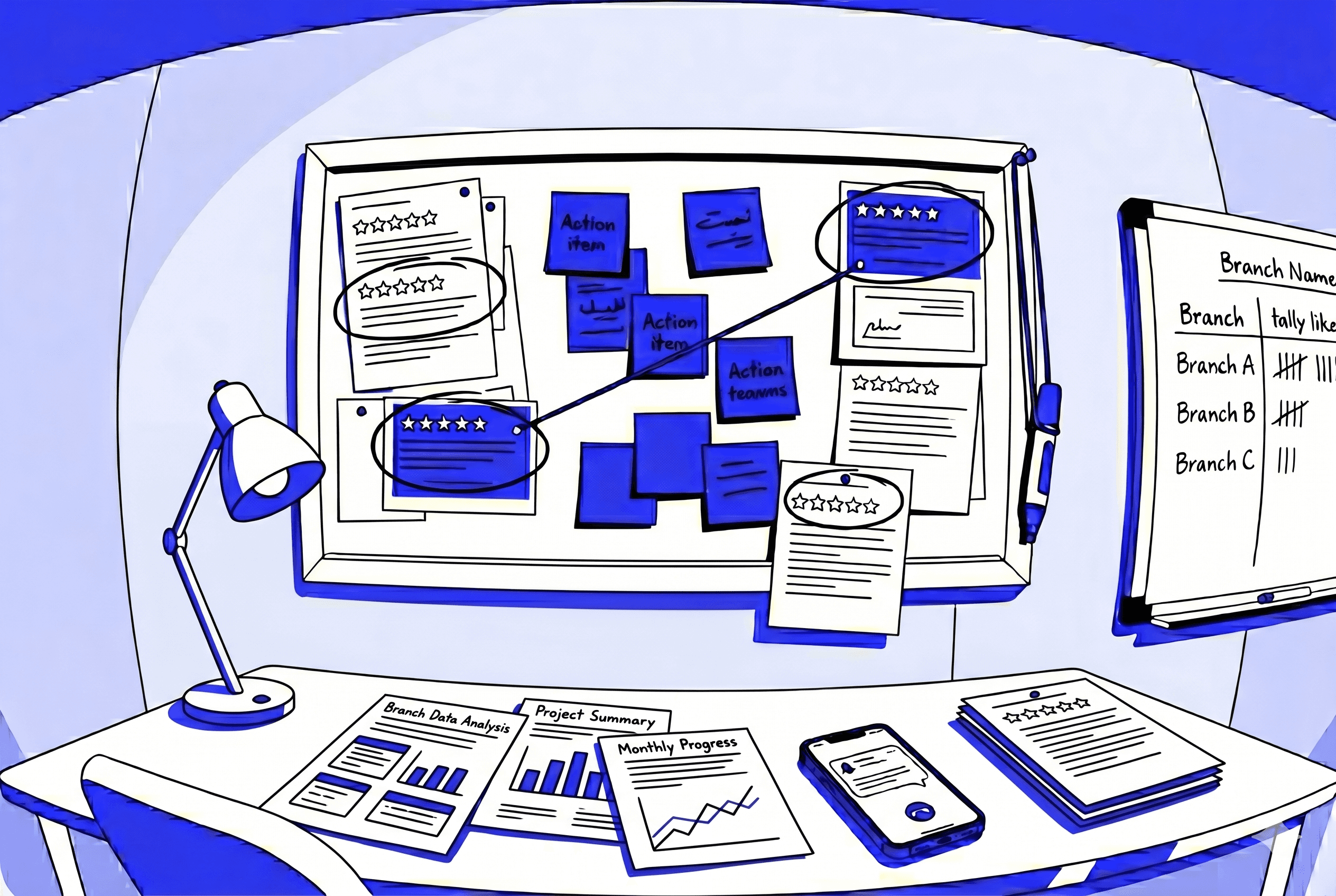
Online reviews are a lagging indicator of customer experience, not a leading one. By the time a review appears on Google or a delivery app, the experience happened days ago. Reviews tell you where you were, not where you are.
Most multi-location brands make three review management mistakes: responding to positive reviews faster than negative ones (should be the opposite), treating reviews as a marketing function instead of an operations function, and looking at aggregate ratings instead of branch-level variance.
The aggregate star rating matters for discovery (customers in the exploring phase use it to decide whether to try you), but the operational value is in the text, not the stars. The text tells you what specifically is working and what is not. Stars tell you nothing actionable.
Reviews from delivery platforms (Keeta, HungerStation, Jahez, Mrsool) carry different operational signals than Google reviews. Delivery reviews skew toward order accuracy, food temperature, and timing. Google reviews capture the full dine-in experience. Analyzing them separately produces better diagnosis.
Reviews are one input to a customer intelligence system, not the whole system. The brands that use reviews most effectively combine them with survey data, social media signals, and internal feedback in a unified platform that classifies root causes and routes issues to the right operational owner.
Online reviews occupy an outsized share of most operators' attention and an undersized share of their operational infrastructure. The typical pattern: someone in marketing monitors Google reviews, responds when they notice something, reports the aggregate rating in a monthly slide, and the conversation moves on. The reviews themselves, the text, the patterns, the branch-level variance, the operational signal buried in thousands of Arabic-language comments, go largely unprocessed.
This article reframes online reviews for multi-location operators: not as a reputation management task but as an operational data source that, combined with other customer signals, can tell you specifically where your operation is succeeding and where it is failing.
Reviews are a lagging indicator
The first reframe is temporal. A review that appears today reflects an experience that happened one to seven days ago. By the time you read it, the problem has either repeated itself several times or resolved on its own. Reviews tell you where you were, not where you are.
This is why reviews alone are insufficient for managing customer experience in real time. They are valuable as a diagnostic (what patterns appear over weeks and months) and as a discovery factor (what potential customers see when deciding whether to try you). They are not valuable as an operational alert system. By the time a complaint appears on Google, the customer has already decided whether to come back.
Internal feedback (complaints to staff, post-visit surveys, in-app feedback) is the leading indicator. External reviews are the trailing confirmation. The brands that manage CX effectively use both, but weight the leading indicators more heavily for operational decisions.
The three mistakes most multi-location brands make
1. Responding to positive reviews faster than negative ones
The natural human tendency is to engage with positive feedback (it feels good) and avoid negative feedback (it feels bad). Most brands' review response data reflects this: positive reviews get replied to within hours; negative reviews sit for days or never get a response.
This is precisely backward. The positive reviewer has already decided to come back. The negative reviewer is deciding right now whether to give you another chance. The recovery window is 24 to 48 hours; after that, the customer has moved on. Speed of response to negative reviews is the metric that predicts retention. Speed of response to positive reviews is a nice-to-have that predicts nothing.
The operational fix: set a 24-hour SLA for negative review responses across all platforms and all branches. Track compliance weekly by branch. Make it a performance metric for whoever owns review responses (whether that is the branch manager, a central team, or a combination).
2. Treating reviews as a marketing function
In most multi-location brands, review management sits with marketing. Marketing monitors the ratings, writes the responses, and reports the numbers. The problem is that the signal in reviews is operational (food was cold, service was slow, order was wrong, branch was dirty), and marketing cannot fix operational problems. The data reaches the wrong audience.
The fix is routing review data, specifically the classified root causes, to operations. The complaint about slow service at Branch 7 during Thursday dinner should reach the operations manager, not the social media coordinator. The pattern of food temperature complaints across delivery orders should reach the kitchen and packaging teams, not the PR team.
This does not mean marketing should stop responding to reviews. It means the response is one output; the operational routing is the other. Both need to happen. Most brands only do the first.
3. Looking at aggregate ratings instead of branch-level variance
A brand with a 4.3 aggregate Google rating feels comfortable. But if that 4.3 is the average of branches ranging from 3.8 to 4.7, the 3.8 branches are silently damaging acquisition. Customers searching locally see the branch rating, not the brand average. A potential customer in the exploring phase who sees a 3.8-star branch will likely skip it, regardless of how well the rest of the brand performs.
The variance between branches is more operationally useful than the aggregate. Narrowing the gap (pulling the lowest-rated branches up toward the average) typically produces more impact on total revenue than raising the average. The lowest-rated branches are where the most acquisition is being lost and where the operational issues are most concentrated.
Where reviews come from and what each source tells you
Different review platforms capture different slices of the customer experience. Treating all reviews as equivalent misses the diagnostic value of the source.
Google reviews capture the broadest experience: food, service, ambiance, value, location, cleanliness. They are also the most visible to potential customers during the exploring phase, making Google the platform with the highest impact on acquisition. Google reviews are typically longer, more reflective (written after the visit, not during), and skew toward strong opinions (very positive or very negative).
Delivery platform reviews (Keeta, HungerStation, Jahez, Mrsool) capture a narrower experience: order accuracy, food quality upon arrival, packaging, and delivery timing. They are shorter, more immediate, and more frequent per customer. Because the delivery experience mixes restaurant-caused and driver-caused issues, delivery reviews require attribution analysis to be operationally useful.
Social media mentions (Instagram, TikTok, X) are less structured but carry disproportionate influence on discovery and brand perception. A viral negative post reaches more potential customers than a hundred Google reviews. Social mentions are harder to track and respond to systematically, but for brands where social discovery is a significant traffic driver, they cannot be ignored.
Survey responses (post-visit, post-delivery) capture structured feedback on specific touchpoints. They are operationally richer than reviews (because you control the questions) but have lower volume and response bias (mostly very happy or very unhappy respondents).
The brands that manage reviews most effectively do not treat each source in isolation. They aggregate all sources into a unified view, classify the root causes consistently, and use the combined signal to identify where the operation is producing the best and worst outcomes.
The text is more valuable than the stars
The star rating tells you the customer's overall sentiment. The text tells you why. For operational purposes, the text is where the value lives.
A three-star review that says "food was great but service was slow on Friday evening" contains a specific, actionable signal: Branch X has a staffing or workflow issue during Friday dinner peak. A three-star review that says "it was okay" contains no actionable signal at all.
The challenge at scale is volume. A 50-location brand generates thousands of reviews annually, most of them in Arabic (often in dialect). No human team can read, classify, and route them all. This is the specific problem that AI customer intelligence platforms solve: automated classification of review text into operational categories (food quality, service speed, cleanliness, order accuracy, packaging, ambiance), connected to specific branches, time periods, and service types.
For Arabic-language reviews specifically, the classification accuracy of the tool matters enormously. Generic sentiment analysis tools trained on English misclassify Arabic reviews frequently, especially when dialect, sarcasm, or mixed-language text is involved. Arabic-native NLP, trained on F&B language and regional dialects, produces materially different (and more accurate) operational signals. This is one of Sira's core capabilities: classifying Arabic review text with high accuracy and routing the results to the right operational owner.
Response strategy that produces results
Review response is not just a courtesy; it is a retention and acquisition tool. Three principles for responses that produce business outcomes:
Be specific. "Thank you for your feedback, we're sorry for the inconvenience" is a non-response. "We've identified that your order on Tuesday at our Tahlia branch was delayed by 18 minutes due to a kitchen staffing gap that we've since corrected" is a real response. Specificity communicates that you actually investigated the issue, which changes the customer's perception of whether you will fix it.
Prioritize negative reviews. Respond to every negative review within 24 hours. Positive reviews can wait 48 to 72 hours. The recovery opportunity is with the unhappy customer, and the future customer reading your response to the negative review is a more important audience than the future customer reading your response to the positive one.
Close the loop publicly. If a recurring complaint led to an operational change (you fixed the packaging, you added staff during Friday peaks, you retrained the team on order verification), mention it in your response to the next relevant complaint. This signals to future readers that the brand responds and changes, not just responds and moves on.
Reviews as one input to a broader system
The most important reframe in this article: reviews are one input to a customer intelligence system, not the whole system. Reviews are public, retrospective, and biased toward extreme experiences. They miss the silent majority of customers who had a mildly good or mildly bad experience and said nothing.
A complete customer intelligence system combines reviews with survey data (structured, controlled), social media mentions (unstructured, high-reach), internal feedback (verbal complaints, in-app feedback), and operational data (POS, inventory, staffing). The combined signal is richer, faster, and more representative than reviews alone.
For multi-location brands, this is where the conversation about reviews connects to the broader conversation about customer experience management. Reviews are the visible tip; the operational intelligence underneath is what drives the decisions that change outcomes. The brands that treat reviews as the whole picture underinvest in the leading indicators (surveys, internal feedback) and overinvest in the lagging ones. The brands that treat reviews as one input to a unified system get the diagnosis right and the timing right.
Conclusion
Online restaurant reviews matter for acquisition (the star rating shapes who tries you) and for diagnosis (the text tells you what is working and what is not). But they are a lagging indicator, and the brands that manage them most effectively treat them as one input to a broader customer intelligence system, not as the primary tool for managing customer experience.
For multi-location brands in KSA and the region: respond to negative reviews within 24 hours with specificity, analyze branch-level variance rather than aggregate ratings, separate delivery reviews from dine-in reviews for better diagnosis, route classified root causes to operations rather than marketing, and combine review data with surveys, social signals, and internal feedback for the full picture.
The brands that do this well are not spending more time on reviews. They are spending their time differently: less on manually reading and replying, more on the systems that classify, route, and measure the impact of the operational changes the reviews point to.
Frequently asked questions
How should multi-location restaurants manage online reviews?
Three priorities: respond to negative reviews within 24 hours with specific, personalized replies (not generic apologies). Analyze branch-level variance rather than aggregate ratings, because the gap between your best and worst branch is where the most improvement opportunity lives. Route classified root causes from reviews to operations, not just marketing, because the signal in reviews is operational (food quality, service speed, order accuracy) and marketing cannot fix those problems. The brands that manage reviews effectively treat them as an operational data source, not a reputation management task.
How quickly should a restaurant respond to negative reviews?
Within 24 hours. The recovery window for a dissatisfied customer is short. After 48 hours, most customers have made their decision about whether to return. The speed of response to negative reviews correlates strongly with customer recovery rates (roughly 80% recovery within 24 hours versus 30% after 72 hours). Set a 24-hour SLA for negative review responses across all platforms and branches, track compliance weekly, and make it a performance metric for whoever owns the response.
Are Google reviews or delivery app reviews more important?
Both matter but for different reasons and with different operational signals. Google reviews are more visible to potential customers during the exploring phase and capture the broadest experience (food, service, ambiance, value). Delivery platform reviews (Keeta, HungerStation, Jahez, Mrsool) capture a narrower experience (order accuracy, food arrival quality, packaging, timing) and require attribution analysis to separate restaurant-caused issues from platform-caused issues. Analyzing them separately produces better operational diagnosis than combining them.
How do you get more positive reviews for a restaurant?
The most effective approach is making it easy for satisfied customers to review at the right moment, usually within an hour of their experience. Post-visit SMS or WhatsApp messages with a direct link to Google or the delivery platform work better than in-person asks. Timing matters more than asking frequency. The structural improvement, though, is to fix the operational issues that produce negative reviews rather than to dilute them with more positive ones. A 4.5 rating with genuine positive reviews is more sustainable than a 4.3 with prompted positive reviews masking unresolved complaints.
Should restaurants respond to every review?
Respond to every negative review (within 24 hours) and every review that raises a specific operational issue. For positive reviews, respond when practical but do not prioritize them over negative ones. For large brands with high review volume, responding to every single positive review can feel automated and inauthentic. A better use of time is ensuring that negative reviews get fast, specific, personalized responses and that the patterns across all reviews feed into operational decisions.
How do reviews fit into a broader customer experience strategy?
Reviews are one input to a customer intelligence system, not the whole system. They are public, retrospective, and biased toward extreme experiences. A complete system combines reviews with survey data (structured, controlled), social media mentions (high-reach, unstructured), internal feedback (complaints to staff, in-app signals), and operational data (POS, inventory, staffing). The combined signal is richer and more representative. The brands that treat reviews as the whole picture overinvest in a lagging indicator and underinvest in the leading indicators that catch problems earlier.