Kitchen Workflow Optimization for Peak Hours
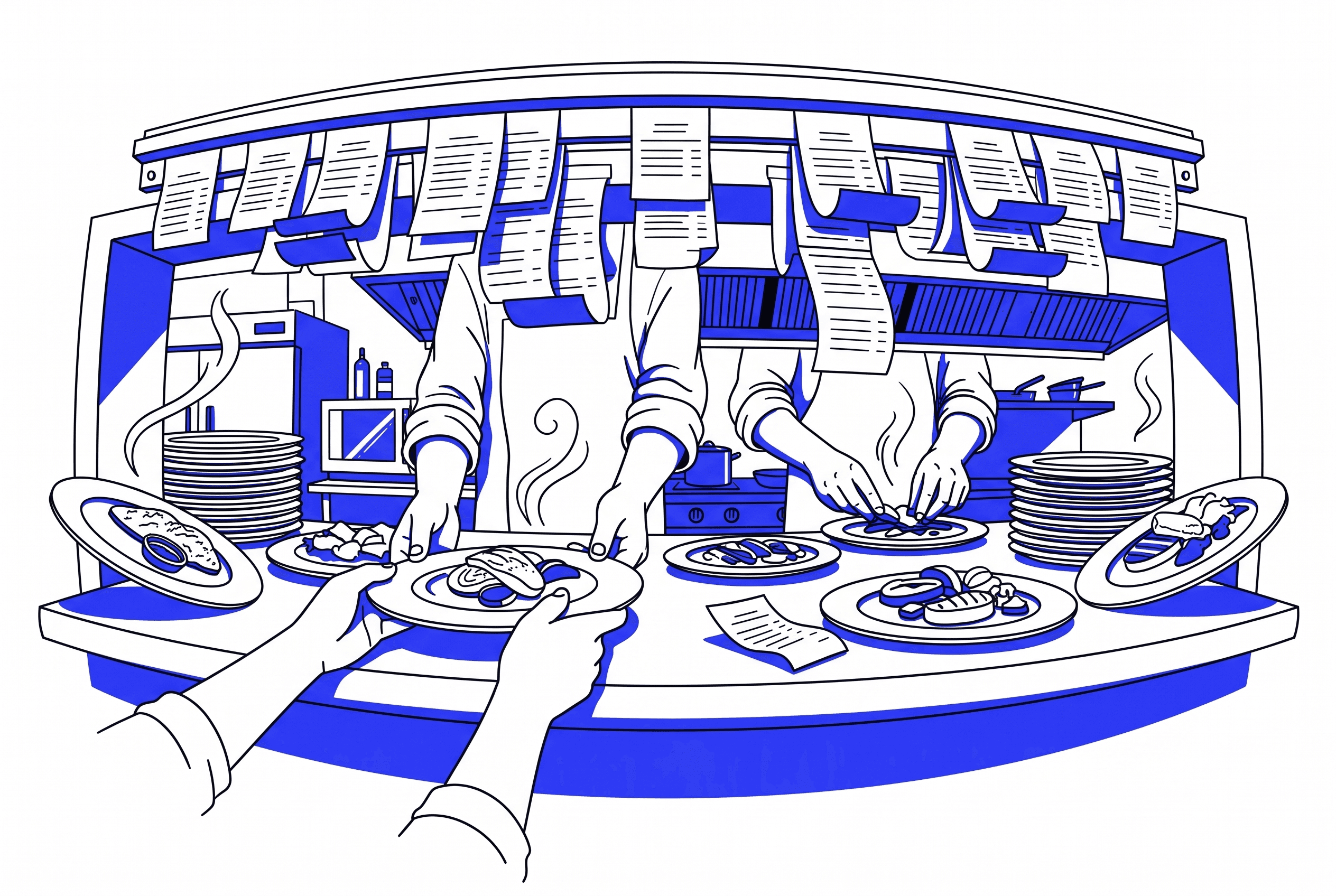
Peak-hour kitchen failures are almost always prep failures, not execution failures. The kitchen that falls apart at 8pm made a mistake at 2pm. Eighty percent of peak-hour optimization is pre-shift preparation.
Station design determines throughput ceiling. A kitchen designed around menu categories (grill, fry, salad) instead of order flow will bottleneck at the station with the most tickets, regardless of how fast the other stations work.
For multi-location brands, the insight that matters most is cross-branch comparison: which branches handle the same peak-hour volume smoothly and which do not, and what specifically differs in their setup, prep, or staffing.
Delivery orders during dine-in peaks create a dual-channel bottleneck that most kitchens are not designed for. Brands operating across Keeta, HungerStation, Jahez, and Mrsool during peak hours need dedicated assembly and handoff workflows.
Kitchen display systems (KDS) with real-time order routing and ticket timing are the single most impactful technology investment for peak-hour performance, because they make bottlenecks visible in the moment, not after the shift.
Every restaurant has a peak hour. The window where order volume spikes, the kitchen hits maximum load, and the difference between a well-run operation and a chaotic one becomes unmistakable. For most F&B brands in KSA, that window is predictable: Thursday and Friday evenings, Ramadan iftar service, weekend lunch rushes. The volume is not a surprise. The failures that happen during that volume usually are.
The pattern we see across multi-location brands is consistent: kitchens that handle peak hours well are not faster or better staffed than kitchens that struggle. They are better prepared. The optimization is not in the moment; it is in the hours before the moment arrives.
This article covers the operational levers that multi-location brands use to keep quality and speed consistent during peak hours, from pre-shift prep strategy to station design to the technology that makes bottlenecks visible.
The prep principle: peak-hour failures start before the rush
The single most common cause of peak-hour kitchen breakdown is insufficient or incorrect prep. The grill station runs out of marinated protein at 8:30pm. The salad station discovers the dressing was not prepped. The fry station is behind because someone forgot to portion the appetizer components.
These are not execution failures. They are planning failures that happened hours earlier and became visible only when volume exposed them. Fixing peak-hour performance starts with fixing pre-shift prep, and fixing pre-shift prep starts with a prep list that is driven by forecasted demand, not yesterday's habit.
The prep list should be built from three inputs: historical sales data for the same day and time window (your POS system has this), any known events or promotions that will shift the mix, and a buffer that accounts for forecast error. The brands that do this well build the prep list systematically, not from memory, and assign each component to a responsible person with a completion time. The brands that do it poorly let the morning crew "figure it out," which works until it does not.
Station design: building for flow, not for menu categories
Most kitchens are designed around menu categories: a grill station, a fry station, a cold station, a dessert station. This makes intuitive sense but creates bottlenecks during peaks because order flow does not follow menu categories. A single order might require output from three stations simultaneously, and the slowest station determines the ticket time for the entire order.
The alternative is designing stations around order flow: grouping equipment and prep by the sequence in which a typical order is assembled, not by the type of cooking. This might mean placing the fryer next to the plating area rather than next to the other fryers, or positioning the sauce station between the grill and the pass rather than at the far end of the kitchen.
For multi-location brands, station design matters doubly because it should be standardized. If Branch A has a kitchen layout that handles 200 orders per hour smoothly and Branch B struggles at 150 with a different layout, the layout is the variable. Standardizing kitchen design across branches (where the physical space permits) is one of the most underused levers for consistent peak-hour performance.
The dual-channel problem: dine-in and delivery competing for the same kitchen
In KSA, most QSR and casual dining brands receive significant delivery volume through Keeta, HungerStation, Jahez, and Mrsool. During peak hours, delivery orders and dine-in orders compete for the same kitchen capacity. This is the dual-channel bottleneck, and it is the single biggest source of peak-hour complaints for brands that have not specifically designed for it.
The symptoms are familiar: dine-in tickets slow down because the kitchen is processing delivery orders. Delivery orders are assembled incorrectly because the kitchen is rushing. Packaging is done carelessly because there is no dedicated space for it. The handoff to drivers is chaotic because there is no staging area.
The fix has three components. First, a dedicated assembly and staging area for delivery orders, physically separated from the dine-in pass, so that packaging and driver handoff do not interfere with table service. Second, order routing rules in the KDS that balance delivery and dine-in tickets based on promised times, not arrival sequence. Third, staffing models that account for dual-channel peaks, with dedicated delivery assembly staff during the heaviest windows.
Brands that treat delivery as "extra orders the kitchen handles" will consistently underperform during peaks. Brands that treat delivery as a parallel workflow with its own space, staff, and routing rules will not.
Order routing and ticket management
How orders flow through the kitchen during peak hours determines both speed and accuracy. Two systems matter here: the order routing logic (which station gets which ticket, in what sequence) and the ticket visibility (what each station sees and when).
The simplest improvement most kitchens can make is moving from paper tickets to a kitchen display system (KDS). A KDS routes orders to the correct station automatically, displays prep time targets, and makes bottlenecks visible in real time (the station with the longest queue is the bottleneck, visible to the expeditor and the team). Paper tickets obscure this information; the expeditor has to scan a rail of tickets to figure out what is behind, and by the time they spot the problem, it has compounded.
For multi-location brands, KDS data also feeds post-shift analysis: average ticket time by station, by branch, by day of week. This data is what turns peak-hour optimization from a subjective conversation ("it felt busy") into an objective one ("Station 3 averaged 14 minutes per ticket on Thursday, versus 8 minutes on Tuesday; here is why").
Staffing for peaks: the schedule is the strategy
Understaffing during peaks is common and usually not because the operator does not know peak hours exist. It happens because scheduling is done by habit (the same number of people every Thursday) rather than by forecasted demand (this Thursday is 20% above average because of a promotion, so add two kitchen staff).
The shift is from fixed schedules to demand-responsive scheduling. Use POS data to forecast order volume by day and hour. Build the schedule to match. Account for delivery volume separately (because delivery peaks do not always align with dine-in peaks). And staff for the worst 30 minutes of the peak, not the average, because the worst 30 minutes is when quality breaks.
Cross-training is the multiplier. A kitchen where every cook can work two or three stations can dynamically rebalance during peaks. A kitchen where each cook is locked to one station has no flexibility when one station surges.
Measuring peak-hour performance across branches
For multi-location brands, the most valuable data is not how a single branch performed during a peak. It is how all branches performed during the same peak, and what accounts for the variance.
Five metrics for peak-hour comparison across branches: average ticket time during peak window (order to completion), order accuracy rate during peak window, customer complaints received during and immediately after peak hours (mapped to specific branches), food waste during peak prep and service, and delivery handoff time (kitchen completion to driver pickup).
The branches that consistently outperform on these metrics during peaks share common traits: disciplined prep, standardized station design, dedicated delivery workflow, demand-responsive staffing, and a KDS with real-time visibility. The branches that underperform are usually missing one or two of these. The cross-branch comparison reveals which one.
Customer feedback data enriches this analysis further. A platform like Sira that classifies complaints by root cause can distinguish between "food was slow" complaints caused by kitchen bottlenecks and those caused by delivery delays, which guides the operator to the right fix rather than the generic "speed up" directive.
Conclusion
Kitchen workflow optimization for peak hours is less about speed and more about preparation, design, and measurement. The kitchen that performs well at 8pm on Thursday made the right decisions at 2pm: the prep was demand-driven, the stations were designed for order flow, the schedule matched the forecast, and the delivery workflow was separated from dine-in service.
For multi-location brands, the additional lever is cross-branch comparison: seeing which branches handle the same volume smoothly and which do not, then diagnosing the specific differences. The data for this comparison comes from POS ticket times, KDS station metrics, and customer feedback analysis. The brands that combine all three see their peak-hour performance converge across branches. The brands that rely on branch manager instinct see it diverge.
Frequently asked questions
How do you optimize kitchen workflow during peak hours?
Start with pre-shift prep: build a demand-driven prep list from POS historical data, assign each component to a person with a completion time, and verify readiness before the rush starts. Then ensure station design supports order flow (not just menu categories), order routing is automated through a KDS, staffing matches forecasted peak demand (not habit), and delivery orders have a dedicated assembly workflow separate from dine-in. Eighty percent of peak-hour optimization is preparation, not in-the-moment speed.
What causes kitchen breakdowns during peak hours?
The most common cause is insufficient or incorrect prep, followed by understaffing, poor order routing (paper tickets instead of KDS), and the dual-channel bottleneck where delivery and dine-in orders compete for the same kitchen capacity without separate workflows. These are planning failures that become visible only when volume exposes them. The kitchen that falls apart during the rush usually made a mistake hours before the rush started.
How should restaurants handle delivery orders during dine-in peak hours?
Three components: a dedicated assembly and staging area for delivery orders physically separated from the dine-in pass, order routing rules in the KDS that balance delivery and dine-in tickets based on promised times, and dedicated delivery assembly staff during peak windows. Brands that treat delivery as extra orders the kitchen handles will consistently underperform. Brands that treat delivery as a parallel workflow with its own space, staff, and routing rules handle dual-channel peaks reliably.
What technology helps most with peak-hour kitchen performance?
A kitchen display system (KDS) is the single most impactful technology investment for peak-hour performance. It routes orders to stations automatically, displays prep time targets, makes bottlenecks visible in real time, and produces data for post-shift analysis (average ticket time by station, by branch, by day). For multi-location brands, KDS data also enables cross-branch comparison of peak-hour performance, which is how operators identify and replicate what the best-performing branches do differently.
How do you measure kitchen performance during peak hours?
Five metrics: average ticket time during the peak window (order to completion), order accuracy rate during peak, customer complaints received during and immediately after peaks (mapped to specific branches), food waste during peak prep and service, and delivery handoff time (kitchen completion to driver pickup). The key for multi-location brands is cross-branch comparison on these metrics during the same peak period, which reveals which branches outperform and what specifically differs in their setup, prep, or staffing.
How does cross-training help during peak hours?
Cross-training allows dynamic rebalancing during peaks. A kitchen where every cook can work two or three stations can shift capacity to wherever the bottleneck is. A kitchen where each cook is locked to one station has no flexibility when one station surges. Cross-training does not replace proper prep or staffing, but it provides the in-the-moment adaptability that absorbs the variance between forecasted and actual demand during the busiest windows.