How to Design and Distribute Guest Surveys That Actually Work
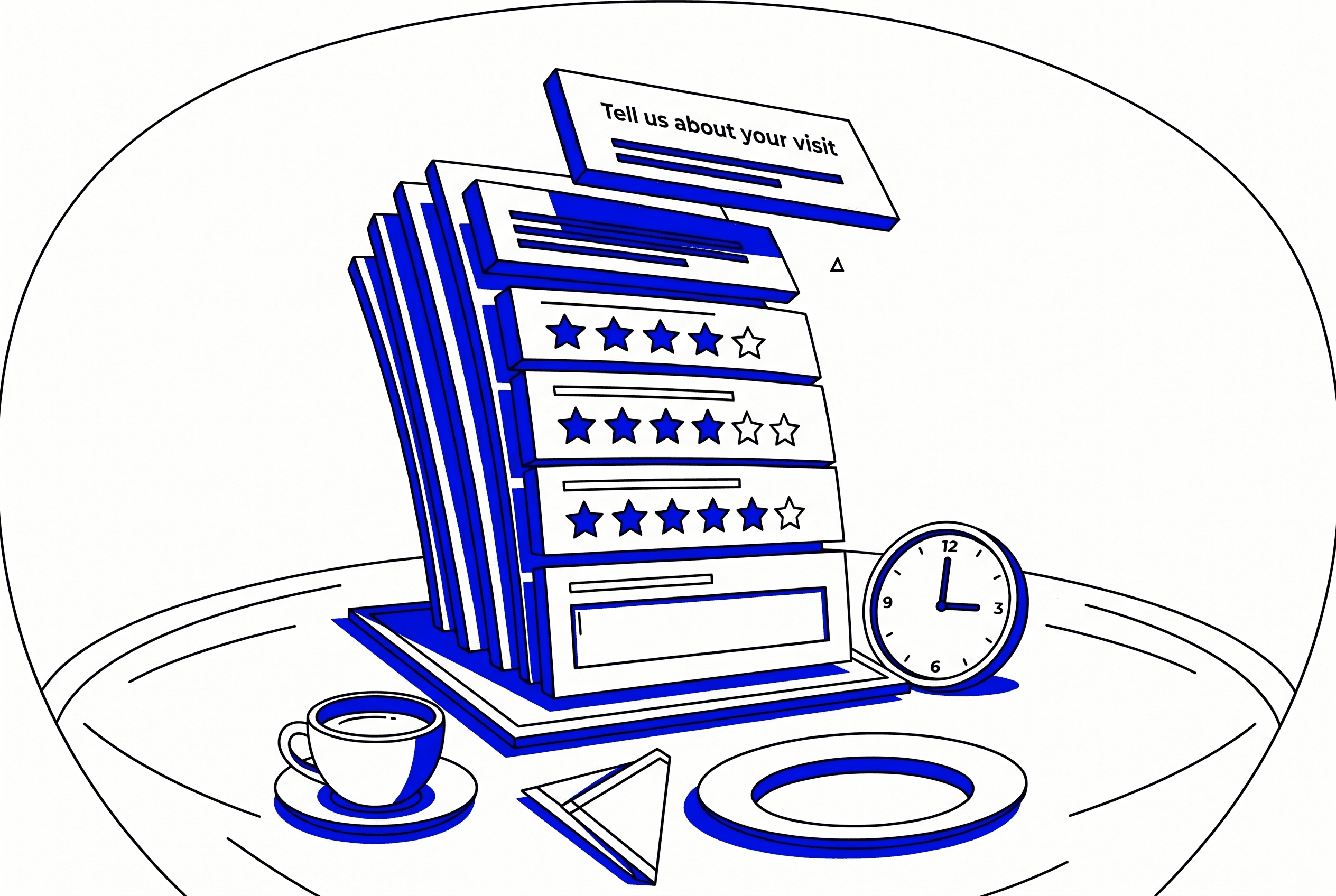
Most restaurant surveys fail because they ask the wrong questions, send at the wrong time, or use the wrong channel. Each of these is fixable.
The right survey runs 4 to 6 questions, takes under 90 seconds, sends through SMS within 6 hours of the visit, and asks specific questions tied to operational dimensions.
Response rates of 5 to 10% are achievable for unincentivized SMS surveys, well above industry averages for email or in-store paper surveys.
This guide covers the design principles, the distribution mechanics, and the response-rate benchmarks that distinguish effective programs from box-ticking exercises.
Why most restaurant surveys produce noise
Most restaurant survey programs underperform for predictable reasons. The questions are too generic to produce diagnostic data. The timing is wrong, so customers have already moved on. The channel is wrong, so response rates collapse. The follow-up is missing, so customers stop participating after the first or second attempt.
None of these problems requires a more expensive tool to fix. They require a tighter design. A 4-question SMS survey designed correctly will outperform a 20-question email survey on every meaningful dimension: response rate, data quality, operational utility, and customer experience.
Choose the right survey type
Three survey types cover the practical use cases for restaurants. The right one depends on what question you are trying to answer.
Survey type | Best for | Frequency |
|---|---|---|
NPS (Net Promoter Score) | Tracking loyalty trend over time | Continuous, sampled |
CSAT (Customer Satisfaction) | Measuring satisfaction with a specific visit or interaction | Per-visit, on a sampling basis |
Diagnostic (operational dimensions) | Identifying specific operational issues | Continuous, attached to CSAT |
The most useful pattern for multi-location restaurants is a combined CSAT and diagnostic survey sent after every visit (or sampled), with periodic NPS surveys layered on top to track loyalty trend. This produces three streams of data: per-visit satisfaction, operational diagnostic detail, and brand-level loyalty trend.
Question design principles
Lead with a single overall measure
The first question should produce the headline metric you trend over time. For most restaurants, that is either NPS ('how likely are you to recommend us?') or CSAT ('how would you rate your experience overall?'). One question, scaled, simple. This is the metric that goes on dashboards and trend lines.
Asking both NPS and CSAT in the same survey creates redundancy. Pick one as the headline and use the other selectively when you need to.
Follow with 2-3 specific operational dimensions
After the headline question, ask 2-3 specific questions that map to operational levers. For a typical restaurant, these would be: speed of service or order arrival, food quality (taste, temperature, accuracy), and staff interaction. Each scaled 1-5.
These questions are where the diagnostic value lives. A low headline score with high operational dimension scores points to something subtle (atmosphere, value perception). A low headline score driven by low food temperature scores points directly to the kitchen-to-table window. The operational dimensions are how you move from 'something is wrong' to 'this specific thing is wrong.'
Add one open-text question
End with one open-text prompt: 'What could we do better?' or 'What stood out about your visit?' This is where the unstructured insight comes from. Customers who leave open-text responses produce the diagnostic detail that scaled questions miss.
Make the open-text question optional. Required open-text drives drop-off rates up significantly. Optional open-text gets meaningful response from the customers most engaged with the brand.
Avoid double-barreled questions
Questions that ask about two things at once produce ambiguous data. 'How would you rate the speed and quality of your food?' is unanswerable when speed was great but quality was poor. The respondent has to pick which dimension to grade against, and you cannot tell which they picked.
The fix is one dimension per question. Speed in one question, quality in another. Yes this means more questions, but it means cleaner data.
Avoid leading language
Questions like 'how delicious was the food?' or 'how friendly was your server?' embed the answer in the question. Respondents who would have rated lower feel awkward contradicting the framing and give higher scores than they would otherwise. The data drifts upward and loses diagnostic value.
Use neutral language. 'How would you rate the food?' or 'How would you rate the service?' produces honest answers. The slight discomfort of neutral framing is a feature, not a bug. It is what makes the data trustworthy.
Channel selection
SMS
SMS is the strongest channel for restaurants. Open rates are above 90%, response rates are 3 to 5 times email, and the immediacy fits the post-visit moment. The trade-off is per-message cost, but at restaurant volumes the cost is usually justified by the response rate gain.
SMS works best when the message is short ('Thanks for visiting [Brand]. How was your experience? [link]') and the link opens to a mobile-optimized survey. Surveys that require account creation, login, or any extra step lose 30 to 50% of clickers before completion.
Email is the cheapest channel and the most familiar. Response rates of 1 to 3% are typical for unincentivized post-visit emails, which means a brand needs significant volume to produce meaningful data. The advantage is that longer surveys (8 to 12 questions) work better in email than SMS, because customers who open email surveys are usually more motivated to respond fully.
Email works for brands with established loyalty programs where the customer has explicit relationship with the brand. For cold or transactional relationships, email response rates are usually too low to be useful.
In-store and on-receipt
QR codes printed on receipts produce moderate response rates (2 to 5%) and the advantage of capturing customers who do not give email or phone. Table tablets work for in-store dining but require operational discipline (functional, charged, clean). Both work better as supplementary channels than as primary.
Timing
When the survey arrives matters as much as what it asks.
Visit type | Optimal send timing | Why |
|---|---|---|
Dine-in | 2 to 6 hours after the visit | Recent enough to remember, distant enough to have processed the experience |
Delivery | 30 minutes to 2 hours after order arrival | Captures the immediate reaction while the experience is freshest |
Takeaway | 1 to 3 hours after pickup | Allows time to consume the food before asking |
Surveys sent more than 24 hours after the visit see significantly lower response rates and produce more generic answers. The customer's specific memory has faded, so they answer in averages rather than specifics. The diagnostic value of the data drops in proportion.
Response rate benchmarks
Knowing what good looks like helps brands evaluate their own programs. The benchmarks below are for unincentivized post-visit surveys at well-run mid-market restaurant brands.
Channel | Response rate range | Survey length cap |
|---|---|---|
SMS, short survey | 5 to 10% | 4 to 6 questions |
Email, short survey | 1 to 3% | 6 to 10 questions |
QR on receipt | 2 to 5% | 4 to 6 questions |
In-store tablet | 10 to 20% | 3 to 5 questions |
Verbal at table | 30 to 50% | 1 to 2 questions |
Brands seeing materially lower response rates than these benchmarks usually have one of three problems: surveys are too long, timing is wrong, or the channel does not match the customer base.
Incentives: when to use them
Incentivized surveys (where the respondent gets a discount, a loyalty point boost, or a small reward for completing) increase response rates to 15 to 25%, but they introduce bias. Respondents motivated by the incentive may be more likely to give the answer they think gets them the reward, regardless of their actual experience.
The pattern that minimizes bias is small, neutral incentives that do not depend on the answer. A 5% discount on the next visit for completing the survey, regardless of what they say, produces higher response rates without distorting the data significantly. Larger incentives or incentives tied to specific answer patterns introduce bias.
For diagnostic data, prefer unincentivized. For brand-health metrics that need higher volume, incentivized works. Many brands run both: an unincentivized continuous program for diagnostic detail, and quarterly incentivized waves for higher-volume NPS measurement.
How Sira's Smart Surveys handle this
Sira's survey module is designed around the principles in this guide. Pre-built question libraries cover the diagnostic dimensions for restaurants. SMS and email distribution run from the same platform with channel-specific timing. Arabic and English versions of every question are templated, with dialect-aware sentiment analysis on the open-text responses.
The differentiator for multi-location operators is that survey responses flow into the same dashboard as Google reviews, delivery platform feedback, and operational data. Patterns in survey responses connect automatically to the operational signals that explain them, which closes the loop from feedback to action without manual stitching.
Frequently asked questions
How long should the survey actually be?
Total completion time under 90 seconds. That usually means 4 to 6 questions for SMS and 6 to 10 questions for email. Longer surveys see drop-off rates above 40% and response bias toward extreme experiences.
Should we run NPS continuously or in waves?
For mid-market brands, sampled continuous NPS works better than periodic waves. Continuous data trends more usefully and avoids the wave-pattern noise that quarterly programs introduce. Sample 10 to 20% of customers continuously to manage cost without losing trend signal.
What is the right way to handle multilingual surveys?
Send each customer the survey in their preferred language. For brands operating in MENA, this usually means Arabic and English options. Arabic surveys should use Modern Standard Arabic for the question text, with sentiment analysis on responses that handles dialect. The channel matters too: SMS in Arabic produces different response patterns than email in Arabic.
How do we measure if our survey program is working?
Three metrics. Response rate (target above the benchmarks above). Data utility (how often the data leads to operational changes, measured monthly). And customer follow-up satisfaction (do customers who left feedback feel heard, measured through occasional follow-up). A program that scores well on all three is producing value.
Should every customer get every survey?
Not necessarily. Sampling reduces survey fatigue and cost. The right pattern for most brands is sending the diagnostic survey to every customer (because the per-customer data is useful), the NPS survey to a 10 to 20% sample (because volume matters more than per-customer detail), and longer-form surveys only to highly engaged customers like loyalty members.